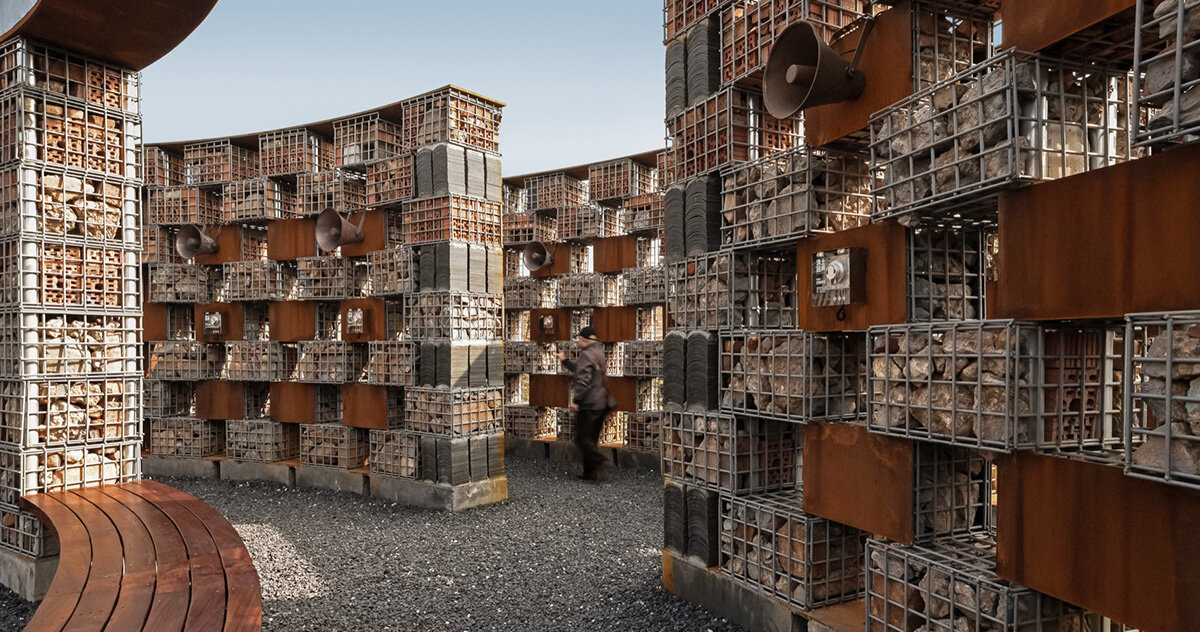
"The design by 1Y Architects approaches this silence as material rather than absence. Instead of clearing the debris scattered across the site, the team gathered bricks, concrete fragments, and broken tiles from former factory buildings. These remnants form the structural fabric of the sound museum itself."
"Echo of the Ruins is shaped by gabion walls, which the team at 1Y Architects fills with the recovered industrial fragments. This construction method, commonly used in hydraulic engineering, forms stable volumes by containing loose material within steel mesh. In Echo of the Ruins, the system allows irregular pieces of brick and stone to remain visible."
"The gabions create a layered texture across the building's curved walls. Rusted steel boxes inserted among them act as niches for audio equipment, benches, and small viewing openings. The palette remains direct: steel, rubble, brick, and gravel underfoot. Every element carries traces of the former workshops that once occupied the site."
Echo of the Ruins is an open-air sound museum designed by 1Y Architects in Zhuzhou's former Qingshuitang industrial zone. The district flourished in the early twentieth century with over two hundred smelting and chemical facilities, but declined as environmental standards tightened. Rather than clearing debris, architects gathered bricks, concrete fragments, and tiles from demolished factories to construct gabion walls—steel mesh containers stabilizing loose materials. This method preserves the visible wear and varied coloring of industrial remnants. Rusted steel boxes inserted among gabions serve as niches for audio equipment and viewing openings. The design treats industrial silence as material substance, allowing discarded components to function as witnesses to the site's former industrial past.
Read at designboom | architecture & design magazine
Unable to calculate read time
Collection
[
|
...
]