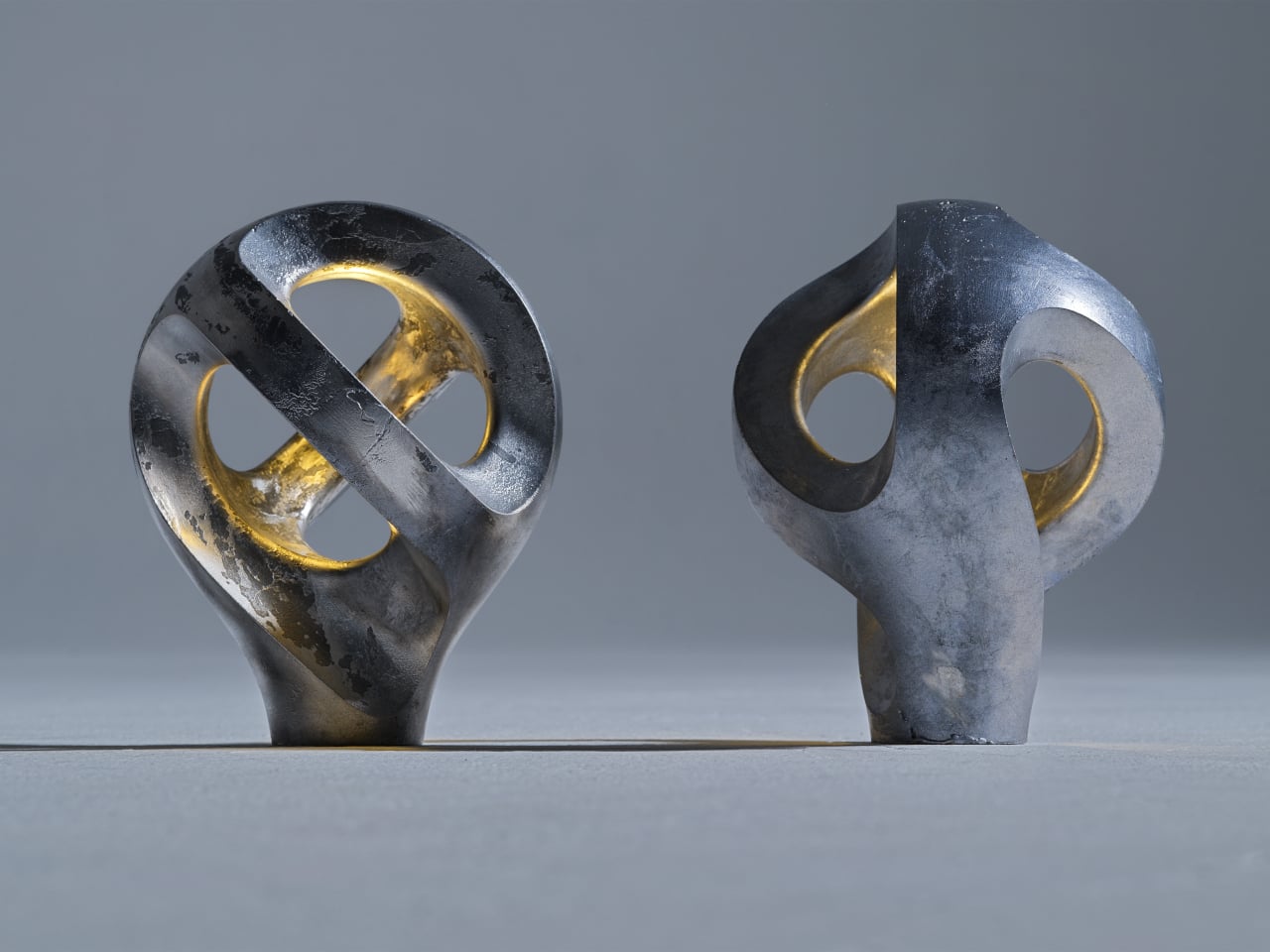
Upcycled materials often look clean and neutral because purification and smoothing remove evidence of their origins. Aperire takes the opposite approach by casting a lighting fixture entirely from discarded aluminum cans while deliberately keeping impurities. Wrinkles, air bubbles, and ink traces from labels remain in the metal, creating unpredictable surface marks that differ from piece to piece. The finish resembles weathered stone or bone rather than machined aluminum, making the material’s origin difficult to identify at first glance. The fixture’s organic, chambered form is inspired by foraminifera, and its geometry is shaped through deliberate addition and subtraction to guide how light interacts with the surface.
"Upcycled materials have become a familiar part of sustainable design, but most of them still try to hide where they came from. The aluminum gets purified, the recycled plastic molded smooth, and the result looks clean and neutral but loses the story of its origins. Pairing genuine sustainability with aesthetic character turns out to be a harder problem than it looks, and most attempts quietly sidestep it."
"Rather than refining the material beyond recognition, he deliberately left in the impurities. The wrinkles, air bubbles, and traces of ink from the original cans were preserved as surface texture, turning what most casting processes would filter out into the fixture's defining character. Melting the cans down without removing too many impurities is what produces that surface. Each piece ends up slightly different, carrying unpredictable marks that no two castings will ever replicate."
"Traces of ink from labels and other irregularities seep through the metal, and the result reads less like manufactured aluminum and more like weathered stone or bone. The artificial origin becomes genuinely difficult to place. The finish that results reads almost like a natural material. The same surface might show shallow depressions, irregular ridges, or fine lines that look nothing like machined metal."
"The shape itself draws from an equally unexpected source: foraminifera, the microscopic marine organisms whose skeletons are riddled with tiny holes and chambers. Combined with the rough appearance of eroded rock, the form was built through the deliberate addition and subtraction of geometric shapes. Light refle"
Read at Yanko Design - Modern Industrial Design News
Unable to calculate read time
Collection
[
|
...
]