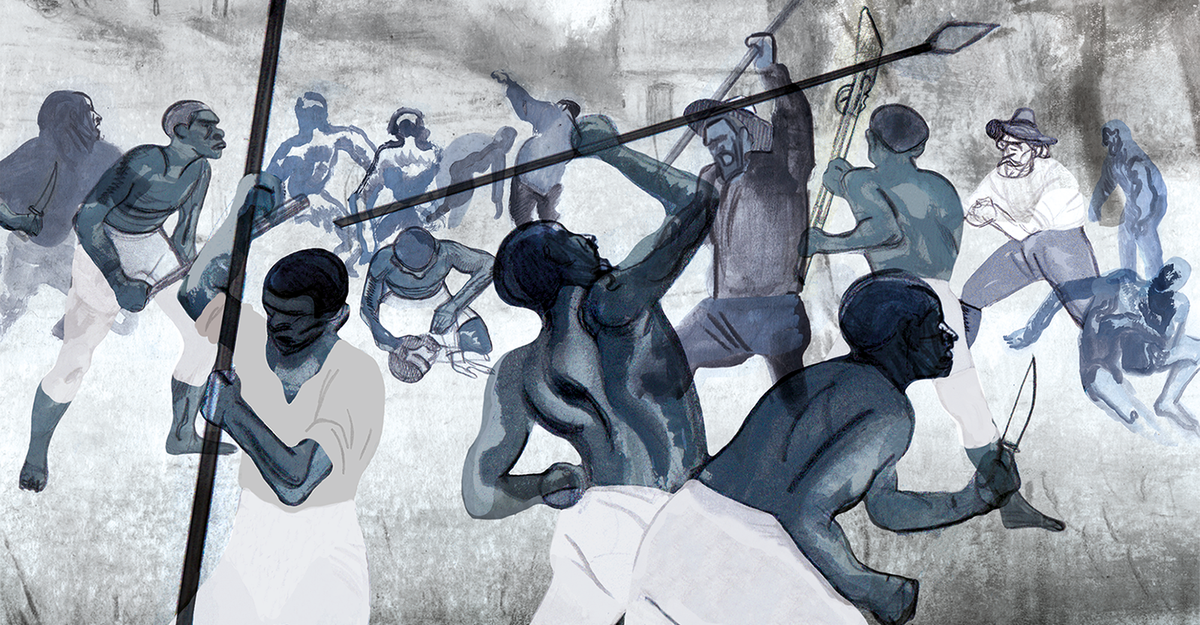
"In 1812, Spanish officials in Havana, searching the house of a man named José Antonio Aponte, discovered a wooden box hidden in a clothing trunk, opened it, and were stunned by what they found inside. "It was unlike any book they had ever seen," Carrie Gibson writes in The Great Resistance: The 400-Year Fight to End Slavery in the Americas, "filled with Biblical and historical images, with many black faces, as well as cut-out bits of paper and handwritten words.""
"When he was asked to explain why he had chosen to include what he did, his answer was simple: "For reasons of history." Aponte was executed after his trial, and his book disappeared. All that is left are Aponte's descriptions of the work, page by page, at his trial. But that testimony has allowed contemporary historians and artists to reconstruct his visionary awareness that, in seeking to change his world, he first had to compile his own history of what had come before."
In 1812, Spanish officials in Havana found a hidden wooden box containing an illustrated book filled with Biblical and historical images, many Black faces, cut-out paper, and handwritten words. José Antonio Aponte, a freeman and former militiaman, belonged to a group that planned an uprising to overthrow slavery and make Cuba independent; the rebellion was quickly suppressed. The images included Abyssinian royalty and the Greek philosopher Diogenes and depicted Black soldiers defeating white troops, evoking Haitian victories. Aponte defended the images "for reasons of history." He was executed and the book vanished; only his trial descriptions survive, enabling reconstruction of his intent to compile a history that could inspire resistance.
Read at The Atlantic
Unable to calculate read time
Collection
[
|
...
]