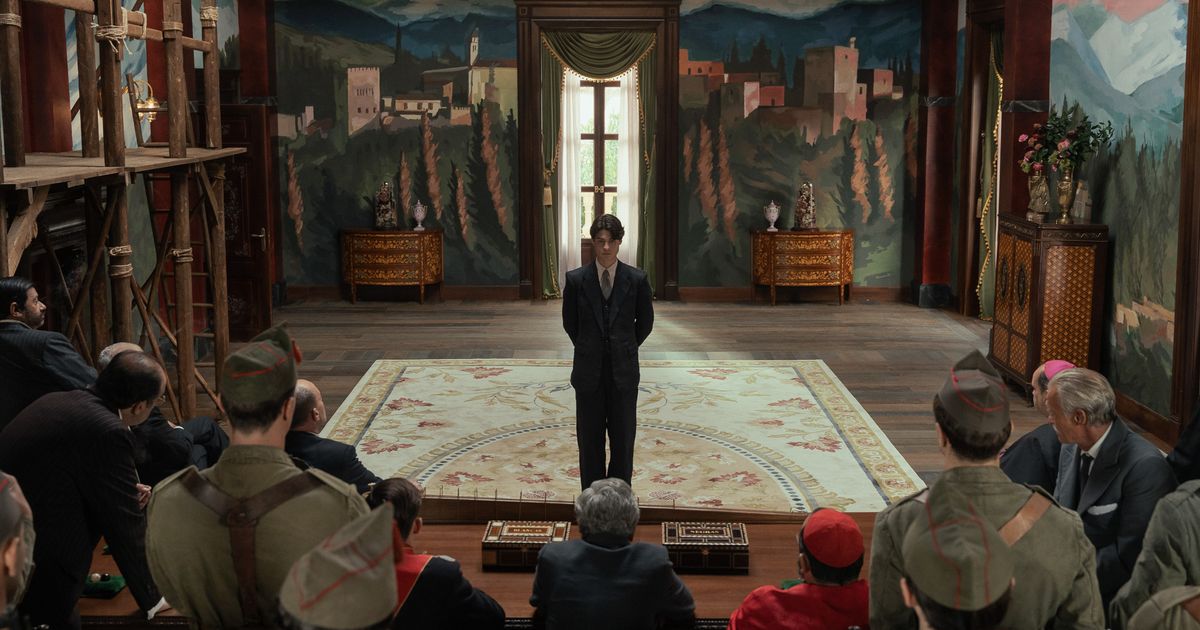
The Black Ball is an ecstatic, imperfect tribute to Federico García Lorca that avoids a conventional biopic structure. Lorca appears late, near the end of the timeline, shortly before his death at the start of the Spanish Civil War. The story instead interweaves the lives of three gay men in 1932, 1937, and 2017, gradually revealing connections to Lorca and to one another. The film frames Lorca’s sexuality as essential to his legacy alongside his artistic and political roles. It also critiques Spanish history for masculine posturing, shame, and self-defensive erasure, including the tendency to praise outside scholars. The film is compelling in the moment, with ambitions that may feel less dominant afterward despite strong festival reception.
"The Black Ball is an ecstatic, imperfect ode to the Spanish poet Federico García Lorca, though it bears little resemblance to a staid biopic. Lorca himself, played by Alberto Cortés, only makes an appearance late in the film, when it has finally wound its way into his presence not long before his death at the start of the Spanish Civil War. Rather than be about Lorca directly, The Black Ball braids together the lives of three gay men in 1932, 1937, and 2017, gradually revealing their connections to him and to each other as it goes along."
"It's a film about laying claim to Lorca as a gay man in addition to an artist and a political figure, insisting that his sexuality is as key to his legacy as any other aspect of his life. While that may not seem like a controversial point, The Black Ball makes a compelling case for Spanish history as remaining mired in masculine posturing, shame, and self-defensive erasure to the point where a visiting Lorca scholar who turns up halfway through the film, and who's played by a (Spanish speaking!) Glenn Close, is commended as part of a tradition of the greatest Hispanists coming from outside the country."
"The Black Ball is itself mighty compelling, though it's also the kind of film that feels weightier during the watching than it does when looked back on the next day, when in retrospect its achievements start to seem like they might have been outstripped by its considerable ambitions. (The film received an exuberant reaction at Cannes, where it premiered.) The second feature from creative (and former romantic) partners Javier Ambrossi and Javier Calvo, also known as Los Javis, it represents a considerable step up in terms of budget and scope from the pair's directorial debut, Holy Camp!,"
"Still, it shares an earnestness with that more modest endeavor that's practically a superpower, fueling the film thr"
Read at Vulture
Unable to calculate read time
Collection
[
|
...
]