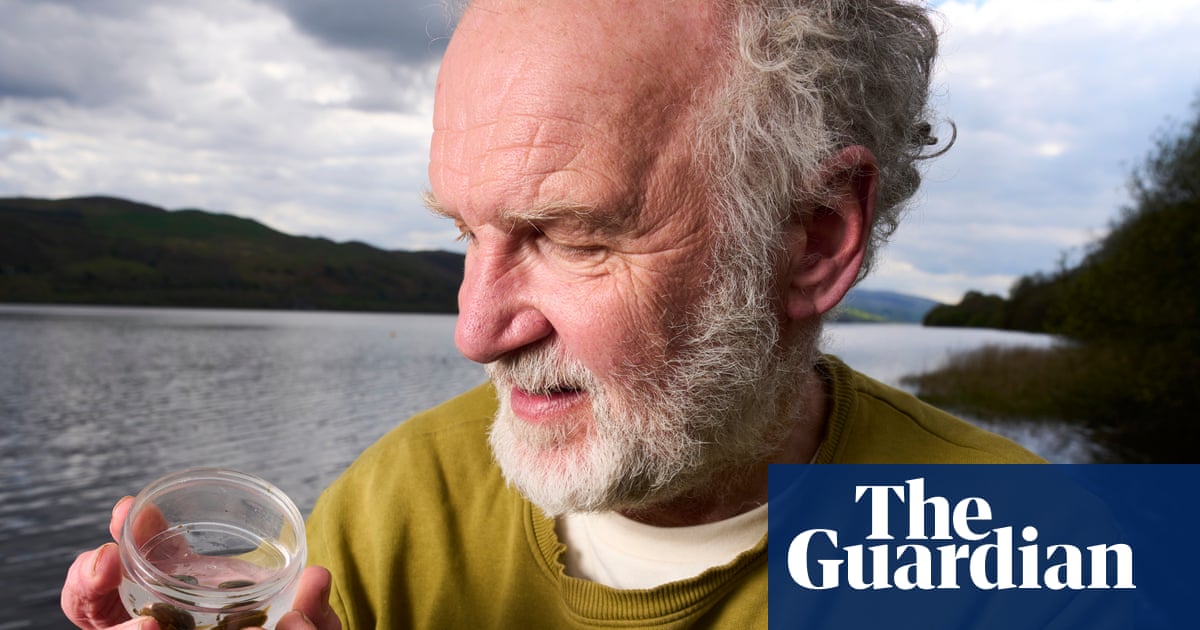
Ian Hughes and his son travel to Llyn Tegid in north Wales to protect glutinous snails, tiny molluscs with delicate shells that require careful handling. The snails’ gelatinous, golden-flecked tissue protects their shells, but low-calcium habitats make the shells extremely fragile, so Hughes transfers them using a fine paintbrush. Glutinous snails have been driven to extinction in England because pollutants from agriculture and industry have degraded freshwater habitats. The lake in Gwynedd holds the last remaining wild population in Britain. Hughes has spent more than a decade conserving the species and other rare wildlife, supported by family help and government funding.
"It is a mollusc the size of a fingertip. It is also one of Europe's most endangered species, which Ian has dedicated himself to protecting. It's beyond passion, he says. It's an obsession. Glutinous snails get their name for the gelatinous, golden-flecked tissue that protects their shell. Because they live in low-calcium habitats, the shell is extremely delicate, and so Hughes uses a fine paintbrush to move them from one place to another."
"The snails have been driven to extinction in England due to the poor quality of the country's freshwater bodies. Pollutants from agriculture and industry have ruined their habitats in English ponds, ditches, lakes and streams. The lake in Gwynedd in which Hughes is partially submerged hosts the last remaining wild population of glutinous snails in Britain."
"Hughes has dedicated more than a decade to conserving the tiny mollusc and other rare species, often with only his enthusiastic family for help. This year, however, the Department for Environment, Food and Rural Affairs (Defra) has listed the snail as one of the threatened species that will benefit from a 60m government funding boost."
"His conservation journey began with an interest in art as a teenager. I always used to draw as an escape. I didn't know it at the time, but I was quite shy, he says. Noticing his talent, the natural history museum in Wollaton Hall, Nottingham, offered him an apprenticeship as a taxidermist and display artist. From there he went on to work in zoos, specialising in invertebrates, before Natural England began funding his"
Read at www.theguardian.com
Unable to calculate read time
Collection
[
|
...
]