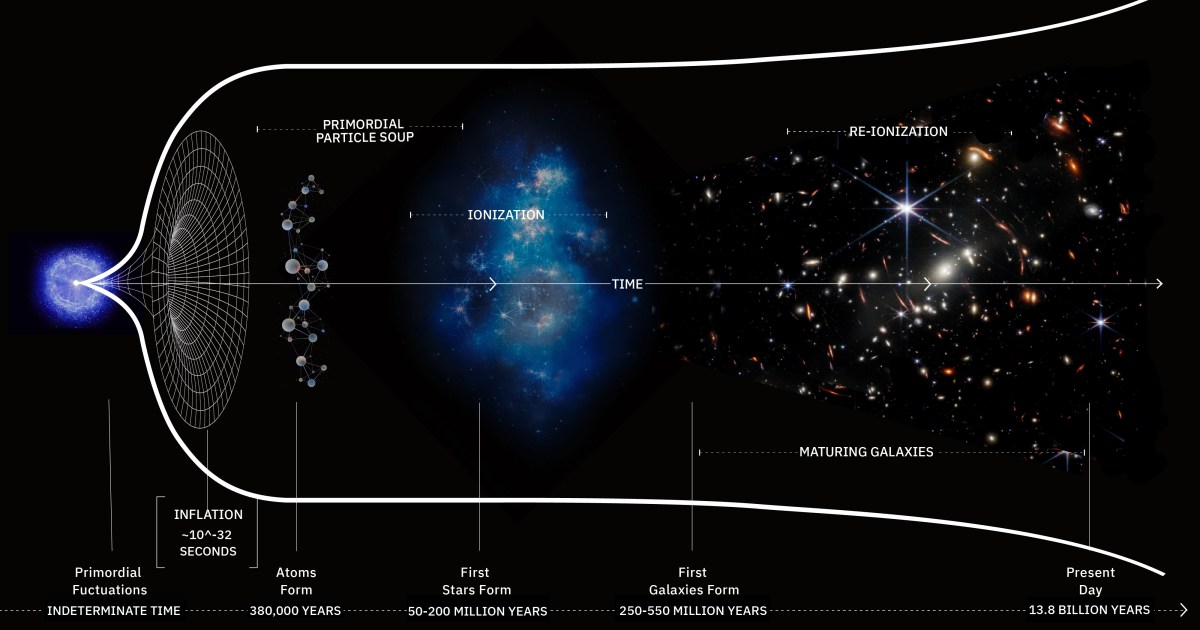
"One of the most mind-bending concepts about the Universe is the idea that the very fabric of space itself is expanding. It was proven, way back in 1922, that this is an inevitable consequence of having a Universe that's filled, in a near-uniform fashion, with any type (or types) of energy at all. Such a Universe cannot be static and stable, but must, in the context of General Relativity, either expand"
"It's now a full century later, and we've learned - to a great degree of accuracy - how quickly the Universe itself is expanding, as well as what forms of energy drive that expansion and how the cosmic expansion has changed over time. Yet, we can only draw these conclusions by examining many different objects at many different cosmic distances, and combining all of that data together. Could we ever hope to see evidence for"
General Relativity predicts that a nearly uniform energy-filled Universe cannot remain static and must either expand or contract. Observational redshift-distance measurements confirmed cosmic expansion and characterized its rate and driving energy components. Expansion stretches photon wavelengths, reduces received flux, and changes apparent angular sizes, but these effects are minuscule over human timescales. Detectable real-time signals require extremely precise spectroscopy to measure redshift drift (Sandage–Loeb effect) over decades. Advanced facilities and long observational baselines could measure fractional redshift changes of order 10^-10 per year. Cosmic acceleration and horizons will reshape the observable Universe over billions of years.
Read at Big Think
Unable to calculate read time
Collection
[
|
...
]