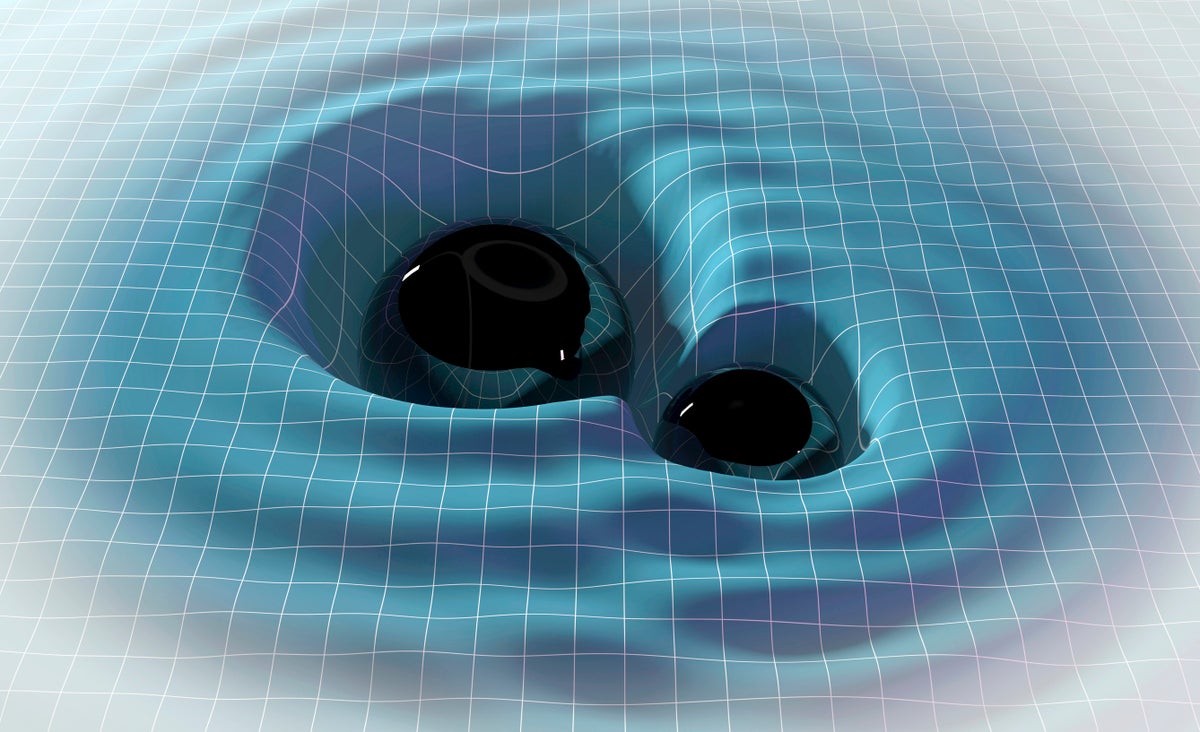
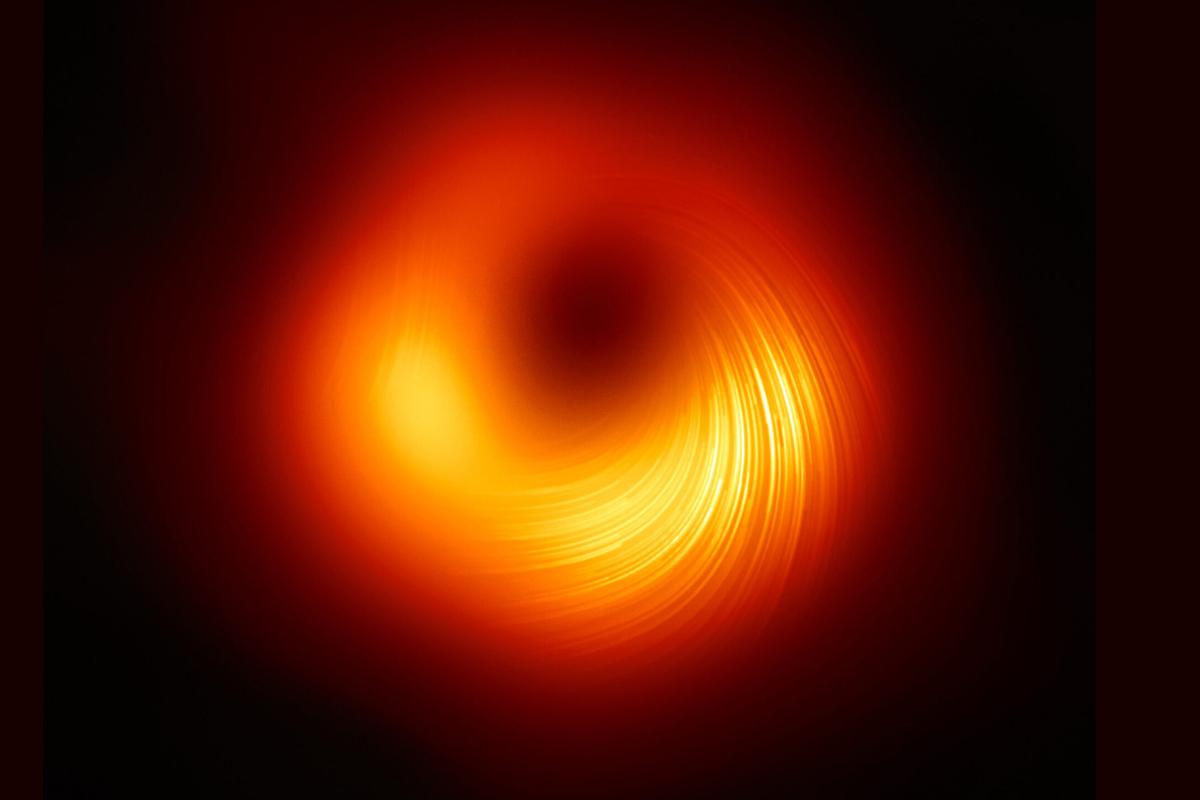
According to Einstein's General Relativity, for every black hole that exists within the Universe, there are only three properties that go into it that matter in any way: the black hole's total mass, the black hole's net electric charge, and the black hole's intrinsic angular momentum, and that's it. It doesn't matter what type of matter went into the black hole in order to form it; all that matters is its mass, charge, and angular momentum.
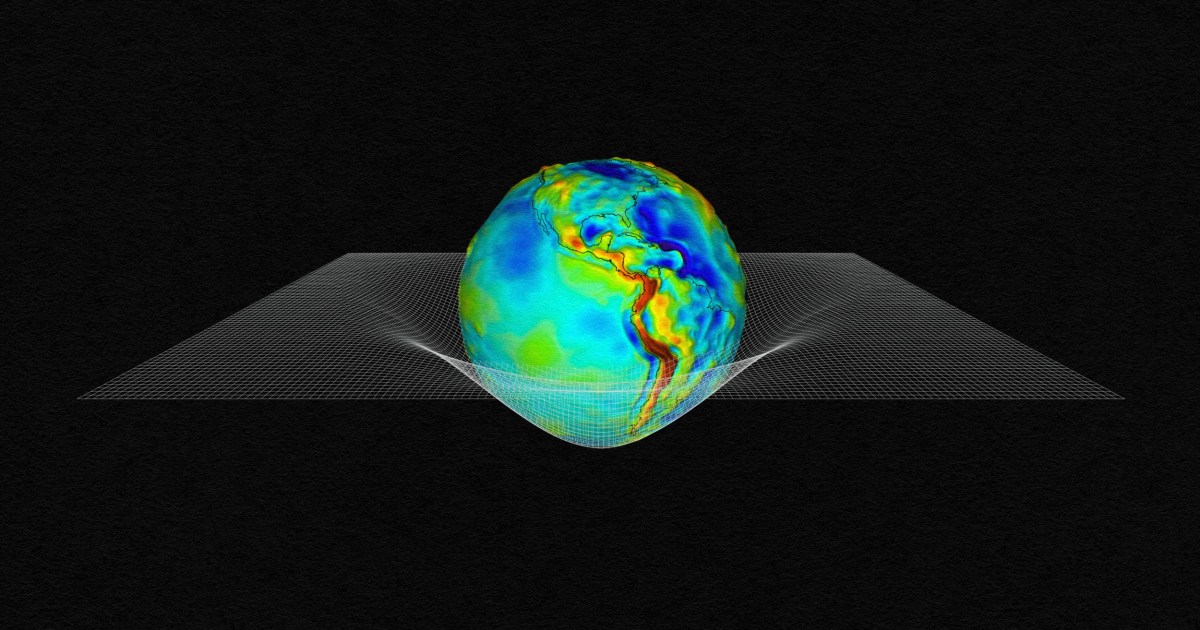
We now recognize that even ideas like "when" and "where" are subject to the laws of Einstein's relativity, and that in relativity, space and time are not absolute quantities, but rather are relative to each and every unique observer.
The closest supermassive black hole pair, in NGC 7727, was discovered in 2021. Just 89 million light-years away, these 154,000,000- and 6,300,000-solar-mass black holes are just 1,600 light-years apart. Approximately 0.1% of young quasars are expected to be doubles, with typical separations of ~10,000 light-years.
A bright star in a nearby galaxy has essentially vanished. Astronomers believe that it died and collapsed in on itself, transforming into the eerie cosmic phenomenon known as a black hole. "It used to be one of the brightest stars in the Andromeda galaxy," says Kishalay De, an astronomer with Columbia University and the Flatiron Institute. "Today, it is nowhere to be seen, even with the most sensitive telescopes."
Star-formation will eventually end, and then the last shining stars will burn out. Galaxies will dissociate due to gravitational interactions, ejecting all masses and leaving only supermassive black holes behind. And then those black holes will decay via Hawking radiation, leaving only cold, stable, isolated bodies, from which no further energy can be extracted, all accelerating away from us within our dark energy-dominated Universe.
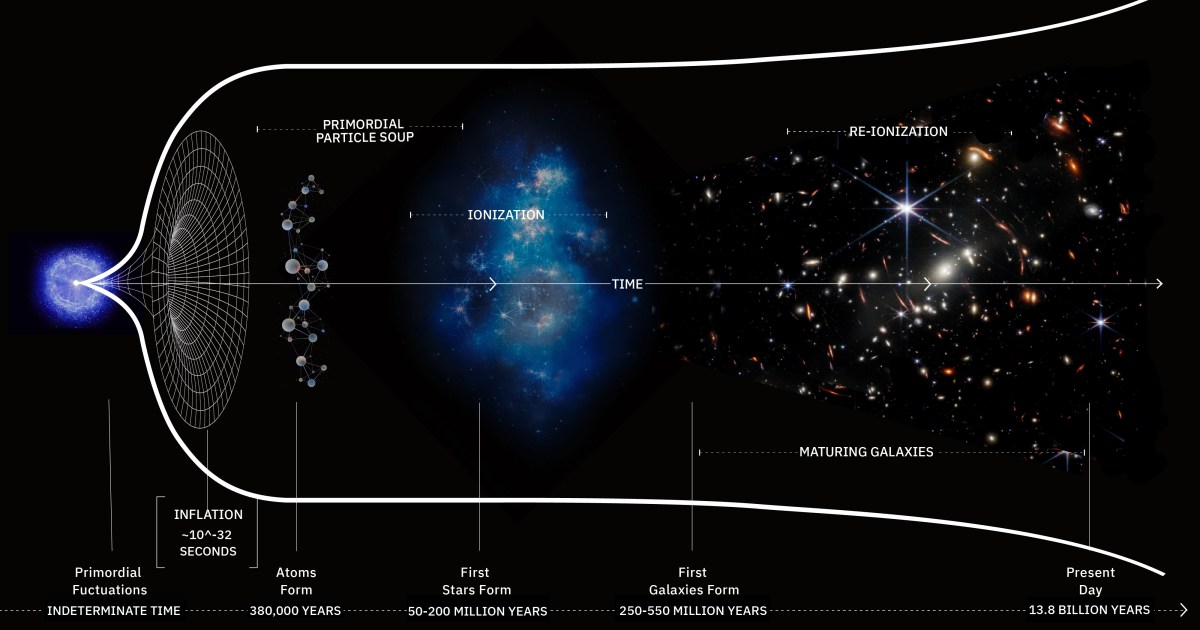
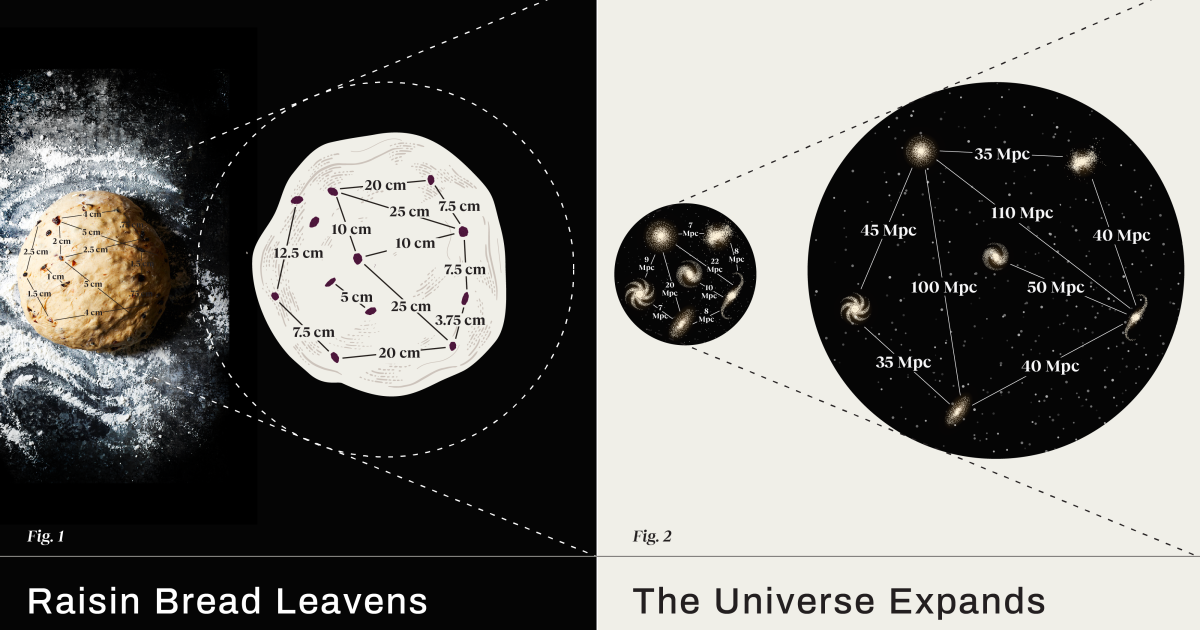
Okay, first thing first: the universe is in fact expanding. We've known this for more than a century now, and it's the basis for modern cosmology. This idea is called the big bang modelwhich is an unfortunate name because it brings to mind a cosmos expanding like an explosion, with galaxies moving away from each other through space like shrapnel. But in fact space itself is expanding, and that's different.
The first time that University of Oxford astronomer Lyla Jung saw the cosmic configuration on her monitor, she almost didn't believe it was real. But it wasand Jung and her colleagues went on to identify one of the largest rotating structures ever found in space: a chain of galaxies embedded in a spinning cosmic filament 400 million light-years from Earth. The finding, published in Monthly Notices of the Royal Astronomical Society, may give astronomers new insights into galaxies' formation, evolution and diversity, Jung says.
The universe is exploding. Or parts of it are. The night sky may seem calm, even serene, but that masks events of a catastrophic and nearly unimaginable scale. Across the galaxy and even the cosmos itself, immense outbursts of energy occur that could easily vaporize our planet. Happily, space is vast, and the terrible distance between these events and us diminishes what we see to a faint glowusually.