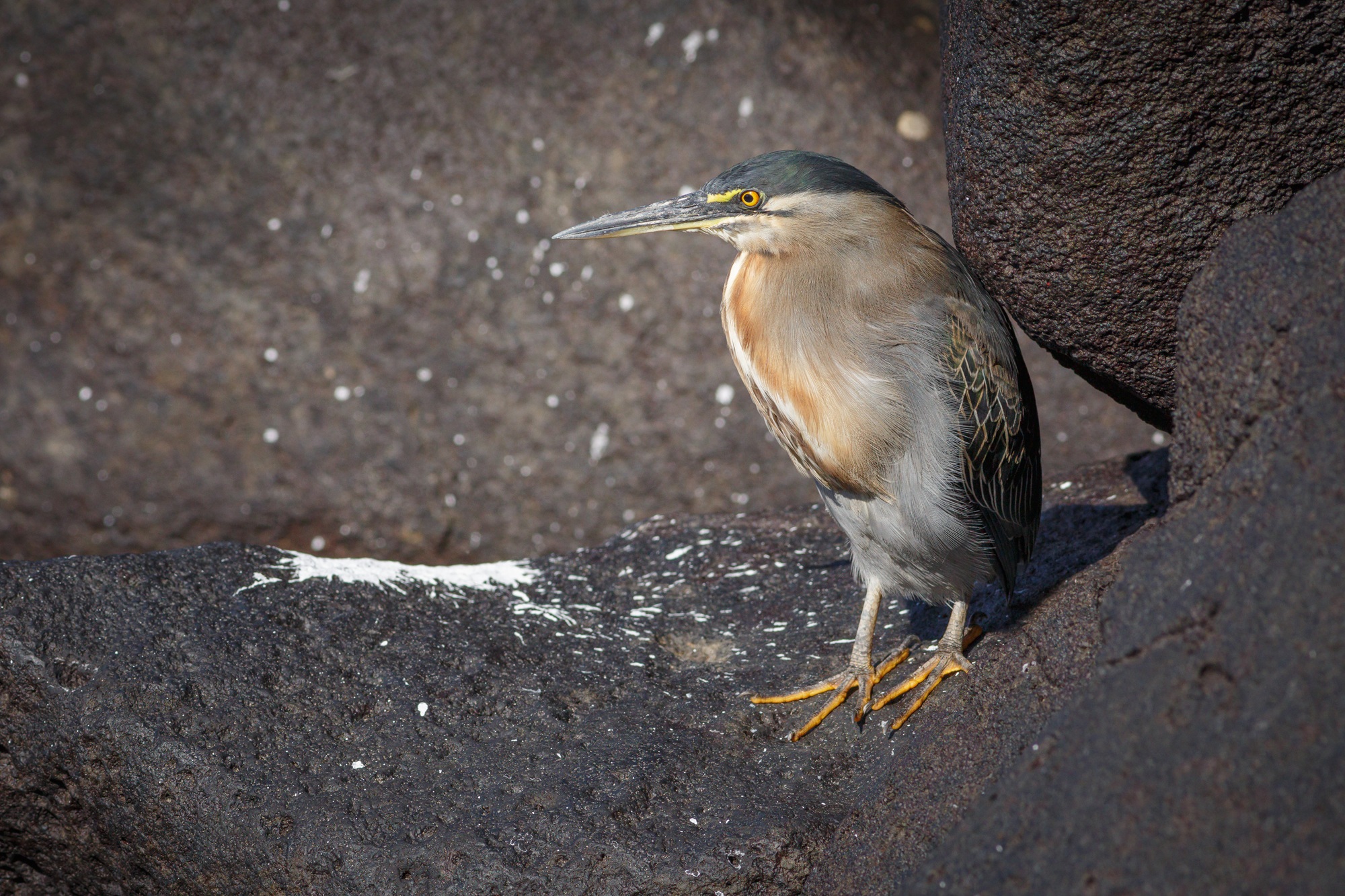
"The lava heron also has a much thicker bill than other closely related herons - an adaptation linked to feeding among sharp volcanic rocks and hard-shelled prey. "What we learned was something that hadn't been reported before," Mendales said. The discovery underscores how much remains unknown, even in iconic places like the Galápagos, said John Dumbacher, the Academy's curator of birds and mammals and Mendales' thesis adviser."
"The lava heron's dark plumage, which blends seamlessly into black lava flows, also offers scientists a window into evolution in real time. While many individuals are nearly charcoal gray, others still show lighter, striped coloration - raising questions about whether the species is still evolving or maintaining multiple forms through natural selection. "These are the kinds of things that evolutionary biologists love to study because it tells you a lot about how selection works," Dumbacher said."
Lava herons on the Galápagos possess a much thicker bill adapted for foraging among sharp volcanic rocks and crushing hard-shelled prey, and they are genetically distinct from closely related herons. Plumage varies from nearly charcoal gray to lighter, striped forms, suggesting either ongoing evolution or maintenance of multiple forms by natural selection. In the Maldives, a new twilight-zone fish, Plectranthias raki, was found around 400 feet deep and displays distinct red blotches and elusive behavior; the name raki means "shy" in Dhivehi. Plastic pollution and fishing debris are present even at those depths, indicating human impacts on deep habitats.
Read at Kqed
Unable to calculate read time
Collection
[
|
...
]