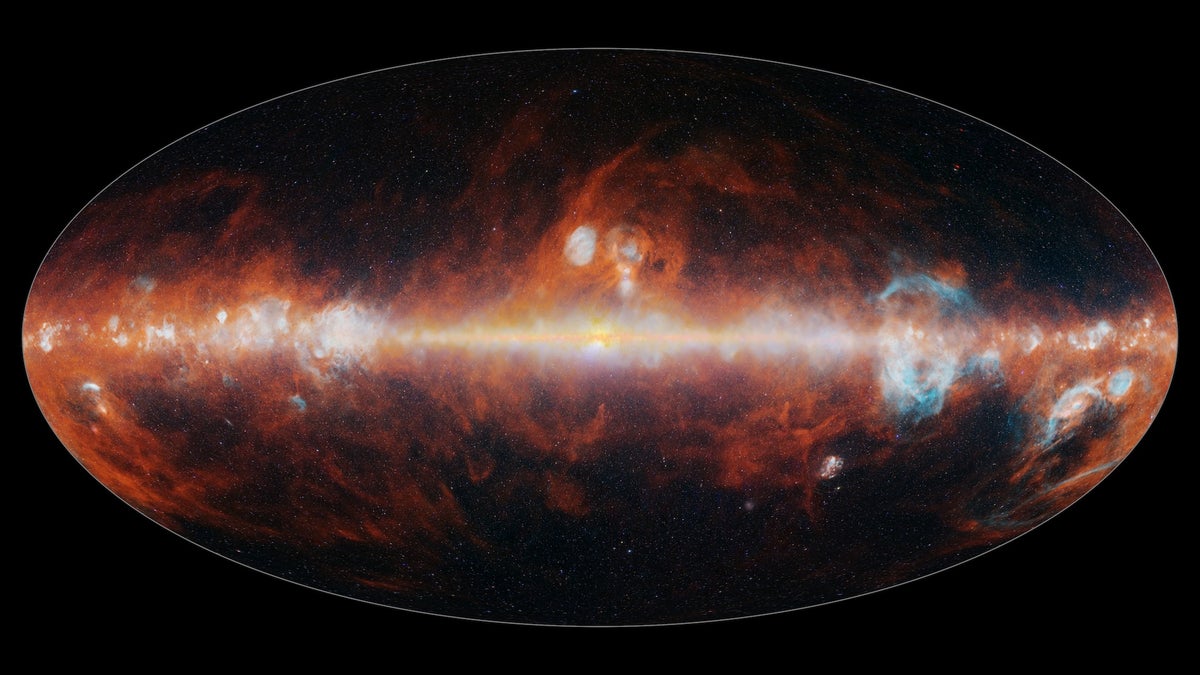
"Just nine months since its launch, NASA's newest space telescope has unveiled a jaw-dropping map of the cosmos unlike any we have seen before. Spectro-Photometer for the History of the Universe, Epoch of Reionization and Ices Explorer (SPHEREx) is a two-year-long mission designed to study the universe in infrared light. It began science operations in May, yet the mission has already completed the first of four full-sky maps, showing the universe off in an image that includes more than 100 colors."
"Space telescopes are typically optimized either to study a small patch of the sky across many wavelengths of light or to survey vaster swaths of the cosmos in only a handful of wavelengths. SPHEREx offers the best of both: with six specialized filters, the telescope can isolate light from 102 different wavelengths. That's powerful because of a fundamental feature of the cosmos: as light travels across the expanding universe, it stretches."
Nine months after launch, NASA's SPHEREx began science operations in May and completed the first of four full-sky maps. The two-year mission studies the universe in infrared light and produced an image showing more than 100 colors. SPHEREx captures the whole sky in 102 colors about every six months. Six specialized filters allow isolation of light from 102 different wavelengths. As light travels across the expanding universe, it stretches; light from farther away is older and has a longer wavelength than closer objects. Scientists can determine distances using spectral information. SPHEREx produces a three-dimensional atlas of the universe.
Read at www.scientificamerican.com
Unable to calculate read time
Collection
[
|
...
]