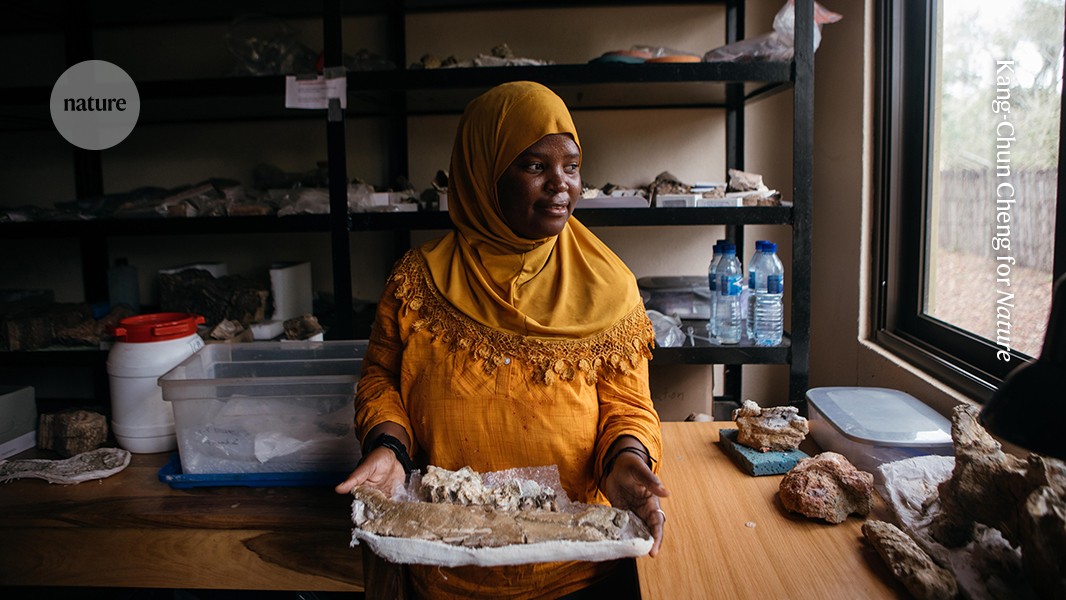
Gorongosa National Park in Mozambique contains fossil sites that remained unexplored until 2016. The Paleo-Primate Project (PPP) studies fossil evidence and living primates to inform human-evolution research. In 2017, during the final year of a bachelor's degree at Eduardo Mondlane University in Maputo, participation in the project provided a first encounter with primatology and changed a career path. Fieldwork centers on observing grey-footed Chacma baboons (Papio ursinus griseipes). A photograph from October 2025 shows the skull of the extinct mammal Arsinoitherium in the park's palaeontology laboratory, where fossils from ongoing excavations are curated. These discoveries indicate Gorongosa was once part of East African coastal forests and may have served as a refuge allowing some species to persist longer than elsewhere.
"Gorongosa National Park in Mozambique has fossil sites that, as recently as 2016, had never been explored. It is here that the Paleo-Primate Project (PPP) studies fossil evidence and living primates to understand human evolution. In 2017, during the final year of my bachelor's degree in archaeology and cultural heritage at Eduardo Mondlane University in Maputo, I had the opportunity to work on that project. It was my first encounter with primatology, and it changed the course of my life."
"Today, I spend most of my time observing grey-footed Chacma baboons ( Papio ursinus griseipes) in the park - the best workplace I can imagine. In this photo, taken in October 2025 in the park's palaeontology laboratory, I'm holding the skull of the extinct mammal Arsinoitherium, a large herbivore that once lived in Africa's swampy and coastal regions. The lab is where fossil remains from ongoing excavations are curated."
Read at Nature
Unable to calculate read time
Collection
[
|
...
]