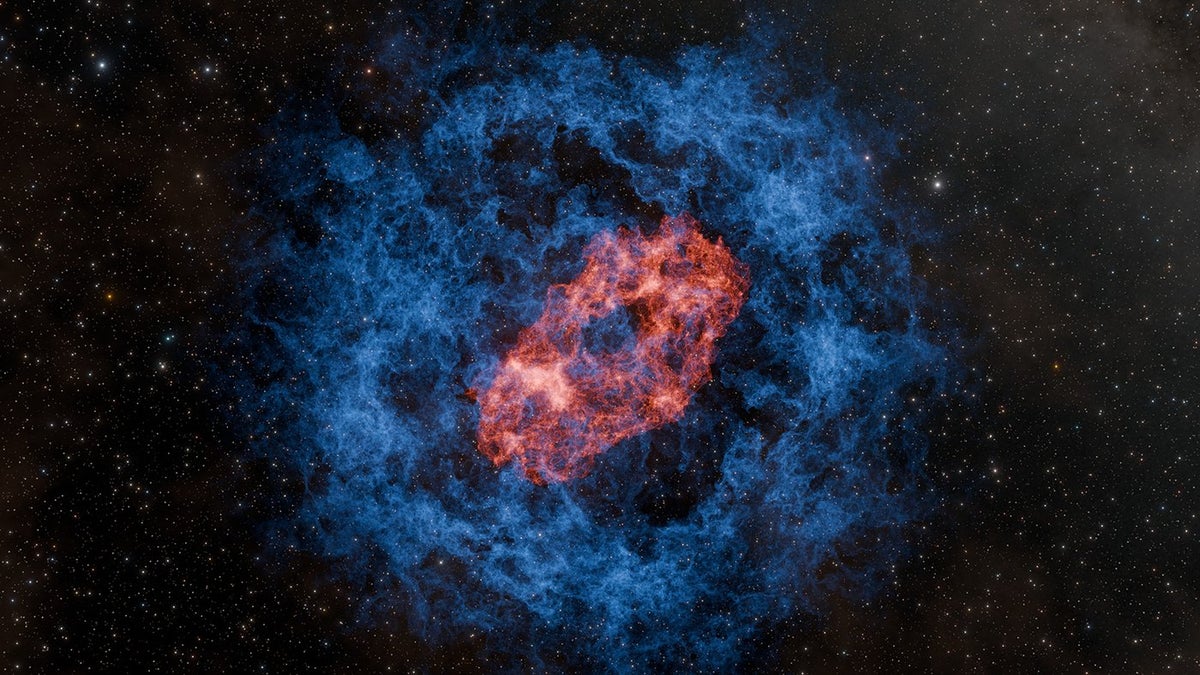
Massive stars that exhaust fusion fuel collapse and explode as supernovae, sometimes leaving behind neutron stars. When two neutron stars collide, the explosion is a kilonova, and only one kilonova has been confirmed to date. Observations from gravitational-wave detectors and electromagnetic telescopes indicate an event combining supernova and kilonova characteristics, described as a superkilonova. The proposed mechanism involves a rapidly rotating massive star whose collapsing core undergoes fission to produce two neutron stars during the supernova; the newly formed pair then collides, producing a kilonova-like signature embedded within the supernova. Other candidate explanations were ruled out by the dataset.
"Astronomers may have discovered a never-before-seen cosmic explosion that effectively combines a supernova with a kilonovathe blast that results when two dead, dense stars collide. When massive stars run out of fuel for nuclear fusion, they collapse, triggering a huge explosion called a supernova that blasts light out into space. These cataclysms sometimes leave behind a small dead corea dense object made mostly of neutrons called a neutron star."
"When two neutron stars collide, the resulting explosion is known as a kilonova. Just one kilonova has ever been confirmed. Now astronomers think they've seen a rare combination of the two. According to California Institute of Technology astronomer Mansi Kasliwal, a co-author of a new study describing the findings, observations from gravitational-wave detectors and telescopes around the world together suggest the combo produced a third kind of powerful explosion: a superkilonova."
Read at www.scientificamerican.com
Unable to calculate read time
Collection
[
|
...
]