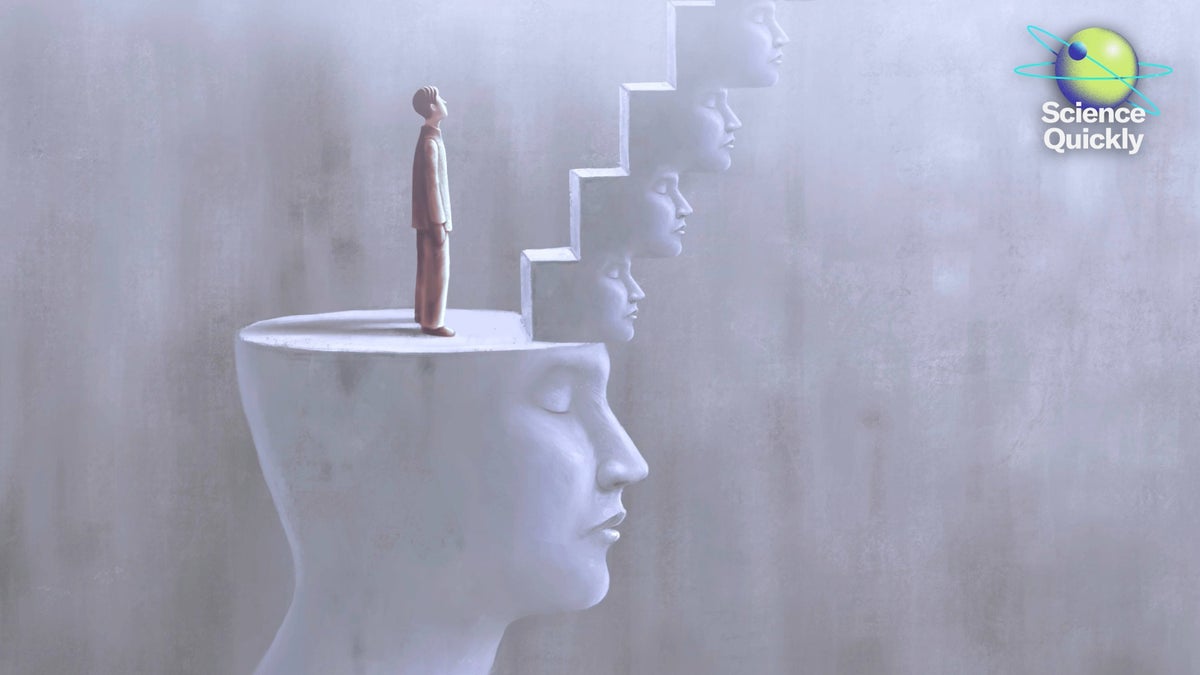
"What he was getting at, in part, is that though our senses might deceive us, the act of thinking was proof of our own existence. But reflect on that sentence again: I think, therefore I am. Who in that short declaration is I? Scientists call that I, that subjective sense of self, consciousness. And understanding what consciousness is, how it functions and where it lives in the brain has plagued researchers for generations."
"There were these really famous split-brain studies many decades ago [with] people who were having seizures and they would try to address it by cutting, basically, the connections between the two brain hemispheres. And this would result in some really weird things where, like, there was information in your brain that you had but you weren't conscious of because consciousness was, like, in one side of the brain and not able to access the other."
Consciousness refers to the subjective sense of self and remains a major unresolved question in neuroscience. Researchers aim to identify how the brain creates conscious experience and where those processes occur. Split-brain studies show that severing connections between hemispheres can isolate conscious awareness to one side, leaving information present but inaccessible to conscious report. Scientists also investigate consciousness in dreaming, under anesthesia, across animal species, and in artificial intelligence systems. Cognitive science and neuroscience approaches combine behavioral experiments, clinical cases, and brain imaging to probe mechanisms and limitations of conscious access and selfhood.
Read at www.scientificamerican.com
Unable to calculate read time
Collection
[
|
...
]