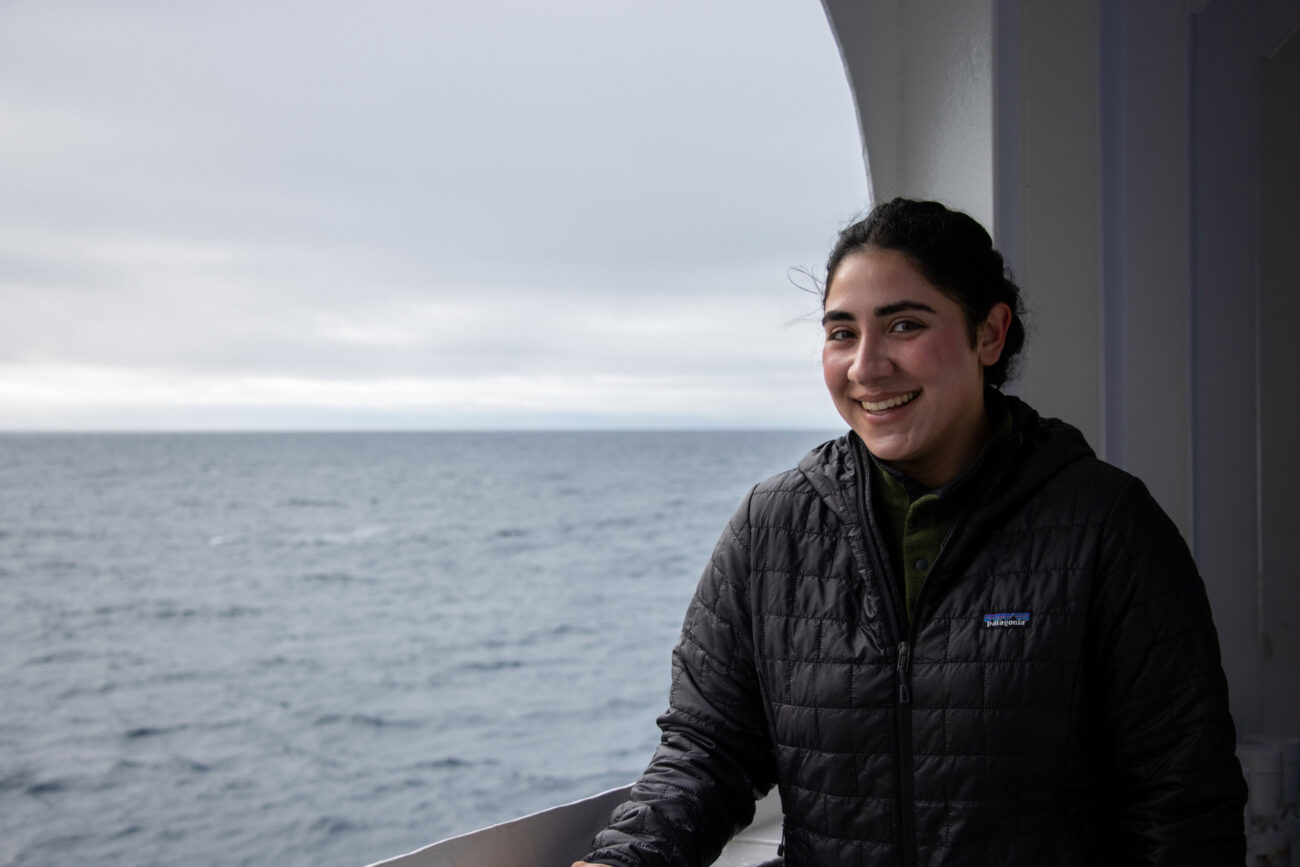
Early exposure to the Keeling Curve sparked a lifelong interest in atmospheric CO2 and paleoclimate. Apollonia Arellano earned a B.S. in environmental Earth and soil sciences from California Polytechnic State University and now pursues a doctorate in Earth and environmental sciences while researching at Lamont-Doherty Earth Observatory within the Columbia Climate School. She studies paleoceanography and applies geochemical analyses to reconstruct deep ocean circulation in the North Atlantic under adviser Jerry McManus. High school research into CO2 curves across timescales prompted questions about past atmospheric concentrations and led her to specialize in paleoclimatology and paleoceanography. She advises younger women and girls entering the field to ask for what they want.
"Arellano, who holds a B.S. in environmental Earth and soil sciences from California Polytechnic State University, is now a doctoral student in Earth and environmental sciences and researcher at the Lamont-Doherty Earth Observatory, which is part of the Columbia Climate School. Here, she studies paleoceanography (the history of oceans in the geologic past) with adviser Jerry McManus and uses geochemical analyses to reconstruct deep ocean circulation in the North Atlantic Ocean. Read more about her journey in the interview below."
"After school that day, I returned home to do my own research and came across various similar curves displaying the concentration of this greenhouse gas over different timescales. The older the timescale, the more interested I became; and when I finally came across the graph showing CO2 over 800,000 years, I was hooked. I had so many questions, namely: How did scientists know the concentrations of this gas during portions of Earth's history humans were not present for?"
"My advice for younger women or girls who are interested in entering the field would be to ask for what you want."
Read at State of the Planet
Unable to calculate read time
Collection
[
|
...
]