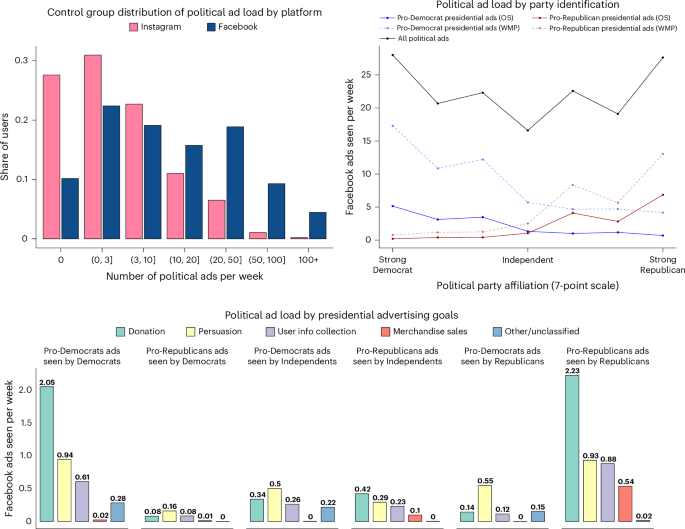
"We study the effects of social media political advertising by randomizing subsets of 36,906 Facebook users and 25,925 Instagram users to have political ads removed from their news feeds for 6 weeks before the 2020 US presidential election. We show that most presidential ads were targeted towards parties' own supporters and that fundraising ads were the most common."
"On both Facebook and Instagram, we found no detectable effects of removing political ads on political knowledge, polarization, perceived legitimacy of the election, political participation (including campaign contributions), candidate favourability and turnout. This was true overall and for both Democrats and Republicans separately."
A large-scale randomized experiment involving 36,906 Facebook users and 25,925 Instagram users examined the impact of political advertising during the 2020 US presidential election. Participants were randomly assigned to have political ads removed from their news feeds for six weeks before the election. The study found that most presidential ads targeted parties' own supporters, with fundraising ads being the most prevalent. Across both platforms, removing political ads produced no measurable effects on political knowledge, polarization levels, perceived election legitimacy, political participation including campaign contributions, candidate favorability ratings, or voter turnout. These null findings held consistently for both Democrats and Republicans when analyzed separately.
#social-media-political-advertising #2020-us-presidential-election #randomized-controlled-experiment #voter-behavior-and-turnout #political-polarization
Read at www.nature.com
Unable to calculate read time
Collection
[
|
...
]