#ai-generated-imagery
#ai-generated-imagery
[ follow ]
Artificial intelligence
fromwww.theguardian.com
4 days agoYou can't control everything': the rise in plastic surgeons asked to create AI face'
AI-generated face images are setting unrealistic cosmetic surgery expectations, reinforcing fixed aesthetic ideals and creating demands for flawless, near-perfect results that surgery cannot guarantee.
#truth-social

US Elections
fromwww.mediaite.com
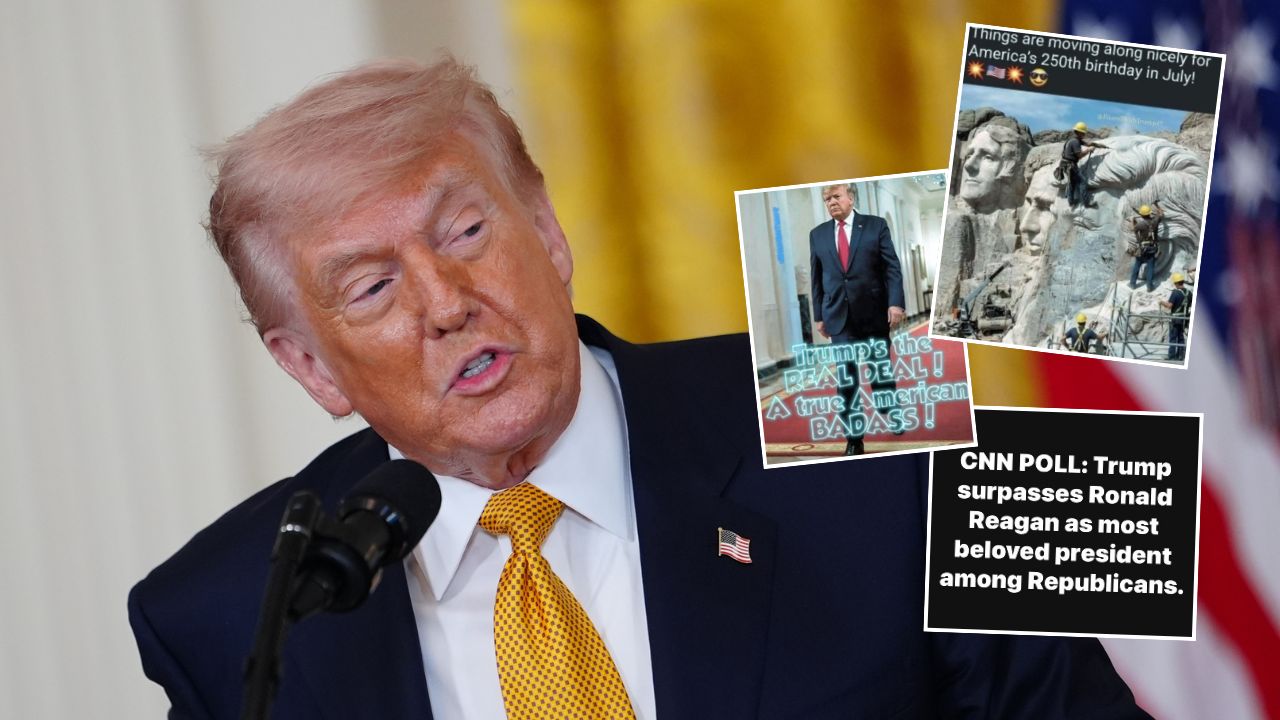
2 weeks agoTrump Drowns Feed With MAGA Praise in Late-Night Truth Social Dump Celebrating Himself
Trump reposted AI-generated praise and attacks on Truth Social, promoted disputed polling claims, revived election-fraud allegations, and ended with anti-Democrat messaging.

Arts
fromSleek Magazine
1 week agoHow SHL0MS Turned a Monet Water Lilies Painting Into Viral Performance Art by Calling It AI How SHL0MS Turned a Monet Water Lilies Painting Into Viral Performance Art by Calling It AI
A real Monet was presented as AI-generated to trigger mass critique, revealing shifting assumptions about authenticity, authorship, and aesthetic judgment online.
Media industry
fromFuturism
2 weeks agoFour Financial Journalists Accused of Being Fake AI-Generated Puppets That Shill Crypto in Forbes, HuffPost, and More
Four crypto-focused freelance financial journalists appear to be fake, with shared ties to a blockchain PR firm and repeated promotion of its clients’ coins.
Right-wing politics
fromwww.theguardian.com
2 weeks agoWhite House calls Mark Hamill sick' after his post with AI image of Trump in a grave
An AI image implying Donald Trump’s death prompted Mark Hamill’s apology, while the White House cited it as evidence of political violence and assassination attempts.
US politics
fromVulture
2 weeks agoWhite House Calls Mark Hamill a 'Lunatic' for Sharing AI Image of Trump's Grave
The White House criticized actor Mark Hamill for posting an AI-generated image of Trump at a gravestone, linking such rhetoric to assassination attempts, while Hamill clarified he wished Trump accountability rather than death.
#misinformation








fromwww.mediaite.com
3 months agoJeffrey Epstein Is Alive in Israel!? The Internet Really Wants to Believe It
Jeffrey Epstein is alive is simply a much better story than Jeffrey Epstein is dead. Dead is an ending. Alive is a franchise. Epstein's death was narratively unsatisfying to many, many people. There was no trial, no public reckoning, no parade of powerful names under oath. The story cut to black before the audience got what it was promised. Conspiracies rush in to fill that void not because they are persuasive, but because they keep the plot alive.
Media industry
fromwww.theguardian.com
3 months agoCondemnation of Elon Musk's AI chatbot reached tipping point' after French raid, Australia's eSafety chief says
"It's nice to no longer be a soloist, and be part of a choir. We've been having so many productive discussions with other regulators around the globe and researchers that are doing important work in this space, she said. I think this really represents a tipping point. This is global condemnation of carelessly developed technology that could be generating child sexual abuse material and non-consensual, sexual imagery at scale."
EU data protection
fromIrish Independent
3 months agoTaoiseach criticises X for 'concerning' and 'disrespectful' decision not to appear in front of Dail committee
X will not attend despite calls for it to face questioning about its AI tool Grok, which has been accused of generating images of sexual abuse, including that of children The Taoiseach has labelled the decision by X not to attend a communications committee hearing as as "concerning" and "disrespectful". Representatives from Meta, TikTok and Google are to appear in front of the Committee on Arts, Media, Communications, Culture and Sport today.
Miscellaneous
US news
fromSlate Magazine
3 months agoImmigration Agents Are Killing and Abusing People. So Civilians Are Turning to a Controversial Tool to Find Justice.
A.I.-generated images and crowdsourced unmasking on social media are being used to identify ICE agents, producing viral misidentifications, harassment, and real-world harms.


fromwww.independent.co.uk
3 months agoReform mayoral candidate replicates Trump's controversial Greenland penguin image
From reproductive rights to climate change to Big Tech, The Independent is on the ground when the story is developing. Whether it's investigating the financials of Elon Musk's pro-Trump PAC or producing our latest documentary, 'The A Word', which shines a light on the American women fighting for reproductive rights, we know how important it is to parse out the facts from the messaging.
UK politics






fromKotaku
4 months agoTrump Uses Stardew Valley To Threaten Third Term
At a glance, it might not look like much. The AI-generated image hast an ugly faux-pixel-art sprite of Trump looking like he got hit in the face with a frying pan, his inventory has a bunch of the things you'd expect like a MAGA hat and a cop badge, and he's shown saying, "We're bringing back Whole Milk and Making America Healthy Again." But also, if you look at the gold he's carrying in the screenshot, the number is 45464748.
US politics
fromwww.bbc.com
4 months agoMusk says X outcry is 'excuse for censorship'
Ofcom says it is conducting an urgent assessment of X in response, with the backing of Technology Secretary Liz Kendall. But the chairwomen of Parliament's technology and media committees have both said they are concerned that "gaps" in the Online Safety Act might hinder the media regulator's ability to deal with the matter. X has now limited the use of AI image function to those who pay a monthly fee, a change dubbed by Downing Street as "insulting" to victims of sexual violence.
UK politics

fromIrish Independent
4 months agoGovernment must decide 'collectively' about its use of X, minister says as Grok linked to AI-generated abuse images
Peter Burke was responding to recent reports that the platform's AI function, Grok, can be used to create fake sexualised images of people, including children. It comes amid reports by some users of X that the social media platform's AI tool Grok has been responsible for the editing of their photos by certain accounts to create nude images in their likeness - as well as sexualised images of children - mainly women and girls.
Europe politics
Artificial intelligence
fromPinkNews | Latest lesbian, gay, bi and trans news | LGBTQ+ news
4 months agoOfcom makes 'urgent contact' with X over Grok generated child abuse material
Ofcom has urgently contacted X and xAI after Grok generated non-consensual sexualised images, including alleged sexualised images of children.



fromThe New Yorker
5 months agoThe Year in Slop
The Turing test, a long-established tool for measuring machine intelligence, gauges the point at which a text-generating machine can fool a human into thinking it's not a robot. ChatGPT passed that benchmark earlier this year, inaugurating a new technological era, though not necessarily one of superhuman intelligence. More recently, however, artificial intelligence passed another threshold, a kind of Turing test for the eye: the images and videos that A.I. can produce are now sometimes indistinguishable from real ones.
Artificial intelligence
fromFast Company
5 months agoSurprise, surprise: People don't want AI slop on 'SNL'
Across the internet, eagle-eyed sleuths are crying " AI slop" after Saturday Night Live aired segments with what looks like AI-generated imagery. The first instance, from Saturday's cold open, shows an illustrated Christmas storybook. The images feature a hazy, yellow-ish hue and an image of streets that don't connect. The next, in "Weekend Update" showed an image of a woman playing a slot machine in an otherwise empty casino while using an oxygen tank with tubes that weren't connected.
Television
fromArchDaily
5 months agoHow 2025 Turned Architectural Visuals Into Disputed Media
For much of modern architectural history, images have functioned as interpretive tools rather than literal records. Renderings, drawings, and competition visuals were traditionally understood as speculative instruments, offering atmospheres, intentions, and possible futures rather than fixed realities. This ambiguity allowed architects to communicate ideas that were still in formation, and it shaped a visual culture in which representation was valued as much for its suggestive quality as for its precision.
Design
fromThe Daily Beast
5 months agoValentino Slammed Over Truly 'Uncomfortable' Ads
The first ad, described as a "journey through kaleidoscopic geometries and pure imagination," was unveiled on the brand's Instagram as part of a "digital creative project" in collaboration with artists. But it was immediately torn apart by viewers for its "cheap" and "lazy" use of AI imagery, which experts have pointed to as proof that the practice has no place in the advertising industry.
Fashion & style
fromThe IP Law Blog
6 months agoThe Briefing - Soup for Change: Campbell's Sues a Congressional Candidate
In this episode of The Briefing, Scott Hervey and Richard Buckley break down Campbell Soup Co. v. Campbell for Congress, the lawsuit over a political candidate's "Soup4Change" slogan and AI-generated soup can design. They cover the backstory, the trademark and First Amendment arguments, and how the Hershey case may influence the court's view of political campaign branding. Tune in for a clear look at where trademark law meets political speech.
Intellectual property law
fromKotaku
6 months agoTrump Takes Break From Destroying White House To Post Halo Meme
GameStop started with a mock-up of a statement declaring the console wars over. Sure, that's the kind of thing a company makes for social media when trying to capitalize on something in the news. The store notes that now that the Halo: Campaign Evolved remake is coming to PlayStation 5, there's nothing to fight about anymore, so you can take your Sony Ponies back to the stable and power down your Xbots.
US politics
World news
fromdesignboom | architecture & design magazine
6 months agois this what saudi arabia's sky stadium for 2034 FIFA world cup will look like?
AI-generated concept renderings of a 350-meter 'Sky Stadium' circulated online exaggerate NEOM's planned elevated stadium for Saudi Arabia's 2034 World Cup.
fromwww.nytimes.com
7 months agoHow Trump Is Using Fake Imagery to Attack Enemies and Rouse Supporters
The era of A.I. propaganda is here and President Trump is an enthusiastic participant. After nationwide protests this weekend against Mr. Trump's administration, the president posted an A.I.-generated video to his Truth Social account depicting himself as a fighter pilot, careening through major cities and dropping excrement on protesters. It was the latest example in a yearslong shift by Mr. Trump to deploy fake imagery, generated by artificial intelligence, as part of his social media commentary.
US politics

Public health
fromIndependent
7 months agoYoung children exposed to online sexual exploitation attempts as criminal gangs produce 'deep fake nudes' from innocent photos
AI-driven 'nudify' tools can convert innocent photos into realistic explicit images, exposing children, including those as young as five, to online sexual exploitation.
fromFast Company
7 months agoOpenAI's Sora could save social networking-as long as it doesn't ruin it
So I was intrigued when two new social networking experiences debuted in rapid succession in late September: Meta's Vibes and OpenAI's Sora. Thanks to the fact that both focus on letting people share AI-generated imagery, they compete directly with each other. But their all-AI format also sets them apart from existing social networks, where generative AI is most often a distraction from human contact, not the main attraction.
Artificial intelligence
Marketing
fromMuse by Clios | Discover the latest creative marketing and advertising news. Muse by Clio is the premier news site covering creativity in advertising and beyond.
7 months agoAI Fills in the Blanks About Stolen Treasures, and More Highlights From Europe | Muse by Clios
AI-generated reconstructions highlight stolen cultural objects while brands use celebrity ads and music-video-style campaigns to promote products and attract Gen Z consumers.
fromwww.npr.org
8 months agoA congressman called Charlie Kirk Jesus's '13th disciple.' Other Christians disagree
Kirk is an evangelical Christian, and that's actually a later development in his life. His group, Turning Point USA, was initially focused on college students, not religion. But around 2019, Kirk had a conversion of sorts. He started incorporating evangelical Christianity into his work, started speaking regularly at churches, hosting pastors conferences and even promoting the idea that the U.S. was founded as a Christian nation. By the end of his life, Kirk was devoting a lot of his time to promoting conservative Christianity.
US politics
fromwww.theguardian.com
8 months agoI always wondered what it would be like up there': artist Paul Cocksedge on his Nelson's-eye view of London
The fused bundle of weathered steel industrial pipes is eye-catchingly at odds with the grand fountains, statues and Victorian pomp of the massive bronze lions. But this sculpture is completely site-specific: press a play button and look into one of the eyepieces embedded into three of the five pipes and you see images of the surrounding city from the viewpoint of naval commander Horatio Nelson's statue 45m up in the sky.
Design


fromFast Company
9 months agoAI passed the aesthetic Turing Test, raising big questions for art
Pick up an August 2025 issue of Vogue, and you'll come across an advertisement for the brand Guess featuring a stunning model. Yet tucked away in small print is a startling admission: She isn't real. She was generated entirely by AI. For decades, fashion images have been retouched. But this isn't airbrushing a real person; it's a "person" created from scratch, a digital composite of data points, engineered to appear as a beautiful woman.
Fashion & style
[ Load more ]