#train-landing
#train-landing
[ follow ]
#infrastructure #hs2 #accessibility #london-underground #high-speed-rail #transportation #london-transport
fromianVisits
4 days agoTunnel to Heathrow could be privately funded under revived rail link plans
The study concludes that the rail link could deliver strong economic returns under both two-runway and three-runway expansion scenarios at Heathrow Airport, indicating its potential impact on regional connectivity.
UK politics
#urban-logistics
Alternative transportation
fromLondon Business News | Londonlovesbusiness.com
4 days agoThe 2026 urban logistics challenge: Managing delivery hubs in the city - London Business News | Londonlovesbusiness.com
Cities are becoming critical for delivery management due to e-commerce growth, requiring innovative logistics solutions to meet consumer expectations.
fromTravel + Leisure
1 week agoAmerica's Fastest Trains Are Here-but Rail Experts Say High-speed Travel Is Still Years Away
True high-speed rail in the U.S. is still years away despite recent advancements and public support. Rail experts emphasize that actual high-speed rail requires dedicated infrastructure and faster trains, similar to systems in Europe and Asia.
Alternative transportation

fromWIRED
1 month agoHow Can a Locomotive Pull a Long Train That's Much Heavier?
Have you ever watched a mile-long freight train rumble by and wondered how one locomotive can pull more than a hundred fully loaded cars? The locomotive weighs maybe 150 metric tons, and each car is about 100 metric tons, which means it's hauling 10,000 tons. I mean, if you weigh 170 pounds, this would be like pulling three SUVs totaling 12,000 pounds.
Science

fromStreetsblog
3 weeks agoOpinion: The Federal Railroad Administration's Proposed Amtrak Restructuring is Worth Considering - Streetsblog USA
While dozens of other countries have delivered fast, modern train networks, we are stuck with a skeletal system built largely on slow, 19th-century alignments. Even developing nations are passing us by. There is growing recognition at the federal level that things need to change, but substantial and comprehensive reform would require an act of Congress.
Alternative transportation
fromThe Drum
1 month agoNetwork Rail's powerful campaign
Sit down with Hannah Bowler and the Story Catchers and Network Rail team where they discuss their wins at The Drum Awards for Marketing EMEA for their 'You vs Train' campaign. Hear about the success of the campaign, how changing behavior was its ultimate goal, and how they reached difficult target audiences.
Marketing
London
fromianVisits
3 weeks agoInside the giant machine digging HS2's railway tunnels to Euston station
HS2's final tunnel boring machine began digging the second tunnel from Old Oak Common to Euston, with the machine's front section remaining permanently underground as trains will eventually pass through it.
#london-underground-infrastructure
London
fromianVisits
1 month agoLondon's weekly railway news
London's rail transport faces multiple challenges including aging infrastructure heat problems, strikes over working conditions, safety incidents, operational disruptions, and service expansion plans across Underground, Elizabeth Line, and mainline networks.
London
fromTime Out London
1 month agoA brand new railway line could serve London's biggest airport
Heathrow Southern Rail would connect Heathrow Airport to Waterloo and Surrey towns via eight miles of new railway line, supporting the airport's expansion to handle 66 million additional annual travelers.
fromFuturism
2 months agoDelivery Robot Gets Stuck on Train Tracks, Gets Obliterated by Locomotive
Footage of the incident, which took place January 15, shows the robot sitting motionless on the tracks, seemingly making no attempt to get out of the way as the unmistakable blare of the train horn gets louder and louder. "Oh it's gonna crush it!" the onlooker taking the video can be heard saying moments before the train, operated by Brightline, flattens the unfortunate bot into the tracks. Sparks can be seen flying from beneath the train before the video cuts off.
Startup companies


Artificial intelligence
fromBusiness Matters
2 months agoAI set to 'turbocharge' Britain's road and rail network, says Transport Select Committee chair
AI and digital technologies will transform Britain's road and rail networks, improving maintenance, reliability and supporting economic growth, with cybersecurity safeguards required.
fromStreetsblog
2 months agoPassenger Rail Is Headed for a Reckoning - and the First 90 Days of 2026 Will Decide It - Streetsblog USA
Let's start with the biggest issue on the horizon: the proposed merger of Union Pacific and Norfolk Southern. Yes, the ultimate decision is about a year away. But sides are lining up for and against, and right now, the Surface Transportation Board, which is colloquially known as STB -- the railroads' economic regulator -- is considering the details of how the rules governing that decision will be applied.
US politics
New York Islanders
fromwww.amny.com
2 months agoPenn Station redesign chief Andy Byford says he's not fully up to speed' on looming Gateway Tunnel project breakdown amNewYork
Andy Byford must catch up on warnings that a federal funding freeze could halt and derail the Gateway Tunnel project affecting Penn Station.
fromLondon Business News | Londonlovesbusiness.com
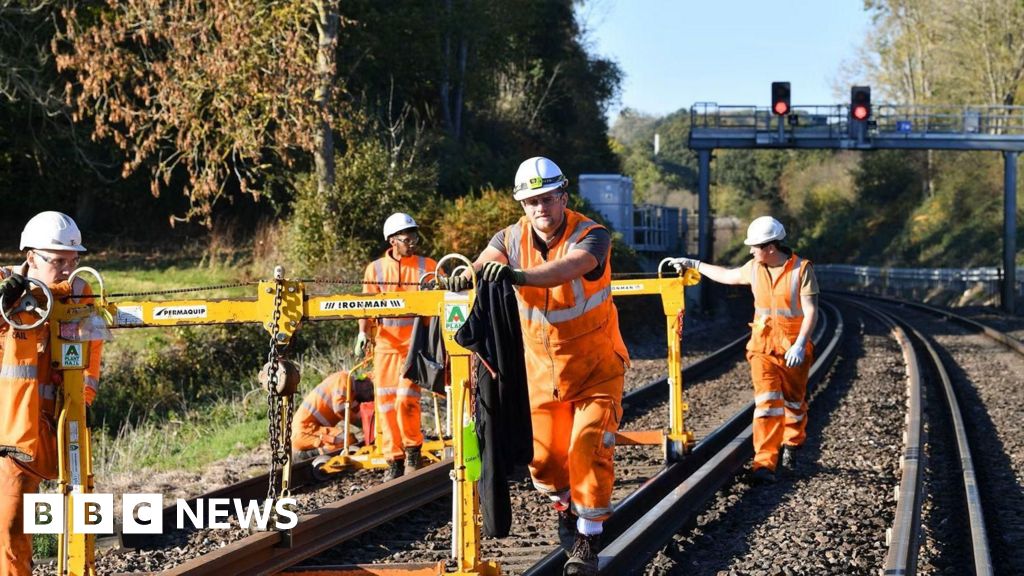
2 months agoA practical guide to personal track safety for new rail workers - London Business News | Londonlovesbusiness.com
Personal Track Safety refers to the rules, procedures, and behaviours that allow workers to operate safely on or near live railway lines. It's designed to minimise risks from moving trains, electrical systems, and environmental hazards. PTS is not just about memorising rules. It's about understanding why they exist and how they apply in real working conditions. When workers grasp this early, they're far more likely to act decisively and safely when situations change.
Careers
from24/7 Wall St.
2 months agoTop 5 Railroad Equipment & Railcar Leasing Stocks: Picks & Shovels of Logistics
The railroad industry is a logistics artery, but the companies supplying the equipment that moves freight are where the real money gets made. Locomotives, railcars, tank cars, and digital rail systems are the picks and shovels of modern logistics. These companies capture recurring revenue from manufacturing, leasing, and maintenance contracts, benefiting from regulatory replacement cycles, nearshoring tailwinds, and the simple reality that freight must move.
Business

UK politics
fromwww.theguardian.com
2 months agoThe Guardian view on Labour's plan for railways in the north: a slow train coming | Editorial
Northern England's rail network is severely underfunded, causing slow, unreliable services and prompting a planned multi-stage Northern Powerhouse Rail upgrade including a new Bradford station.
California
fromStreetsblog
2 months agoOpEd: How High-Speed Rail Could Reach LA by 2039...Without Waiting for the Mountains - Streetsblog California
Electrifying and sharing the Antelope Valley Line enables one-seat San Francisco–Los Angeles high-speed service earlier, lowering cost and risk while modernizing Metrolink.
fromSustainable Bus
2 months agoAutonomous Systems: depot-first autonomy for smartbuses
For more than a decade, autonomous buses have been "almost ready." Demonstrations with safety drivers began around 2015, and ten years later, this is still largely what we see. The reason is not a lack of ambition - it is physics, safety, and economics. Autonomous buses on city streets are inherently difficult. They carry dozens of passengers, operate as heavy vehicles, and move through a chaotic urban environment.
Business


Artificial intelligence
fromeLearning Industry
2 months agoArtificial Intelligence In Transportation Training And Education
AI enables individualized transportation training by evaluating trainee performance, tailoring instruction, simulating real scenarios, and measuring performance for targeted improvement.
fromianVisits
2 months agoTron on the Tube: London Underground's new trains are being tested on the Piccadilly line
The new trains are the first of a fleet of 94 new trains being built in Yorkshire at the moment, and will eventually replace the Piccadilly line's existing 50-year old rolling stock. However, before passengers can ride the new trains, they need hundreds of hours of testing and assurance that they will work as expected. And testing has been underway ever since the first train arrived in London last year.
UK news
fromianVisits
2 months agoTickets Alert: Railway 200 tours of three London stations
Three of London's mainline terminus stations have announced more dates for the Railway 200 themed heritage tours that they were running last year. The tours will run once a month from January to March next year at London Bridge, Victoria, and Waterloo stations and will be led by Network Rail and historian-author Rachel Kolksy. They will last around two hours and involve walking around each station and the surrounding areas. The tours will cost £25 per person and dates are below. London Bridge station Tickets
Travel
fromwww.bbc.com
1 month agoNew train stations part of 14bn UK government rail funding promise
The UK government has not said when the money will be made available or over what period. It had already announced 445m for rail projects in Wales at last June's spending review, and has now explained that money will go towards building each of the seven stations. Initial work on five of the south east stations will begin later this year, with construction on two of them beginning in 2029. While no timescales have been announced, it is expected that Magor and Undy will be the first station to be completed.
UK politics
fromwww.bbc.com
2 months agoCalls to withdraw fresh floating bus stop guidance
The design, which has a cycle lane between the stop and the kerb, is intended to allow bus passengers to get on and off safely while cyclists continue moving. Sarah Gayton, street access campaign co-ordinator at the National Federation of the Blind of the UK, said: "It does not address the concerns that blind and visually impaired people have and it's totally insulting to think that we'll accept this."
UK politics
fromThe Local France
1 month agoEurostar station boss pledges to cut boarding times
Passengers travelling between London and Paris are currently told to check in between 45 minutes and 75 minutes in advance of their departure times, and usually end up waiting in the crowded waiting areas at London St Pancras or Gare du Nord stations.
Travel
fromredBus Blog
1 month agoIndian Railways Reintroduces Emergency Quota for Premium Sleeper Trains - redBus Blog
Indian Railways has restored the emergency quota for premium sleeper trains - Vande Bharat sleeper and Amrit Bharat. The purpose behind reintroducing the emergency quota is to serve those in urgent need of train tickets due to unexpected circumstances. Indian Railways continues to review and revise its policies to meet the evolving demands of travellers. In this guide, we have discussed all that you need to know about the emergency quota in Indian Railways for premium sleeper trains.
Travel
fromTheregister
2 months agoBork on Elizabeth Line Paddington station
Bork!Bork!Bork! London's Elizabeth Line is the latest thing in urban development (at least as far as the UK is concerned). So it seems appropriate that its borks should be similarly up to date, and its emoticons rotated so the intent cannot be mistaken. Sent in by an eagle-eyed Register reader, today's entry in the pantheon of bork was snapped at London's Paddington station,
UK news
[ Load more ]