#uspto-art-unit-assignment
#uspto-art-unit-assignment
[ follow ]
#patent-law #uspto #federal-circuit #ptab #intellectual-property #patent-prosecution #inter-partes-review
#patent-law


Intellectual property law
fromIPWatchdog.com | Patents & Intellectual Property Law
3 days agoFederal Circuit Affirms PTAB Decision Finding Information Exchange Patent Application Claim Ineligible Under Section 101
Claim 14 of McFadden's patent application was deemed ineligible for patent protection due to lack of an inventive concept.
Intellectual property law
fromGlobal IP & Technology Law Blog
4 days agoA New Path for Patent Owners in Ex Parte Reexams - But What About the Rules?
Patent owners can now respond to ex parte reexamination requests before the SNQ determination, despite existing rules that typically prohibit such responses.
Intellectual property law
fromIPWatchdog.com | Patents & Intellectual Property Law
3 days agoCAFC Says Appellant Declaration Failed to Tie Planned Product Features to Challenged Substitute Claims
ironSource's appeal was dismissed due to lack of standing and failure to prove injury from Digital Turbine's patent claims.
#uspto
Intellectual property law
fromIPWatchdog.com | Patents & Intellectual Property Law
8 years agoWhat I Want and Why: An Open Letter to the Next PTO Director
New USPTO Director should believe in patents and support the professional staff to improve the patent system.

Intellectual property law
fromIPWatchdog.com | Patents & Intellectual Property Law
4 years agoPatent Filings Roundup: Heavy District Court Docket Sees Fortress Biotech ANDA Litigation; WePay Expands GUI Design Patent Assertion Against Major Online Payment Systems
Over 100 new patent complaints were filed in the district court, with significant activity in pharmaceutical and cybersecurity sectors.
Intellectual property law
fromIPWatchdog.com | Patents & Intellectual Property Law
2 days agoDOJ Again Pushes Back Against Antitrust Claims Filed Over Allegations of SEP Abuse, False RAND Promises
The DOJ states that failing to negotiate on RAND terms does not alone indicate exclusionary behavior in antitrust cases.
Intellectual property law
fromIPWatchdog.com | Patents & Intellectual Property Law
4 days agoPatent Monetization: Markets, Misaligned Incentives, and the AI Inflection Point | IPWatchdog Unleashed
The incentive structure for innovation has eroded, disadvantaging individual inventors and leading to a decline in long-term innovation output.
#ptab

Intellectual property law
fromIPWatchdog.com | Patents & Intellectual Property Law
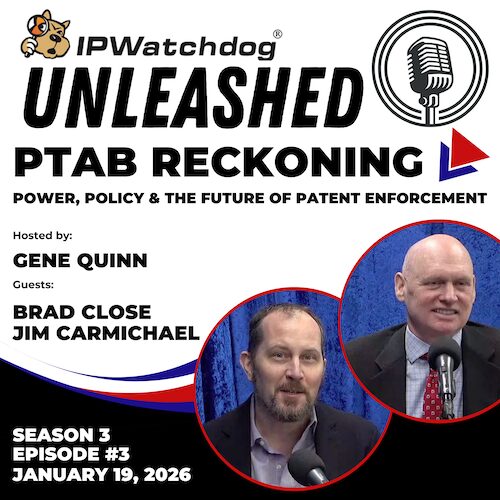
1 week agoThe USPTO is Trying-But the Most Abusive Practices to Kill Patents Are Still in Play
Aggressive procedural strategies in PTAB practice exploit reexamination to bypass IPR estoppel, creating significant loopholes in patent litigation.
Intellectual property law
fromIPWatchdog.com | Patents & Intellectual Property Law
1 week agoHow to Draft AI Patents That Survive the Next Guidance Cycle, and the One After That
The rapid changes in USPTO AI guidance create challenges for patent application strategies, necessitating a durable prosecution philosophy.
Intellectual property law
fromIPWatchdog.com | Patents & Intellectual Property Law
2 weeks agoThe Problem of Abusive Serial Challenges Using Reexaminations Needs to Be Addressed by the USPTO
Serial patent challenges undermine the patent system and create unfair advantages for larger companies over smaller competitors.
#ai-in-patent-prosecution


Intellectual property law
fromIPWatchdog.com | Patents & Intellectual Property Law
3 weeks agoPatent Prosecution in the AI-Native Future: How IP Counselors Can Succeed
AI's impact on patent prosecution depends on how practitioners and enterprises choose to adapt, with potential for both empowerment and disruption based on strategic action.
Intellectual property law
fromIPWatchdog.com | Patents & Intellectual Property Law
1 month ago'Patent Prosecutor' or 'AI-Agile IP Counselor'?-A High-Stakes Crossroads
AI-driven patent prosecution tools will significantly impact the profession, requiring practitioners to evolve beyond traditional patent prosecution into strategic IP counseling roles to avoid commoditization and maintain competitive relevance.
Intellectual property law
fromIPWatchdog.com | Patents & Intellectual Property Law
15 years agoPTO to Effectively Extend Provisional Applications to 24 Months
The USPTO pilot program offers inventors additional options for transitioning from provisional to nonprovisional patent applications, though it functions differently than a simple extension despite appearing similar.
Intellectual property law
fromIPWatchdog.com | Patents & Intellectual Property Law
3 weeks agoAI, Budget Cuts, and the Future of In-House Patent Teams | IPWatchdog Unleashed
Corporate IP departments face budget constraints and must prioritize portfolio quality, business value, and strategic use of AI tools to maintain competitive advantage.
fromPatently-O
3 weeks agoThe Patent Term Distribution, and What it Reveals
Congress set the patent term at twenty years from the earliest effective filing date. 35 U.S.C. § 154(a)(2) (not counting provisional or foreign national filing). But that statutory baseline is just the starting point. But, the actual term is shaped by a series of prosecution decisions, USPTO delays, terminal disclaimers, and patent family structure.
Intellectual property law
Intellectual property law
fromIPWatchdog.com | Patents & Intellectual Property Law
14 years agoPatent Strategy: Discovering Crucial Patent Examiner Data
Track 1 acceleration may cost less overall than waiting in the standard patent queue, making the $4,800 fee a worthwhile investment for clients needing faster patent issuance.
Intellectual property law
fromIPWatchdog.com | Patents & Intellectual Property Law
4 weeks agoUSPTO to Consider Extent of U.S.-Based Operations in Deciding AIA Institutions
The USPTO will now consider U.S. manufacturing presence and small business status as discretionary factors when deciding whether to institute inter partes reviews and post-grant reviews.
Intellectual property law
fromIPWatchdog.com | Patents & Intellectual Property Law
4 weeks agoOther Barks & Bites for Friday, March 13: Former USPTO Patent Examiner Settles Conflict Allegations; EU Parliament Endorses EUIPO Register of Works Used to Train AI; U.S.-Based Operations Become Discretionary Denial Factor at PTAB
The U.S. Department of Justice settled a conflict of interest case with a former USPTO patent examiner for $122,480, marking the second such settlement in two weeks.
Intellectual property law
frompatentlyo.com
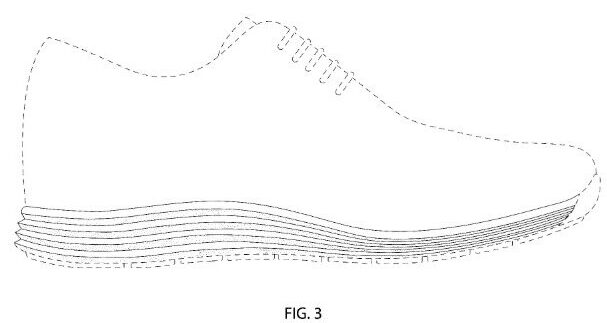
1 month agoUntethered: USPTO Loosens the Article of Manufacture Requirement for Digital Designs
The USPTO relaxed design patent rules for computer-generated interfaces and icons, removing display panel requirements, allowing 'for' prepositions in claims, and extending eligibility to projected, holographic, virtual, and augmented reality designs.
Intellectual property law
fromIPWatchdog.com | Patents & Intellectual Property Law
1 month agoWhat Shrinking Patent Budgets Say About the Patent System/ IPWatchdog Unleashed
Shrinking patent budgets combined with rising expectations reveal that companies have lost faith in the patent system's value and strength.
Intellectual property law
fromPatently-O
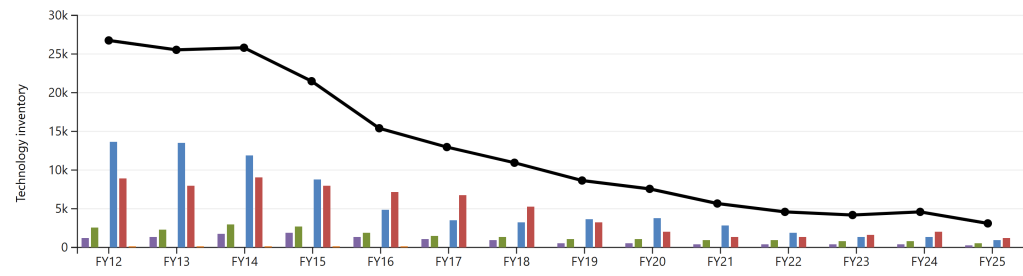
1 month agoThe Expanding Patent Document: Fewer Claims, More Words, and a Trend That Predates Alice
Patent specifications have nearly doubled in length over twenty years to over 13,000 words, but claim counts have declined since 2005, contradicting expectations that Alice Corp. v. CLS Bank would cause a structural break in 2014-2015.
#uspto-allowance-rates
Intellectual property law
fromPatently-O
1 month agoThe Third Way: Examiner Action Dates and the Allowance Rate Curve
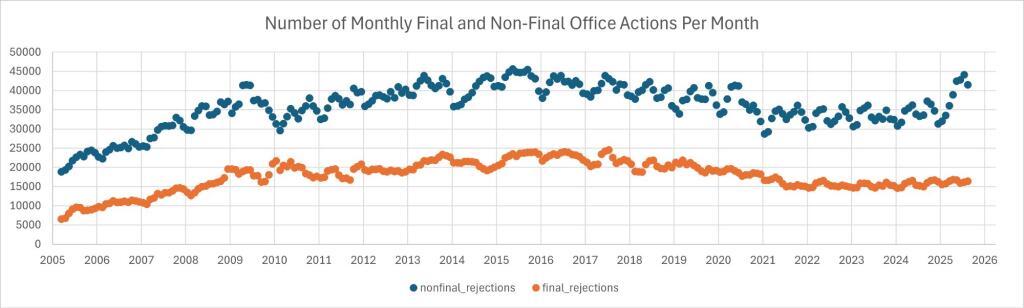
Examining USPTO allowance rates by anchoring outcomes to examiner mail dates provides the most direct measure of examination policy by capturing the moment examiners make final decisions.
Intellectual property law
fromPatently-O
1 month agoThe Third Way: Examiner Action Dates and the Allowance Rate Curve
Examining USPTO allowance rates by anchoring outcomes to examiner mail dates provides the most direct measure of examination policy by capturing the moment examiners make final decisions.
Intellectual property law
fromIPWatchdog.com | Patents & Intellectual Property Law
12 years agoPatent Claim Drafting 101: The Basics
Self-drafted patent applications typically result in narrower rights and prosecution complications, making professional attorney assistance strongly advisable despite higher costs.
#patent-reform

Intellectual property law
fromIPWatchdog.com | Patents & Intellectual Property Law
1 month agoOpinion: Keep Going Squires USPTO: Inventors Want a Streamlined Claim Set Pilot Program 2.0
The USPTO's Streamlined Claim Set Pilot Program addresses inventor constraints by enabling reduced claim sets with prioritized examination, offering a pathway toward patent system reform that allows inventors to partially opt out of the one-size-fits-all utility patent model.
Intellectual property law
fromIPWatchdog.com | Patents & Intellectual Property Law
1 month agoDOJ and USPTO File Statement Backing Injunctions for NPEs
The USPTO and DOJ argue that restricting injunctive relief for patent owners, including non-practicing entities, undermines innovation incentives and should not be categorically denied.
Intellectual property law
fromPatently-O
1 month agoExtolling the Virtues: 'Space-Efficient' Preamble Fails to Limit
The Federal Circuit reversed an indefiniteness ruling while affirming dismissal of breach-of-contract claims in NimbeLink Corp. v. Digi International Inc., with the patent issue centering on whether claim preambles impose substantive limitations.
fromIPWatchdog.com | Patents & Intellectual Property Law
1 month agoOpinion: The ITC Has Lost Sight of the Public Interest
The U.S. International Trade Commission (ITC)-an agency with the extraordinary power to block imports and, in turn, influence the direction of American technology policy-has drifted out of that balance. To align with the Trump Administration's intellectual property priorities and pro-investment agenda, the ITC is in urgent need of reform.
Intellectual property law
Intellectual property law
fromPatently-O
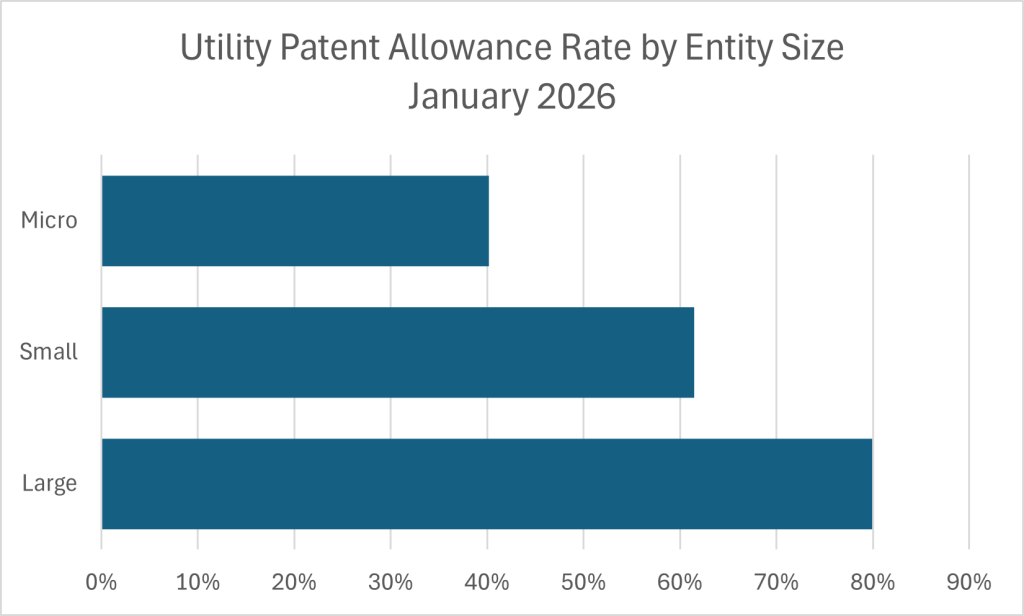
1 month agoThe Real-Time View: USPTO Allowance Rate "Dips" to 75%
The disposal allowance rate, measuring patents issued among applications resolved in a given month, provides a real-time indicator of USPTO examination practices, complementing the backward-looking filing-date cohort approach.
Intellectual property law
fromPatently-O
1 month agoPatent Examiner Pays $500K for Financial Conflicts - But the Real Story may be Systemic
A USPTO patent examiner settled allegations of examining patent applications from companies where she held substantial undisclosed stock positions, paying $500,000 in penalties for ethics violations.
Intellectual property law
fromIPWatchdog.com | Patents & Intellectual Property Law
7 years agoProtecting an Idea: Can Ideas Be Patented or Protected?
Ideas cannot be patented or copyrighted; only concrete inventions and expressions receive intellectual property protection, so ideas require tangible manifestation or contractual secrecy.
Intellectual property law
fromGlobal IP & Technology Law Blog
1 month agoSweeping Claims, Sliding Stones: Mastering AI Patent Prosecution with a Curling Twist
Successfully prosecuting AI patents before the USPTO requires foresight, adaptability, strategic claim drafting, teamwork, and anticipation of evolving legal guidance.
Intellectual property law
fromIPWatchdog.com | Patents & Intellectual Property Law
1 year agoWhy Companies Should Still Build a Patent Portfolio
Building and maintaining a strong patent portfolio remains valuable despite litigation pressures such as IPRs, Section 101 attacks, apportionment limits on damages, and eBay injunctions.
fromAbove the Law
2 months agoFrom Cost Center To Value Engine: Patent Management In The AI Era - Above the Law
In a recent Tradespace and Above the Law survey, two-thirds of companies that draft patents in-house described IP as a value driver, while 71 percent of companies that outsource drafting viewed IP as a cost. When drafting and prosecution move inside, IP teams work closer to engineers and product leaders. This proximity improves invention quality, strengthens claim strategy, and aligns patent decisions with product direction, market timing, and business priorities.
Intellectual property law
Intellectual property law
fromIPWatchdog.com | Patents & Intellectual Property Law
2 months agoStrengthening IP Enables Human Creativity and Economic Mobility | IPWatchdog Unleashed
Megan Carpenter rebuilt UNH Franklin Pierce School of Law's IP identity, reversing enrollment decline and restoring alumni engagement through focused strategy, credibility, and execution.
Intellectual property law
fromIPWatchdog.com | Patents & Intellectual Property Law
1 month agoReexamination vs. IPR: Which is Better for Patent Owners?
Patent owners must choose between PTAB IPR and USPTO ex parte reexamination amid shifting policies, differing procedures, costs, and strategic trade-offs.
fromIPWatchdog.com | Patents & Intellectual Property Law
2 years agoSince 2020, Patent Errors Have Decreased by 11.24%
In an ideal world, issued patents would not contain errors. In reality, patent drafting is tedious and time-consuming work and perfection is not an attainable goal. The patent industry seems to be steadily getting better, though. In a recent study, we uncovered an 11.24% decrease in errors per patent over the past four years. We observed this decrease by reviewing every patent issued by the U.S. Patent and Trademark Office (USPTO) since 2020 - nearly 1.4 million patents.
Intellectual property law
Intellectual property law
fromIPWatchdog.com | Patents & Intellectual Property Law
2 months agoPatent Portfolio Economics: Balancing Quality, Cost and Market Coverage
Patent portfolios must be strategically managed to balance quality, lifecycle cost, and market coverage to deliver business value rather than becoming liabilities.
fromIPWatchdog.com | Patents & Intellectual Property Law
2 months agoUSPTO De-Designates Two PTAB Decisions on RPIs in Light of Corning Optical
The Office de-designated Proppant Express Invests., LLC v. Oren Techs., LLC, IPR2017-01917, Paper 86 (PTAB Feb. 13, 2019); and Adello Biologics LLC v. Amgen Inc., PGR2019-00001, Paper 11 (PTAB Feb. 14, 2019). According to a USPTO email sent Tuesday, both decisions conflict with the decision in Corning Optical Communications RF, LLC v. PPC Broadband Inc., IPR2014-00440, Paper 68 (PTAB Aug. 18, 2015) (precedential).
Intellectual property law
fromIntellectual Property Law Blog
2 months agoPTAB Overly Relied on Statements of Doubt in Determining Conception and Reduction to Practice in Interference Proceedings
Regents of the University of California ("Regents") and Broad Institute were engaged in a patent interference proceeding involving the adaptation of CRISPR systems to edit eukaryotic DNA. Both parties were engaged in extensive testing related to editing eukaryotic DNA during the time of the invention, and both filed multiple patent applications that became the subjects of the patent interference proceedings.
Intellectual property law
fromElectronic Frontier Foundation
2 months agoCopyright Should Not Enable Monopoly
There's a crisis of creativity in mainstream American culture. We have fewer and fewer studios and record labels fewer and fewer platforms online that serve independent artists and creators. At its core, copyright is a monopoly right on creative output and expression. It's intended to allow people who make things to make a living through those things, to incentivize creativity. To square the circle that is "exclusive control over expression" and "free speech," we have fair use.
Intellectual property law
fromIPWatchdog.com | Patents & Intellectual Property Law
1 month agoHarrity & Harrity is Seeking a Patent Attorney / Patent Agent - Electrical & Mechanical Innovations
Harrity & Harrity is looking for experienced patent attorneys and agents who want a smarter way to practice law. Our practice is built around streamlined workflows, custom AI and automation tools, and a data-driven approach that keeps the focus where it belongs: on quality, strategy, and client service-not busywork or billable-hour math. You'll work on high-value patent portfolios for top-tier technology companies while enjoying true flexibility, strong support, and meaningful autonomy.
Intellectual property law
fromIPWatchdog.com | Patents & Intellectual Property Law
1 month agoCopyright Office Report: Copyright Claims Board a Success, But Statutory Changes Needed for Efficiency
The Copyright Claims Board estimated that 'as much as three-quarters of its time is spent on the initial review of claims and amended claims and writing noncompliance orders explaining claim deficiencies,' according to the report. The U.S. Copyright Office on Friday released its report pursuant to the Copyright Alternative in Small-Claims Enforcement (CASE) Act, finding that the Copyright Claims Board (CCB) is largely successful but that there is 'room for improvement in various respects.'
Intellectual property law
fromIPWatchdog.com | Patents & Intellectual Property Law
2 months agoInside the PTAB Reset: Practical Fixes for a Reengineered PTAB | IPWatchdog Unleashed
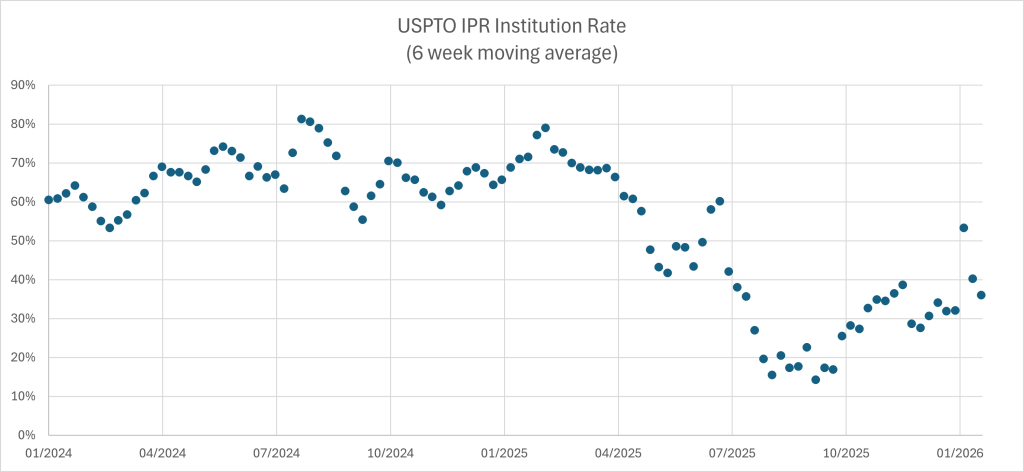
Johnson and I discuss obviousness determinations built on excessive combinations of prior art, warning that such analyses blur the line between legitimate hindsight reconstruction and genuine innovation assessment. We also highlight a systemic blind spot: nuisance "ankle-biter" assertions that exploit litigation economics while largely evading PTAB scrutiny. These cases have driven much of the political backlash against patents while remaining functionally untouched by the post-grant review process.
Intellectual property law
[ Load more ]