#warhols-muses
#warhols-muses
[ follow ]
#art-history #contemporary-art #photography #art #jeff-koons #andy-warhol #chelsea-hotel #jeffrey-epstein




fromAll That's Interesting
3 weeks agoThe Heartbreaking Story Of Evelyn McHale, The Woman Whose Death Became A Famous Photo
Evelyn McHale wrote in her suicide note that she didn't want her family to see 'any part' of her body. Instead, a photo of her death would become one of the most famous photographs of all time.
Photography


fromHi-Fructose Magazine - The New Contemporary Art Magazine
4 weeks agoUncanny Valley: The Oil Paintings of the Late Eyvind Earle Still Have A Resounding Influence on Artists & Viewers Today - Hi-Fructose Magazine
To call the oil paintings of Eyvind Earle "landscapes" is accurate but very sorely wanting. For more than seventy years, Earle turned his unique refracting eye on what he called the "stupendous infinity of nature," interpreting what he saw through a long lens shaped by a very particular kind of mythopoeia.
Miscellaneous
Writing
fromwww.theguardian.com
1 month agoLove Magic Power Danger Bliss by Paul Morley review reappraising Yoko Ono
Yoko Ono was a pioneering avant-garde artist in 1960s downtown New York, creating experimental music and conceptual art before meeting John Lennon, challenging conventional definitions of artistic merit.
fromHyperallergic
1 week agoThe Art World Is a Joke
Kamrooz Aram is everywhere this year, from Mumbai Art Week to the Whitney Biennial, and critic Aruna D'Souza is grateful. She pens a beautiful meditation on his work, reading his abstract paintings as not simply a denunciation of Western modernism nor a reassertion of Islamic visual motifs, but something else entirely - something gestural, exuberant, riotous, and incomparably his own.
Arts
Television
fromenglish.elpais.com
1 month agoIt's a trompe-l'il, it can't even turn you on': Have on-screen bodies become too unrealistic?
Despite increased sexual content in film and television, critics argue these portrayals lack genuine eroticism due to idealized bodies and choreographed encounters, potentially causing audience fatigue.
Fashion & style
fromBustle
4 weeks agoGray Eyeshadow Is The '90s Makeup Trend That Dominated Fashion Month
Gray eyeshadow emerged as fashion month's dominant beauty trend, ranging from metallic slate to matte pewter, drawing inspiration from late '90s and early 2000s aesthetics rather than 2016's gray trend.
fromArtnet News
1 week agoLillian Bassman Pushed Fashion Photography to the Edge of Abstraction
Bassman's photographs, in fact, looked more like illustrations. She achieved this effect through darkroom experimentation and manipulation: donning a cardboard mask with a pinhole aperture, she selectively exposed portions of the paper to light, tracing the contours of the garments until they seemed to dissolve into atmosphere.
Arts
fromIntelligencer
2 months agoMovie Review: Does Melania Dream of AI-Generated Sheep?
The primary question in all matters concerning Melania Trump is " What is she thinking?" The First Lady is an endless font of utterly puzzling behavior. So it's fitting that at the premiere of her film on Thursday night she stood before the audience and declared, basically, "Ceci n'est pas une documentary." "Some have called this a documentary. It is not," she said.
US politics
Books
fromThe Art Newspaper - International art news and events
2 months ago'The good, the bad and the ugly': a short history of how artists depict the female body
Public visual culture simultaneously overexposes and marginalizes the female body: abundant naked female imagery on buildings contrasts with few monuments honoring named women.
Arts
fromwww.theguardian.com
3 weeks agoAbsolutely transformative': Willem de Kooning exhibition uncovers raw intensity of early work
Willem de Kooning's 1948 solo exhibition at Charles Egan Gallery launched his international career, establishing him as a pre-eminent painter by the 1950s through his innovative exploration of figuration and abstraction.
Photography
fromOregon ArtsWatch * Arts & Culture News
1 month agoAn absence of flattery: Diane Arbus at JSMA * Oregon ArtsWatch
Diane Arbus's portraiture exposed subjects' vulnerabilities and identity fault-lines, producing unflattering yet compelling images showcased in a Eugene exhibition of vintage prints.
fromArtforum
2 months agoCommercial Break
AT FIRST GLANCE, the phrase "avant-garde advertising" might seem like a contradiction in terms: The avant-garde is assumed to be inherently anti-capitalist and the realm of advertising crassly commercial. But the involvement of avant-garde artists with advertising is in fact rich, complex, and long-standing, encompassing a full century of collaborations, critiques, and reworkings of all sorts. That entanglement-in all its diversity-is the topic
Film
Arts
fromdesignboom | architecture & design magazine
1 month agowhitney biennial asks: what does 'american art' mean in 2026?
The Whitney Biennial 2026 examines what constitutes American art by featuring artists whose practices connect Indigenous histories, land, migration, institutions, and cultural memory across diverse territories and communities.
Arts
fromThe Art Newspaper - International art news and events
1 month agoIs it finally time for the Guerrilla Girls to remove their masks?
The Guerrilla Girls maintained anonymity for 40 years to protect members from professional retaliation and to emphasize systemic art world discrimination over individual grievances.


fromHyperallergic
2 months agoA View From the Easel
I work outside, carving and shaping the stone. Outside my house, I have a table, an extension cord, and tools. It's very cold and I have to wear all my winter clothes. When it's too cold, I do the filing and finishing work inside after I shape it outside. I listen to all kinds of music. I listen to Eminem all the time; his albums are all my favorites. For drawings, I work at Kinngait Studios or at home on my kitchen table.
Arts
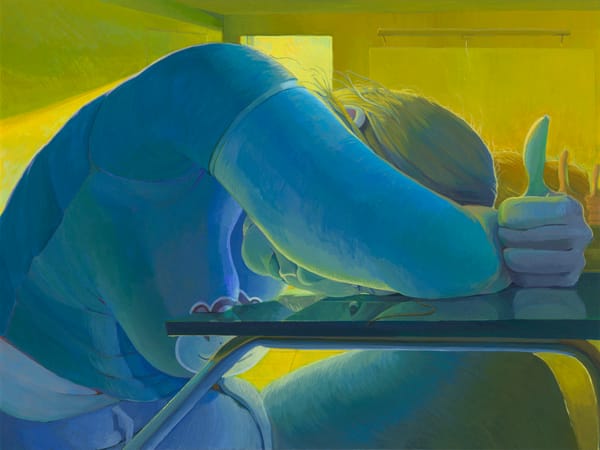
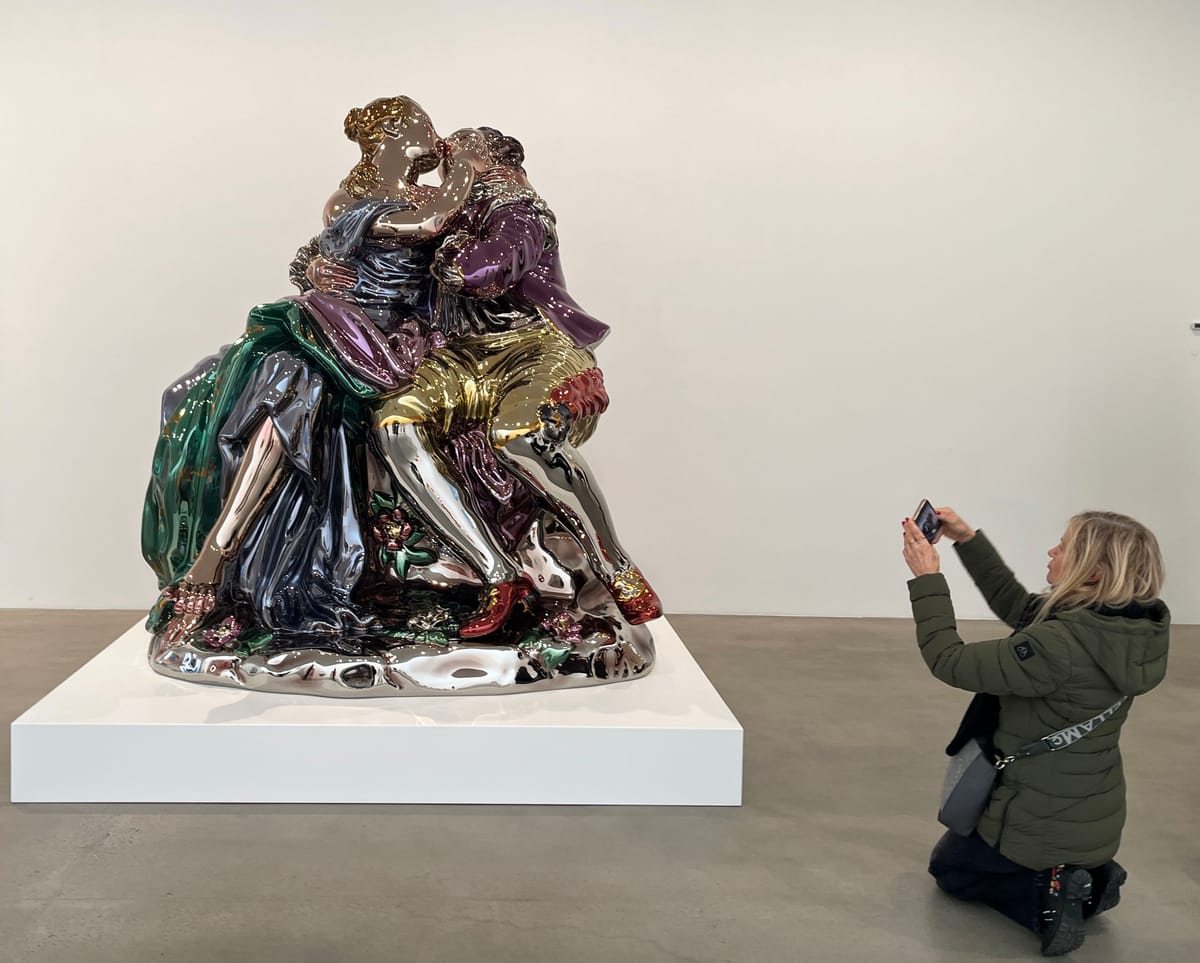
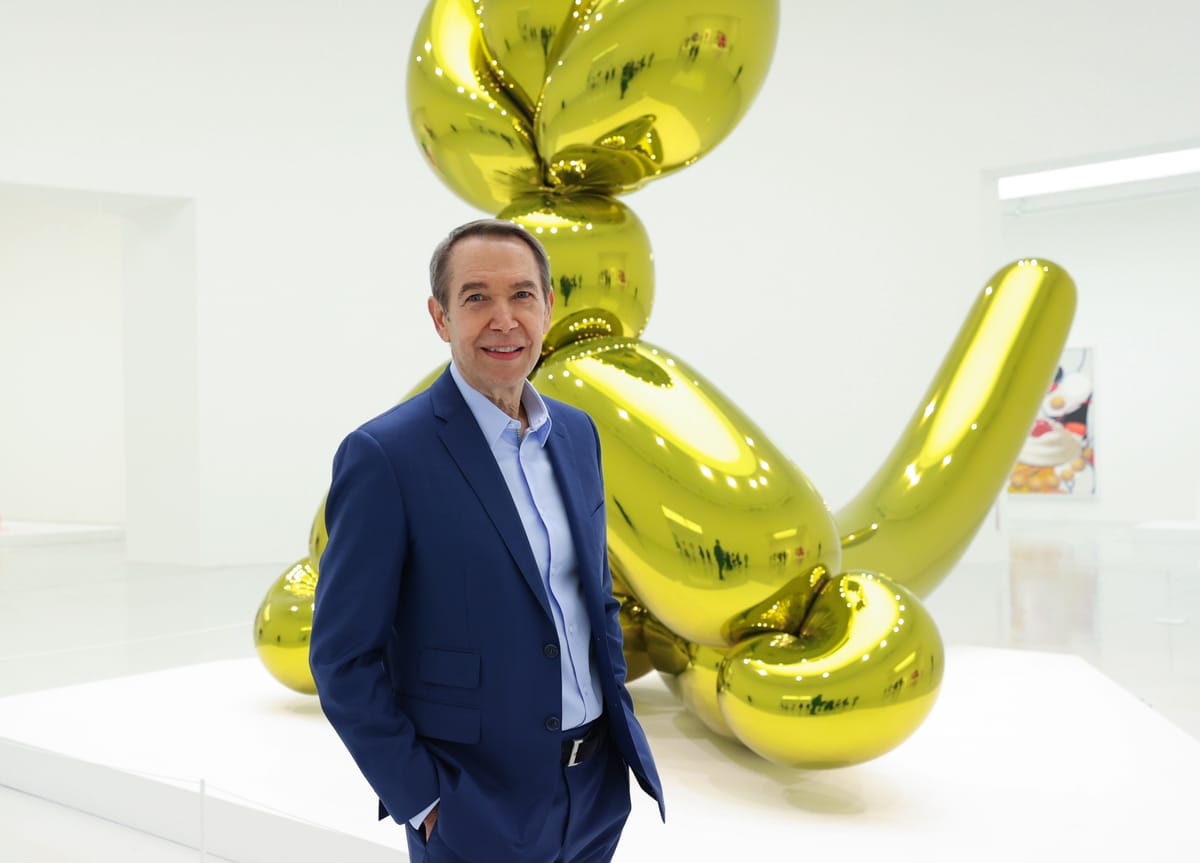
fromHyperallergic
2 months agoJeff Koons's Trumpian Reflections
"As I stood and looked at it on a drizzly gray day," John Yau writes of looking at a radiant painting by Edward Zutrau, "I forgot that it was raining." That's what art can do - stop you in your tracks, make you forget absolutely everything save for that essential encounter between you and the work.
Arts
fromHyperallergic
2 months agoThe Art World After Epstein
We knew everything we needed to know about the art world before the Epstein Files dropped. Before heinous allegations against Museum of Modern Art trustee Leon Black emerged, or School of Visual Arts chair David A. Ross's sympathetic endorsement of Epstein came out, we knew about the intimate connections between institutional heads and donors and trustees. The exchanges of money, donations, or favors that bind them.
Arts

fromHyperallergic
2 months agoThe Unruly Politics of Glitter
Presented with improbable dignity in a golden box is a hanging ornament in the shape of the Trevi Fountain that comes with a "complimentary papal blessing." Its roughly shaped details would be dull if the whole thing weren't drowned in glitter. Under the shop lights, this perfect miniature of late Baroque architecture explodes in shine: a beacon promising a brighter future and a better life.
Arts
fromHyperallergic
2 months agoDavid Wojnarowicz in the Age of Surveillance
Happy New Year! Our first book reviews of 2026 are here, beginning with critic Bridget Quinn. There's a special place in hell for Pablo Picasso, but you probably already knew that. Because the conversation tends to stop there, what you may not have known are the names of some of the women whose artistic legacies have long been overshadowed by his: Fernande Olivier, Olga Khokhlova, Marie-Thérèse Walter, Dora Maar, Françoise Gilot, and Jacqueline Roque.
Arts
fromwww.theguardian.com
2 months agoHer time has come': did Mondrian owe his success to a crossdressing lesbian artist who lived in a Cornish cove?
Why the volte-face? Because it is now widely recognised in the art world that it was as much Moss who influenced Mondrian as the other way round, at least when it came to the double or parallel lines he started using in the 1930s to add tension to his harmonious abstract paintings, one of which hammered last May for $48m.
Arts
fromThe Art Newspaper - International art news and events
2 months agoNaomi Campbell reflects on Picasso's muses for exhibition in Swiss Alps
Naomi Campbell will offer a supermodel's perspective on the intimate relationship between artist and muse in an essay for an upcoming exhibition of Pablo Picasso paintings being staged by Nahmad Contemporary in Switzerland. The New York-headquartered gallery was founded in 2013 by Joseph Nahmad, a scion of the billionaire art-dealing family. Nahmad's father, David Nahmad, is believed to have the largest private collection of works by Picasso.
Arts
fromHyperallergic
2 months agoA View From the Easel
Mornings are best for concentrated work. In the winter, I turn on the heat at 8am and get started around 10am. Summer, I start around 9am. I have two areas in the studio for projects. The large, heavy wood sculptures are carved in the front section of the studio, closest to the roll-up wide door. Smaller sculptures are placed on a hydraulic workbench. Before I start, I focus, connect with the Source, and ask for guidance.
Arts
[ Load more ]