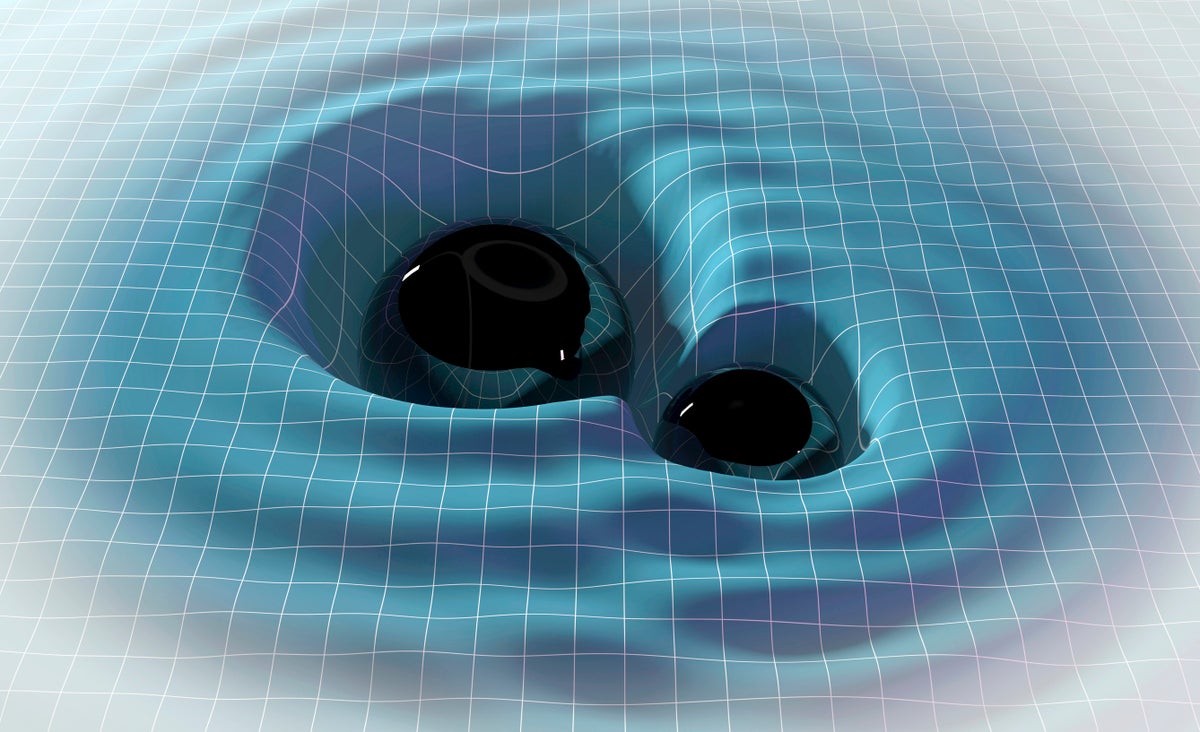
"When black holes collide, the crash generates ripples in the fabric of spacetime—gravitational waves. These distortions travel far out into the universe, but by the time they reach Earth, they have become faint, making them extremely hard to detect. Thanks to a global network of observatories—called the Laser Interferometer Gravitational-Wave Observatory (LIGO), Virgo and the Kamioka Gravitational-Wave Detector (KAGRA)—scientists have found scores of these tiny wobbles in spacetime."
"The new catalog also reveals a greater variety of known black holes, including some that appear lopsided, and others that spin incredibly fast. Together, the observations are phenomenal, says Zsuzsanna Marka, an associate research scientist at Columbia University, who was previously involved in the LIGO-Virgo-KAGRA collaboration."
"The expanded set of detections enables astronomers to test Albert Einstein's general theory of relativity, which holds that gravity is a geometric property of spacetime. Doing so can help answer one the holy grails of the field."
Gravitational waves are ripples in spacetime generated by colliding black holes and neutron stars. These distortions travel across the universe but become extremely faint by the time they reach Earth. The LIGO, Virgo, and KAGRA observatory network has detected numerous gravitational waves, and recently released an expanded dataset more than doubling previous detections. The new catalog reveals collisions between black hole pairs, black holes with neutron stars, and neutron star pairs. Observations show greater diversity in black hole properties, including asymmetrical shapes and rapid spins. These detections enable testing of Einstein's general theory of relativity and advance understanding of cosmic phenomena.
Read at www.scientificamerican.com
Unable to calculate read time
Collection
[
|
...
]