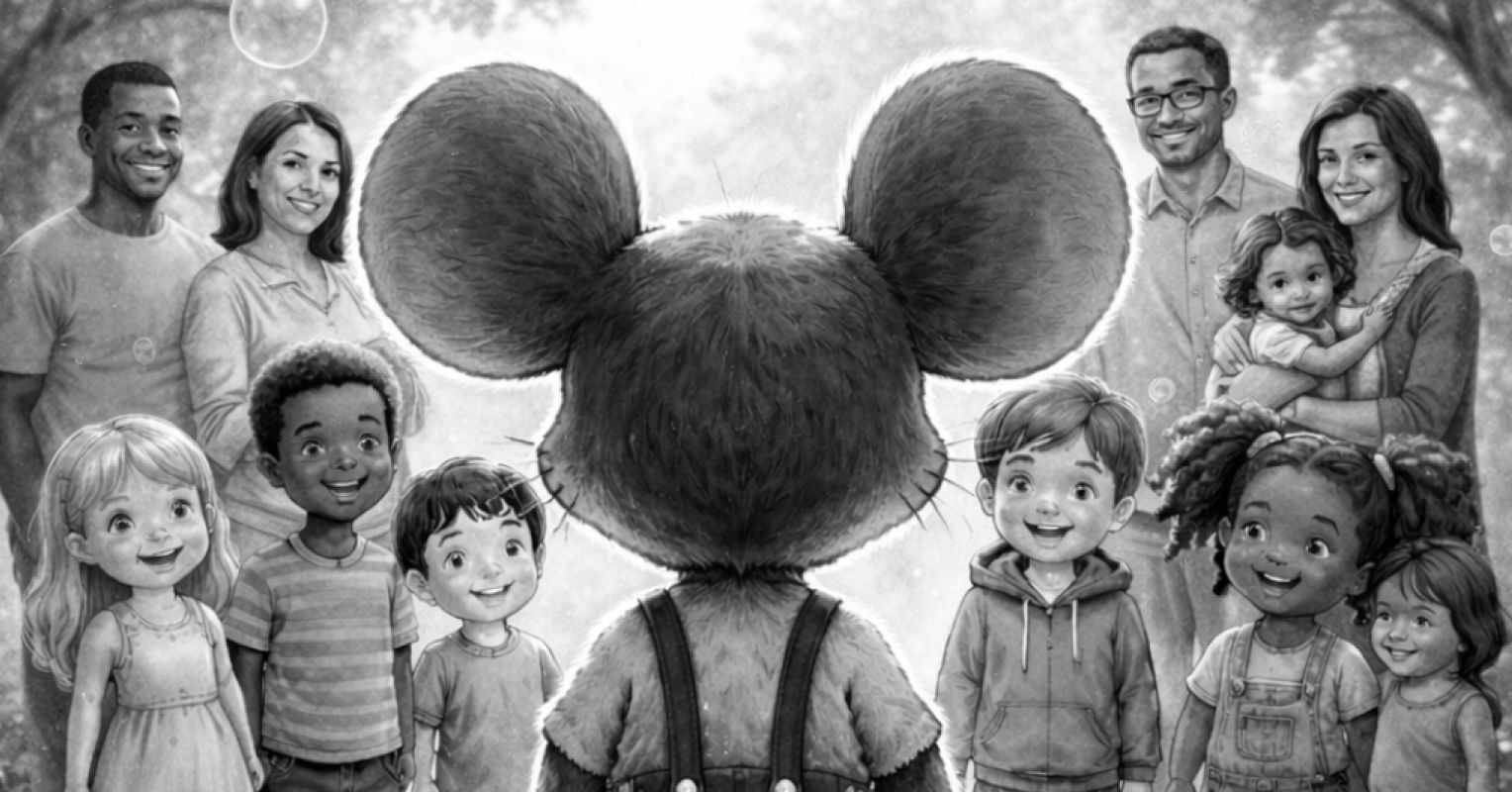
"Mickey Mouse is more than a simple animated character. He represents a particular emotion that most people experience before they have a chance to process what they've seen. From Mickey Mouse's two black dots for his ears, his round-shaped head, his big doe-like eyes, and his expressionless smile, it is clear that one can understand Mickey Mouse without being told anything about him."
"The design of Mickey Mouse conveys specific universal characteristics that allow easy recognition from the least desirable location within a noisy movie theater (typically, the back row). In part, that recognizability has been achieved through careful choices about how to represent Mickey Mouse. The geometric shape of Mickey's face (rounded) and large eyes are indicative of the infant stage of development, which makes him appear forgiving and approachable, as well as signaling his harmlessness."
"From an evolutionary standpoint, human beings developed the capacity to recognize an infant's ability to communicate and defend themselves. The use of large eyes and a small nose is a universal feature shared across cultures. It elicits feelings of warmth and parental care towards the baby from the adult. Therefore, when we react positively to Mickey Mouse, we are activating a robust biological response."
"There is also scientific evidence to support these arguments. Numerous studies have shown that humans respond positively towards baby-like characteristics (such as baby schema features) even when these features appear in drawings rather than real human faces (Glocker et al., 2009). Mickey Mouse looks friendly to humans not only because of the way that he looks, but because Mickey activates a profound and direct biological response within humans"
Mickey Mouse's rounded face, large eyes, and simplified features embody infantile cues that trigger innate caregiving responses and immediate recognizability. Those baby-like characteristics elicit warmth and perceptions of harmlessness, enhancing approachability. From an evolutionary perspective, humans developed sensitivity to infant cues to support communication and protection. Empirical studies show positive responses to baby schema even in drawings (Glocker et al., 2009), indicating a biological basis for Mickey's appeal. Make-believe and nostalgia provide emotional resilience across the lifespan by sustaining imagination and human connection during stress. Imaginative engagement helps adults retain empathy and emotional flexibility.
Read at Psychology Today
Unable to calculate read time
Collection
[
|
...
]