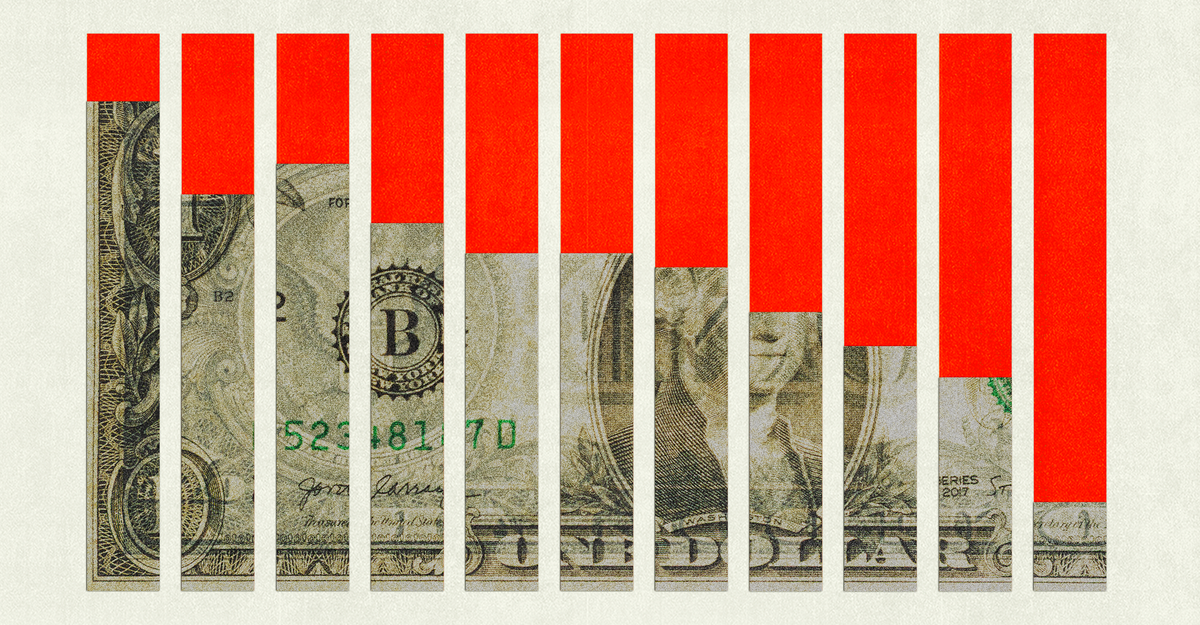
The U.S. dollar has been weakening and the president has welcomed the decline. A weaker dollar can make U.S. goods cheaper abroad, boosting exports and supporting parts of the economy. The dollar index's 1.3 percent plunge meant a 1.3 percent loss relative to a basket of competing currencies, which makes some imports more expensive without directly reducing domestic purchasing power at grocery stores. Costlier imports partially offset affordability goals. The president has promoted a weak-dollar approach for decades, citing foreign competitors like China and Japan, even as unpredictable foreign-policy and trade decisions risk damaging America's economic standing overseas.
"When Trump talks about the relative strength or weakness of the dollar, he's talking about its value in foreign-exchange markets. When the dollar index plunged 1.3 percent last Tuesday, that meant the dollar lost 1.3 percent of its value relative to a group of competing currencies, making some foreign goods a little more expensive to import. It did not mean that your dollar was immediately worth 1.3 percent less at the grocery store (although costlier imports do somewhat counteract the president's affordability agenda)."
"Trump understands that a weak dollar doesn't sound good. In his first term, he tweeted, "As your President, one would think that I would be thrilled with our very strong dollar. I am not!" His logic is that the relatively weak currencies of America's foreign competitors, such as China and Japan, can make their goods cheaper in international markets, and that the United States would do well to replicate their strategy."
Read at The Atlantic
Unable to calculate read time
Collection
[
|
...
]