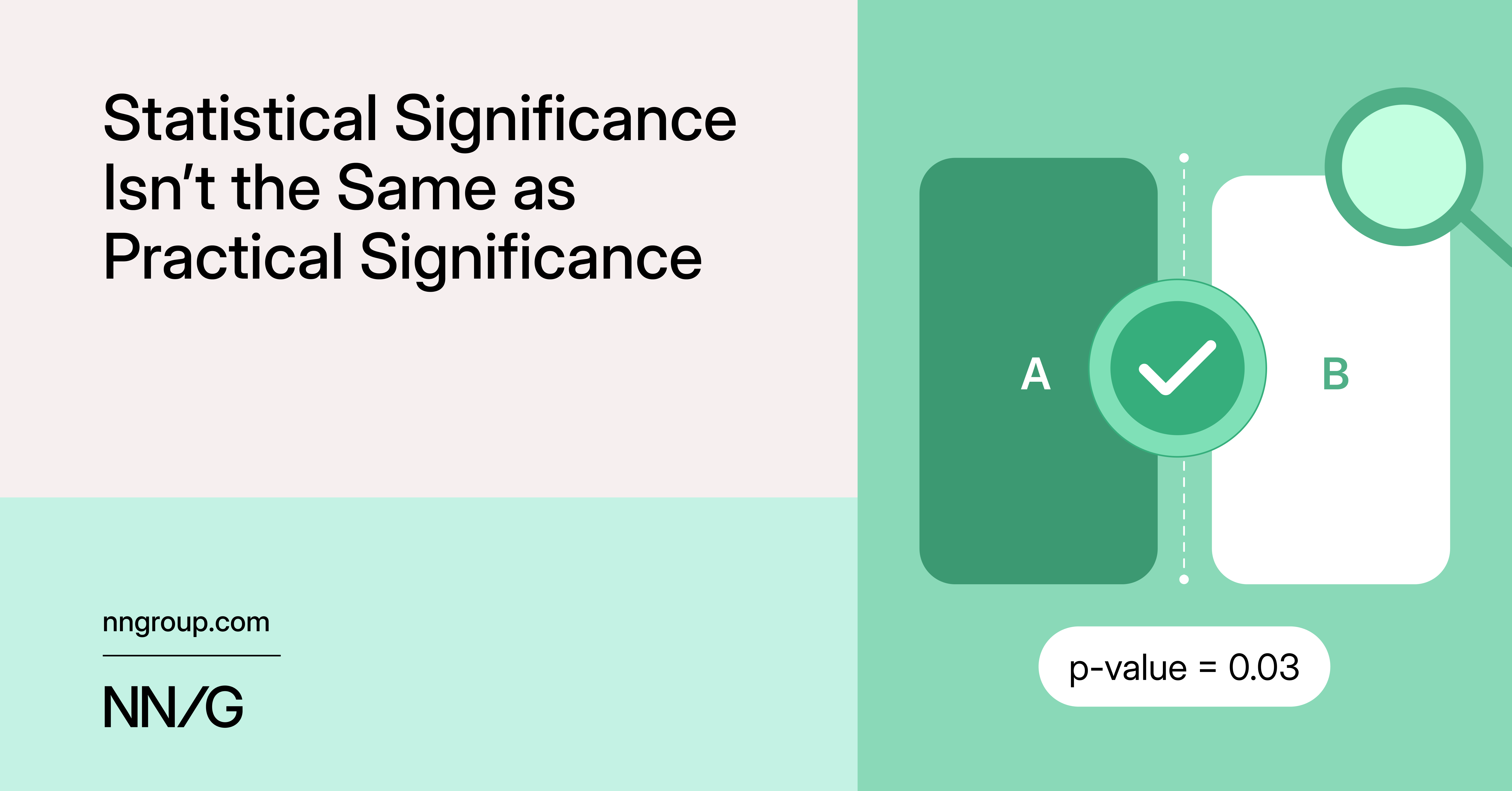
"Statistical significance means that a result is unlikely to have occurred by chance. More specifically, the probability of that result being due to chance (also known as the p-value) is less than a preset threshold (usually 0.05). When you run a statistical-significance test - say, comparing conversion rates between two webpages - you're testing whether the difference you see could have appeared randomly."
"That's all statistical significance means. It says nothing about how large, valuable, or noticeable the effect is to users or the business. Statistical significance is just the start. Learn to calculate, interpret, and report the full picture from your quantitative studies - with hands-on practice in a UX context."
Statistical significance measures whether a result is unlikely to occur by chance, determined by a p-value threshold typically set at 0.05. When a p-value falls below this threshold, the result is considered statistically significant, meaning similar results would reliably appear if the experiment were repeated under similar conditions. However, statistical significance does not indicate the magnitude, value, or practical importance of an effect to users, product teams, or business outcomes. A statistically significant result may represent only a negligible difference that has no meaningful impact in practice. UX researchers must distinguish between statistical significance and practical significance to accurately interpret quantitative study results and make informed decisions about product changes.
Read at Nielsen Norman Group
Unable to calculate read time
Collection
[
|
...
]