Growth hacking
fromEntrepreneur
10 hours ago3 Ways Thought Leaders Can Create Immediate Value For Their Audiences
Real influence requires a unique perspective; audiences seek actionable insights from credible thought leaders.
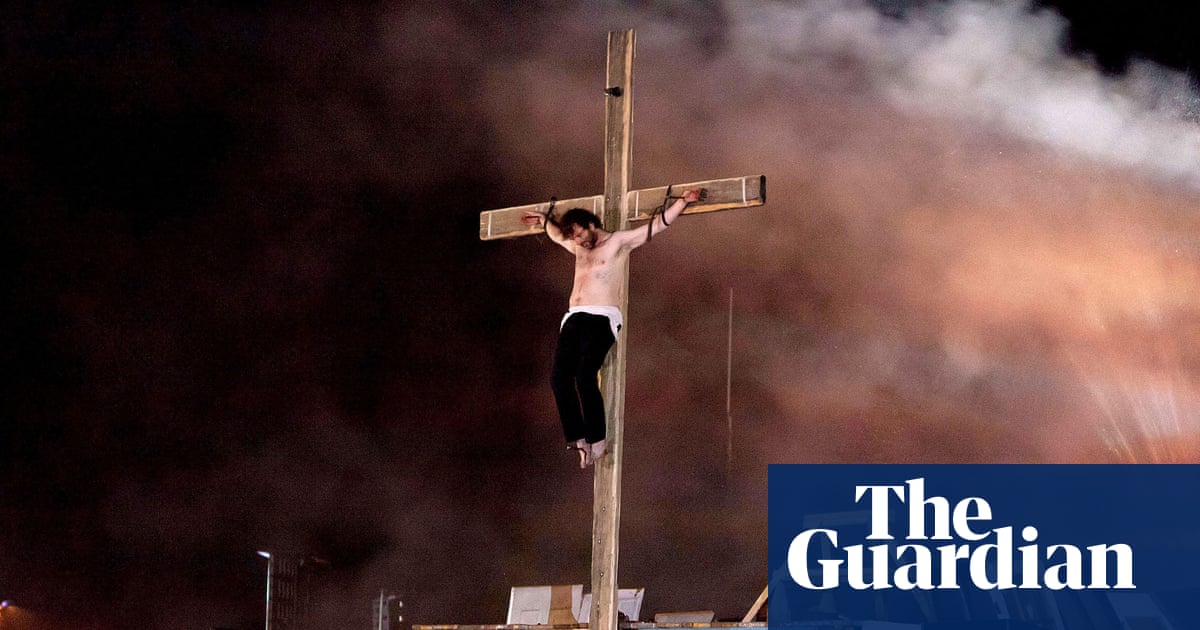
Paula White stated, 'No one has paid the price like you have paid the price.' She emphasized that Trump faced betrayal and false accusations, similar to Jesus, and that his journey reflects a divine plan.
Devon Hase states, 'People are trying desperately to fix, optimize, or escape their way out of relationship difficulty - and suffering more for the effort. Social media has made this worse! We're surrounded by images of perfect partnerships while quietly drowning in our own ordinary struggles.' This highlights the pressure couples feel in the age of social media.
The purpose of everyday practices in ancient contexts is not easy to discern because contemporary, local folk have no need to talk about why they are doing what they are doing. This is perhaps especially true when it comes to attire related to decency.
Behind the closed doors of a therapy practice, science and spiritual traditions are not adversaries. In fact, knowing how to ensure that your belief system is compatible with counseling can transform your experience and strengthen your bond.
Psychology researcher and professor Lisa Miller in her book The Spiritual Child explains that spirituality often increases in adolescence. The teenage brain has a larger gap between experiencing and interpreting than in adulthood. As a result, adolescents' feelings are strong, dramatic and oscillate more wildly than the playground swing you so recently used to push them on.
The pace at which we're all working today doesn't naturally lend itself to being reflective. As a leader, you don't get enough quiet time. The thought leaders and business leaders I work with figure out how to make it part of their routine. For some, it's during a commute, a workout, a shower, or a walk. For others, it's a more involved practice where they shut down their devices and spend scheduled time reflecting.
We're also spending less time with friends. For years, Americans averaged about 6.5 hours a week with friends. Between 2014 and 2019, that number plunged by 37%, to just 4 hours. The year 2014 coincides with a rise in smartphone users.
Part of the answer lies in the visceral nature of the game. Unlike chess, football is physical to the point of absurdity. Grown adults in body armor crash into each other over what is essentially a leather egg. There's drama in every play. You don't need a PhD in physics to appreciate a one-handed catch while somersaulting over a defender like a caffeinated acrobat.
In the early 20th century, sociologist Max Weber noted that sweeping industrialization would transform how societies worked. As small, informal operations gave way to large, complex organizations with clearly defined roles and responsibilities, leaders would need to rely less on tradition and charisma, and more on organization and rationality. He also foresaw that jobs would need to be broken down into specialized tasks and governed by a system of hierarchy,
We are living through one of the most disorienting periods in recorded history. The AI race is accelerating toward ever faster, ever more sophisticated automation and optimization. Agentic AI systems are moving from research labs into workplaces, healthcare, and governance. Geopolitical tensions are restructuring alliances faster than institutions can adapt. And planetary systems are signaling, with increasing urgency, that our current trajectory is unsustainable. Amid all this, it is dangerously easy to lose sight of a foundational question: What are we actually optimizing for?
I'll never forget the moment that changed how I think about leadership. It happened during my tenure as president of the University of Nevada, Las Vegas, when I learned that one of our longtime supporters, a commercial real estate developer named Irwin, was nearing the end of his life and despairing that his contributions no longer mattered. We brought him to campus to show him otherwise.
Colleges and universities hold huge influence in their communities. They can mediate differences and foster healthy debate. Indeed, several institutions have established schools of civic life that would, presumably, raise the alarm when constitutional rights are being violated. Academic research influences policy and informs public conversations. Scholars can put this violence into context and help remind us that this is not OK.
Catch up quick: President Trump created the White House Faith Office by executive order on Feb. 7, 2025, placing it within the Domestic Policy Council and moving it into the White House complex. The move was designed to signal a "direct line" between people of faith and the executive branch. Unlike the versions under prior administrations, which were often situated in agencies or outside the immediate West Wing orbit, this office is central to Trump's "religious freedom" agenda.
What's striking is less that the federal government is using Bible verses in its promotional videos than that the agency doing the recruiting is Immigration and Customs Enforcement. The videos, set to music, include militaristic images. They show heavily armed agents in tactical gear, weapons drawn, donning masks, looking through night-vision goggles, zip-lining from helicopters, breaking down doors, and conducting nighttime raids.
In the aftermath of Alex Pretti's killing in Minneapolis, my Instagram algorithm served up a never-ending carousel of sizzling rage. Most of that rage was directed toward the country's immigration-enforcement agencies, while some, of course, was aimed at defending them. But I wasn't expecting the post from Blake Guichet. "There's a difference between compassion that is grounded and compassion that is hijacked," Guichet, a pro-Trump Christian influencer who posts on Instagram under the handle "thegirlnamedblake," had typed on butter-yellow slides.
I have been in a prayer group for a few years now. I enjoy praying and discussing all the ins and outs of the Bible. However, even though spiritually it's enriching, the people are a bit 'meh' - they are a bit of a letdown.