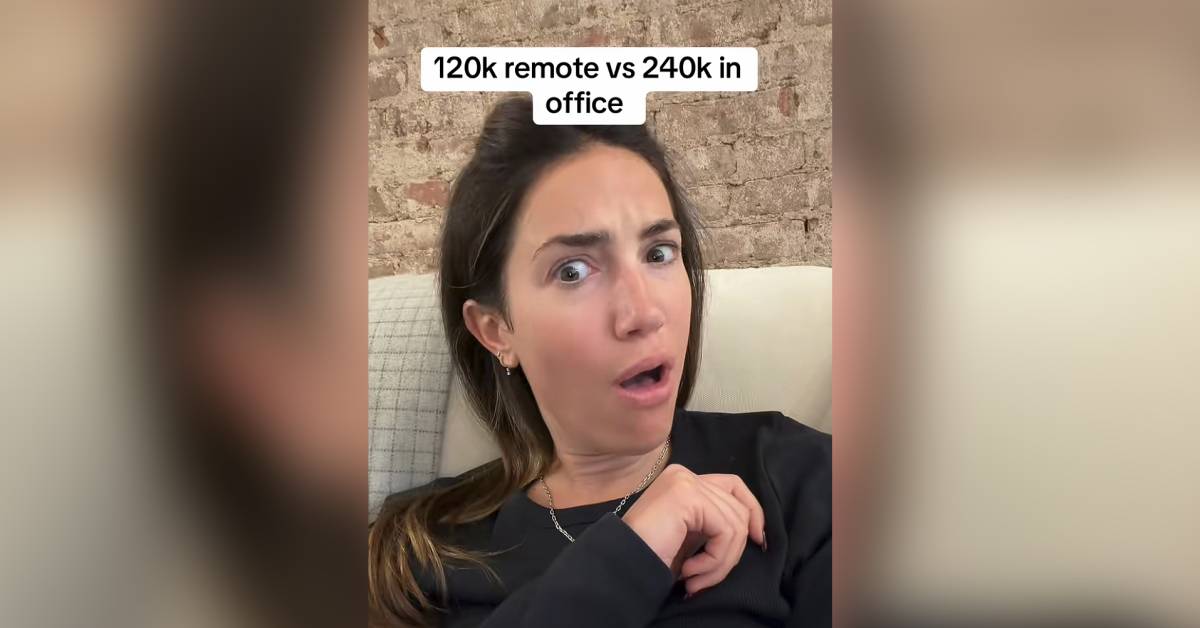
"The question being asked is whether it's better to accept a fully remote job with a $120,000 salary or earn twice as much working in a traditional office setting. Opinions are divided, with some users touting the mental health benefits of remote work, while others say the job with the higher salary is the obvious choice. Shifting priorities around work, money and quality of life mean there simply isn't a one-size-fits-all answer."
"Those who say the extra salary is the obvious choice tout the benefits of saving and potentially being able to retire early. Radio host Christina Najjar, also known as Tinx, kicked off the debate after posing the question in a TikTok video on Dec. 9 that has since garnered over 5.6 million views (1). She came down firmly on the side of the higher pay."
"Taking on an office job with a higher salary makes sense for many budding workers. According to credit bureau Experian, Gen Z (7.8%) and millennials (1.6%) were the only generations to experience an increase in consumer debt as of mid-2025 compared to a year earlier (2). Across credit cards, loans and mortgages, Gen Z had an average $34,328 of consumer debt, while millennials were $132,280 in the hole."
A social media debate contrasts accepting a fully remote job paying $120,000 with taking a traditional office role that pays twice as much. Opinions split between valuing remote-work mental health and flexibility versus maximizing income to pay down debt and accelerate savings. Radio host Christina Najjar prompted the conversation after a viral TikTok. Credit bureau Experian data show Gen Z and millennials saw increases in consumer debt, with average balances of roughly $34,328 and $132,280 respectively. The choice depends on individual financial situations, values, debt burden, and priorities around work-life balance and retirement goals.
Read at Moneywise
Unable to calculate read time
Collection
[
|
...
]