#groupthink

[ follow ]
#leadership
Careers
fromEntrepreneur
6 hours ago

How Letting Go of Your Ego Makes You a Better, Stronger Leader

Self-seriousness is a major barrier in careers; humility and approachability foster better leadership and team outcomes.
Careers
fromEntrepreneur
6 hours ago

How Letting Go of Your Ego Makes You a Better, Stronger Leader

Self-seriousness is a major barrier in careers; humility and approachability foster better leadership and team outcomes.
Psychology
fromEntrepreneur
1 month ago

How Welcoming Disagreement Makes You a Better Leader

Leaders resist disagreement by perceiving idea criticism as personal threat, but domain-specific confidence and psychological safety processes enable openness to diverse perspectives.
Relationships
fromSilicon Canals
8 hours ago

True class is mostly about knowing when to stay silent - the gossip you didn't spread, the correction you didn't make - Silicon Canals

Real class is demonstrated through restraint and the choices not to engage in gossip or negativity.
Philosophy
fromPsychology Today
2 days ago

Why Hybrid Sovereignty Starts Inside

Hybrid sovereignty connects strategic autonomy to the cognitive and ethical architecture of people, emphasizing the importance of human judgment in an AI-driven world.
fromPsychology Today
3 days ago

When Sliced Fruit Isn't an Apology

In many Asian households, love and repair weren't always spoken-they were implied, indirect, and often left for us to interpret. This isn't what I advise for the next generation of Asian parents.
Parenting
fromThe Nation
3 days ago

Drowning Out the Noise

On the morning of the Unite the Right rally, I lumbered down the staircase of a Catskills Airbnb rented for a bachelor party to learn that only hours before, a gang of white nationalists stormed the University of Virginia campus wielding Tiki torches and chanting, 'Jews will not replace us.'
Left-wing politics
Photography
fromSilicon Canals
4 days ago

People who always volunteer to take the group photo instead of being in it aren't being helpful - they've found the one socially acceptable way to remove themselves from the frame without anyone asking why, and that quiet self-removal is the most visible invisible thing a person can do in a room full of people who never notice who's missing from the picture until years later when someone asks "wait, where were you?" - Silicon Canals

People often hide behind cameras at events to avoid being in front of them, masking their insecurities.
Startup companies
fromSilicon Canals
4 days ago

Psychology says the people who find lasting success in business aren't the ones who mastered the habits productivity culture celebrates - they've quietly figured out that most of what business media treats as essential is noise, and the actual signal is found in a much smaller set of decisions most people overlook - Silicon Canals

Sustainable business success comes from focusing on key decisions rather than following productivity trends and hacks.
Psychology
fromSilicon Canals
16 hours ago

Some people aren't the planner in every friend group because they like control. They became the planner because they noticed, early and painfully, that when they didn't initiate, nobody did, and being forgotten felt worse than doing all the work - Silicon Canals

Chronic planners often act out of a fear of being forgotten rather than a desire for control or dominance.
Relationships
fromSilicon Canals
15 hours ago

The people who are constantly checking in on everyone else aren't necessarily nurturing. Many of them are quietly running an experiment to see if anyone will ever check in on them unprompted, and the experiment has been returning the same result for decades - Silicon Canals

Constantly reaching out to others can stem from childhood experiences of needing to earn attention.
Careers
fromPsychology Today
4 days ago

A Novel Approach to Navigate Hard Conversations at Work

Young employees perceive feedback as personal attacks, requiring leaders to adapt their approach to prevent conflict and support their emotional needs.
#disagreement
Relationships
fromPsychology Today
1 day ago

Just Because We Disagree Doesn't Mean You're Wrong

Disagreement often stems from differing values rather than faulty reasoning, highlighting the importance of understanding what others care about.
Relationships
fromPsychology Today
1 day ago

Just Because We Disagree Doesn't Mean You're Wrong

Disagreement often stems from differing values rather than faulty reasoning, highlighting the importance of understanding what others care about.
Psychology
fromPsychology Today
20 hours ago

The Cost of Being the Person Everyone Likes

Overly agreeable individuals conceal significant negative feelings while creating a facade of closeness, leading to personal exhaustion and relationship challenges.
Relationships
fromSilicon Canals
1 day ago

I'm 37 and I finally understand why I keep saying yes to things I want to say no to - psychology calls it "fawning" and once you see it you can't unsee it - Silicon Canals

Fawning behavior leads to difficulty in saying no, causing resentment despite self-awareness and understanding of its irrationality.
Marketing
fromFortune
2 weeks ago

Liking corporate BS may be a sign you're bad at decision-making, Cornell expert finds | Fortune

Corporate jargon can mislead and impair decision-making, as shown by research on receptivity to corporate bulls-t.
fromEurekAlert!
2 weeks ago
Online Community Development

Why some people change only when enough others do

Understanding individual thresholds for change and social networks can help overcome resistance to adopting new behaviors like climate change solutions.
Philosophy
fromPsychology Today
1 week ago

What's the Difference Between Wisdom and Critical Thinking?

Wisdom and critical thinking are distinct, with wisdom arising from experience and offering long-term insights, while critical thinking can foster wisdom over time.
Psychology
fromSilicon Canals
4 days ago

Psychology says the quietest person in a group conversation often isn't the least engaged - they're often the one processing at a depth the loudest voices in the room have stopped bothering to reach - Silicon Canals

Silence in group settings often indicates deep cognitive processing rather than disengagement.
Artificial intelligence
fromFortune
2 weeks ago

The biggest mistake CEOs make with AI has nothing to do with the technology | Fortune

Advanced generative AI tools will transform industries rather than destroy established software companies.
#decision-making
Psychology
fromSilicon Canals
4 days ago

People who research every decision exhaustively before acting aren't thorough - they're trying to build a guarantee in a world that doesn't sell them because the last time they trusted their gut without evidence something expensive happened and the body never forgot the bill - Silicon Canals

Chronic overanalysis of decisions stems from past failures, leading to wasted time and missed opportunities.
Mindfulness
fromInfoQ
3 weeks ago

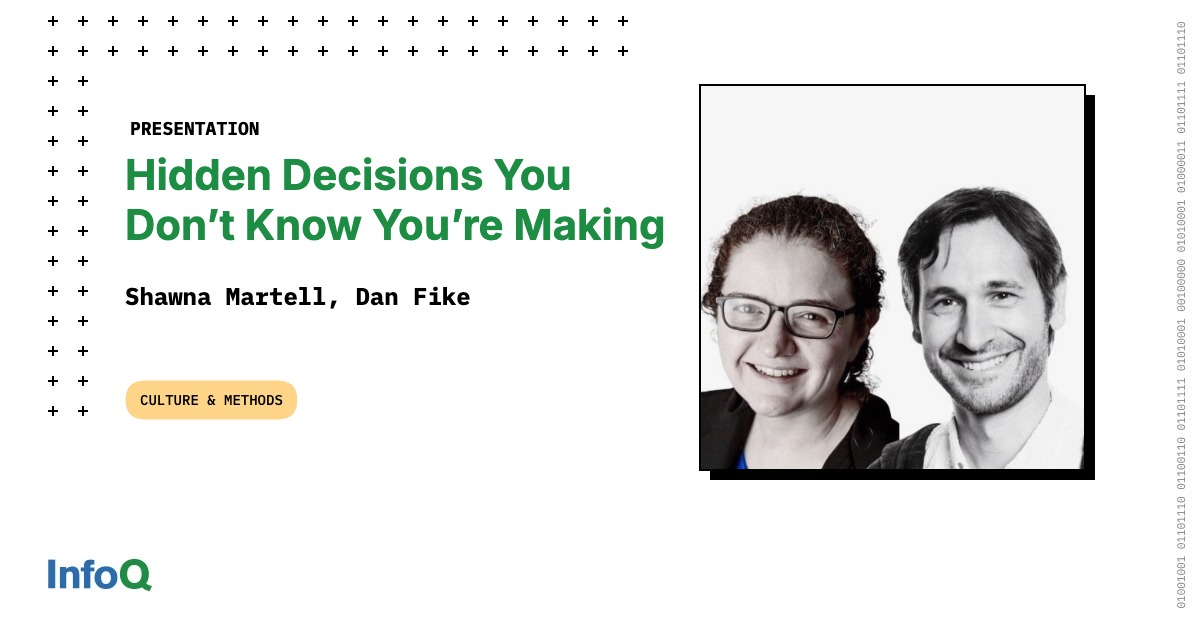
Hidden Decisions You Don't Know You're Making

Decision-making is a fundamental aspect of work and life, influencing culture, relationships, and future choices.
Psychology
fromSilicon Canals
4 days ago

People who research every decision exhaustively before acting aren't thorough - they're trying to build a guarantee in a world that doesn't sell them because the last time they trusted their gut without evidence something expensive happened and the body never forgot the bill - Silicon Canals

Chronic overanalysis of decisions stems from past failures, leading to wasted time and missed opportunities.
Philosophy
fromThe Atlantic
3 weeks ago

How to Make Better Decisions

Decision-making quality shapes life outcomes, with two main models: heroic-visionary and technocratic, each having significant flaws.
Psychology
fromSilicon Canals
5 days ago

The person who always says 'I don't mind, you choose' isn't easygoing. They learned that having a visible preference made them a target, and disappearing into someone else's choice became the safest place in the room. - Silicon Canals

Preference-erasure is a survival strategy developed in childhood, often misinterpreted as easygoing behavior, masking deeper emotional suppression.
Psychology
fromFast Company
1 week ago

How we make decisions, and how to reach people who've already made up their minds

The Elaboration Likelihood Model explains how motivation and ability influence how people process persuasive information through central and peripheral routes.
Psychology
fromPsychology Today
1 week ago

How Judgments and Opinions Can Make Matters Worse

Misleading thoughts and emotions can disrupt performance, but psychological flexibility allows individuals to pursue goals despite distress.
World politics
Portraying leaders as evil symbols justifies intervention while obscuring underlying political structures that enabled their rise, perpetuating cycles of instability.
#intelligence
fromSilicon Canals
2 weeks ago
Psychology

Research suggests that high intelligence doesn't protect against bad decisions - it makes people better at constructing convincing justifications for the bad decisions they were already going to make - Silicon Canals

Higher intelligence can lead to greater polarization rather than alignment on contested facts.
Psychology
fromSilicon Canals
1 month ago

Psychology says the loneliest part of high intelligence isn't being misunderstood - it's watching people you care about make decisions you can see will hurt them and knowing that explaining why won't help because the gap isn't in information, it's in how you process consequences six moves ahead while they're still on move one - Silicon Canals

Intelligence involves not just knowledge but the ability to foresee consequences, creating a gap that can lead to loneliness.
Psychology
fromSilicon Canals
2 weeks ago

Research suggests that high intelligence doesn't protect against bad decisions - it makes people better at constructing convincing justifications for the bad decisions they were already going to make - Silicon Canals

Higher intelligence can lead to greater polarization rather than alignment on contested facts.
Psychology
fromSilicon Canals
1 month ago

Psychology says the loneliest part of high intelligence isn't being misunderstood - it's watching people you care about make decisions you can see will hurt them and knowing that explaining why won't help because the gap isn't in information, it's in how you process consequences six moves ahead while they're still on move one - Silicon Canals

Intelligence involves not just knowledge but the ability to foresee consequences, creating a gap that can lead to loneliness.
Productivity
fromFast Company
1 month ago

Why your best ideas get ignored during meetings

Being right too early in group settings undermines influence because people resist ideas imposed on them rather than discovered collaboratively, and groups rely on social shortcuts instead of evaluating substance.
US politics
fromPsychology Today
2 months ago

When Everyone Agrees, Nobody Sees

A multicultural military harnesses immigrant experiences and diverse perspectives to strengthen national defense and improve collective decision-making.
Psychology
fromSilicon Canals
2 weeks ago

Psychology says people who command the most respect in a room aren't the loudest or most confident - they're the ones who can disagree without making others feel stupid for having believed something different - Silicon Canals

Respectful disagreement fosters genuine influence and encourages open dialogue.
Philosophy
fromPsychology Today
1 month ago

Why Some Scientific Debates Never End

Complex questions involving values cannot be definitively settled by evidence alone, as different priorities lead experts to emphasize different findings from the same data.
Psychology
fromFast Company
3 weeks ago

Stop trying to 'educate' people into changing. Science proves it doesn't work

False assumptions hinder change; simply providing information does not guarantee behavior change.
Psychology
fromPsychology Today
3 weeks ago

New Research: Some People Really Do Fall for Corporate BS

Employees impressed by corporate gibberish perform poorly in decision-making and confuse it with business savvy.
Philosophy
fromPsychology Today
1 month ago

What Is the 'Critical' in Critical Thinking?

Critical thinking is the ability to analyze, evaluate, and make judgments for decision-making, not merely critiquing or criticizing ideas.
Higher education
fromPsychology Today
1 month ago

Why "Do Your Own Research" Is Bad Advice

Research requires at least a rigorous literature review; reading to inform oneself is educating, not full research, which demands specific review skills and evaluation.
Business
fromPsychology Today
2 months ago

The 5 Characteristics of Effective Work Teams

Psychological safety, dependability, clear structure, meaningful work, and effective leadership enable teams to perform effectively, with psychological safety the most critical factor.
fromPsychology Today
1 month ago

A Science for Social Coherence?

In the practice of psychiatry, we like to think we have better radar than most doctors for identifying incoherent thinking in our fellow humans. Incoherence is one of the crucial signs for potential disasters in the central nervous system-delirium, psychosis, mania, intoxication, stroke, encephalitis. And yet, now in the waning years of my career, I confess that I've practiced this skill of identifying incoherent thinking with only the vaguest definition of coherence, and no measure.
Medicine
fromwww.scientificamerican.com
1 month ago

How to win The Traitors, according to science

We watch people lying, and we know they're lying. And also, you watch people dealing with lying not very well and not enjoying it. The lying, backstabbing and manipulation the game inspires does indeed make for delightful TV viewing.
Television
Psychology
fromPsychology Today
3 weeks ago

Do Your Identities Make You Vulnerable to Misinformation?

Tightly overlapping identities increase vulnerability to misinformation, while distinct identities enhance resilience against biased information processing.
Psychology
fromPsychology Today
3 weeks ago

Beyond Suspicion: Why We Doubt Greatness-and What It Says About Us

Mental mastery and team trust are crucial for success in cycling, transcending past performance and skepticism.
fromSilicon Canals
2 months ago

Psychology says the people everyone secretly respects never do these 7 things in group settings - Silicon Canals

What I've discovered is that the people who earn genuine, lasting respect aren't doing something special. They're actually not doing certain things that the rest of us can't seem to resist. Psychology backs this up. Research on social dynamics and group behavior reveals that respect isn't earned through dominance or attention-seeking. It's earned through restraint, authenticity, and a quiet confidence that doesn't need constant validation.
Relationships
Philosophy
fromBig Think
1 month ago

The philosophy of indoctrination and how to fix it

Indoctrination occurs when beliefs are sealed off from questioning through prepackaged instructions that frame scrutiny as irrational or immoral, preventing rational evaluation of counterevidence.
Philosophy
fromPsychology Today
2 months ago

Embracing Intellectual Humility in Political Conversations

Intellectual humility recognizes knowledge limits, seeks other perspectives, and restrains certainty, tribalism, extremism, and contempt in political judgment.
Psychology
fromPsychology Today
1 month ago

Gossip, Power, and the Stories We Tell

Gossip evolved as verbal grooming enabling humans to maintain large social networks and evaluate trust and cooperation through shared social information.
fromPsychology Today
1 month ago

Why We Gossip

Research on casual conversations reveals that more than 60 percent of informal conversations are gossip or the exchange of related social information. Dunbar defines exchange of social information as conversations about people and relationships (e.g., who's related to whom, who's allied with whom, who's married to whom), whereas a more narrowly defined subset of social conversations constitutes pure gossip, containing an element of judgment or evaluation of a not-present third party.
Psychology
Psychology
fromPsychology Today
2 months ago

Why Kind People Join Cruel Crowds: Risk of Collective Sadism

Collective sadism spreads via emotional contagion, overriding personal values as crowds escalate cruelty driven by diverse sadistic expressions and belonging pressures.
Psychology
fromMail Online
1 month ago

Conspiracy theorists are probably control freaks, study reveals

People with strong preferences for structured, rule-based thinking are more likely to believe conspiracy theories because these theories provide orderly explanations for chaotic events.
Psychology
fromPsychology Today
2 months ago

Confirmation Bias and the Choices We Make

Confirmation bias leads people to interpret the same events differently, complicating truth-finding during misinformation while open-mindedness and better methods can improve accuracy.
Psychology
fromMedium
4 years ago

Draw Little Conclusions, Not Big Ones

Avoid drawing broad conclusions from single negative events because overgeneralizing can lead to unnecessary, lasting losses and missed opportunities.
Psychology
fromPsychology Today
2 months ago

The Psychology of Holding On to Beliefs

Beliefs tie to identity and belonging, resist direct challenge, and change slowly through emotionally safe relationships and education addressing emotion, meaning, and uncertainty.
Psychology
fromBackyard Garden Lover
2 months ago

Modern Day Mind Control: 16 Hidden Ways Society Is Steering Our Thoughts

Subtle influence tactics, from targeted advertising to social proof, shape beliefs, choices, and autonomy, requiring awareness and critical thinking to resist.
[ Load more ]