#hirise-camera
#hirise-camera
[ follow ]
#perseverance-rover #mars #nasa #artemis-ii #space-exploration #curiosity-rover #james-webb-space-telescope
Science
fromYanko Design - Modern Industrial Design News
2 days agoThis $349 NASA Mars Perseverance Rover Kit Lets You Build an AI-Powered Mars Robot at Home - Yanko Design
CircuitMess offers a buildable AI-capable replica of NASA's Perseverance rover for $309, emphasizing hands-on learning and modular expansion.
fromwww.scientificamerican.com
1 week agoNASA releases stunning new Saturn imagesand the gas giant has never looked so good
Hubble captured the planet's reflected visible light and highlighted Saturn's iconic yellow hues, which are, in part, a product of the sunlight-reflecting ammonia crystals and hydrocarbons such as methane in its atmosphere.
OMG science


OMG science
fromwww.scientificamerican.com
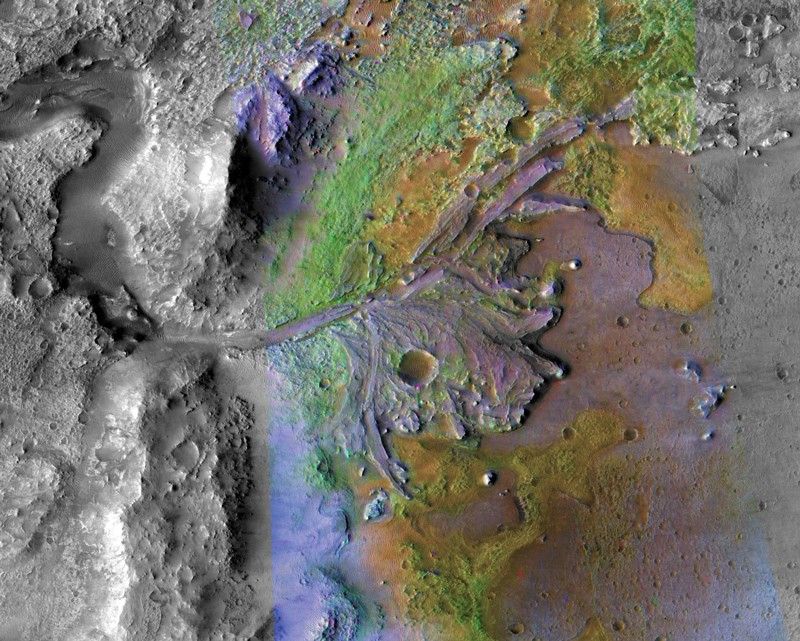
2 weeks agoNASA's Perseverance Mars rover discovers even older lost rivers at Jezero Crater
NASA's Perseverance rover discovered evidence of an ancient river-delta system buried beneath Jezero Crater's surface, extending Mars's habitability window to at least 4.2 billion years ago.
Science
fromwww.scientificamerican.com
1 month agoIs there lightning on Mars? New evidence suggests it's there, just hard to see
Scientists have detected possible evidence of lightning on Mars, with the phenomenon likely appearing as electrostatically charged dust sparks rather than dramatic bolts due to Mars's thin atmosphere and weak magnetic field.
Science
fromArs Technica
1 month agoA non-public document reveals that science may not be prioritized on next Mars mission
NASA released a pre-solicitation for a $700 million Mars orbiter spacecraft contract to relay communications and provide navigation support through 2035, with competition expected to be more open than originally intended.
fromTheregister
1 month agoNASA uses Mars Helicopter's SoC for rover navigation upgrade
NASA has revealed it repurposed the processor the Perseverance rover used to communicate with the Ingenuity Mars Helicopter, to help the rolling robot navigate the Red Planet autonomously "for potentially unlimited distances." The aerospace agency revealed the hack last week in a post that says it used the rover's Helicopter Base Station (HBS) because its processor is 100 times faster than the rover's other kit.
Science
fromTheregister
2 months agoNASA taps Claude to conjure Mars rover's travel plan
It did so with the blessing of engineers at NASA's Jet Propulsion Laboratory (JPL), who decided to delegate the meticulous work of route planning to Anthropic's AI model. This involves consulting orbital and surface imagery of Mars in order to set a series of waypoints to guide the rover's movements. Once plotted, this data gets transmitted about 140 million miles or 225 million kilometers - the average distance from Earth to Mars - where it's received by Perseverance as a navigational plan.
Science
fromEngadget
2 months agoNASA used Claude to plot a route for its Perseverance rover on Mars
Since 2021, NASA's Perseverance rover has achieved a number of historic milestones, including sending back the first audio recordings from Mars. Now, nearly five years after landing on the Red Planet, it just achieved another feat. This past December, Perseverance successfully completed a route through a section of the Jezero crater plotted by Anthropic's Claude chatbot, marking the first time NASA has used a large language model to pilot the car-sized robot.
Science
fromTheregister
2 months agoVery tough microbes may help us cement our future on Mars
A global research team has analyzed the prospects for biomineralization on Mars, a process in which bacteria, fungi, and microalgae can create minerals as part of their metabolism, offering a byproduct that could be useful to prospective Martian explorers by providing the raw materials needed to produce aggregates such as concrete. With an extremely thin and mostly carbon dioxide atmosphere, air pressure less than 1 percent of Earth's,
Science
[ Load more ]