Marketing tech
fromwww.marketingdive.com
1 day agoHow AI Is making ad creative faster and more fair
Artificial intelligence is democratizing advertising, enabling creativity and innovative storytelling for businesses of all sizes.
The petition accuses the school of promoting OpenAI's ChatGPT, which 'steal the art of [tens of thousands] of artists and rot the essence of the industry and have devastating consequences on the environment all to create facsimiles of real human art.'
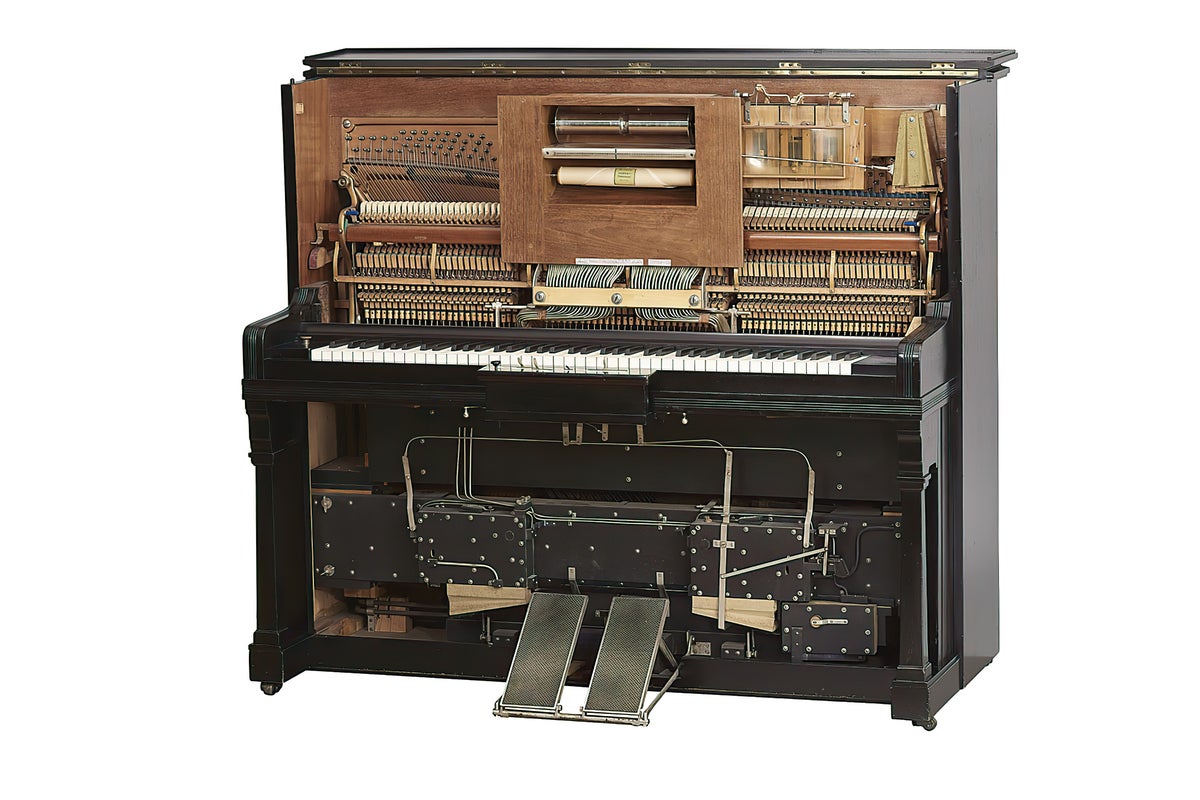
By the early 1900s, player pianos had evolved to more fully reproduce a human performance, including subtle dynamics like tempo changes and the introduction of a damper pedal. The human role went from deskilled to fully deprecated as electric motors replaced foot-powered bellows. With the Seeburg Lilliputian Model L, the only job left for humans who wanted to play the piano in the 1920s was to put in a coin.
Galen Buckwalter, a 69-year-old research psychologist and quadriplegic, participated in a brain implant study to contribute to science that aids those with paralysis. The six chips in his brain decode movement intention, allowing him to operate a computer and feel sensations in his fingers again.
The Portrait of Edmond de Belamy seems to be a paradigmatic example of generative AI art. Generative AI art has to be distinguished from AI-assisted art. The latter involves AI just as a tool that supports human art creation, comparable to a brush or a typewriter. In generative AI art, in contrast, the artistic achievement supposedly lies solely with the AI, while humans play no or only a minimal role in the creative process.
Junho Park's graduation concept borrows all the right cues from TE's playbook, that modular control layout, the single bold color, the mix of knobs and buttons that practically beg to be touched, but redirects them toward a gap in the market. Where Teenage Engineering designs for people who already understand synthesis and sampling, the T.M-4 targets people who have ideas but no vocabulary to express them.
The vocoder was never supposed to be a revolution in music. Its development began a century ago, when an engineer at Bell Labs was looking for a simpler way to send phone calls across copper telephone lines.
If you've ever used tools like PhonicMind or LALAL.AI, you know the drill: Upload your MP3. Wait in a queue. Pay for "credits" or high-quality downloads. Your file sits on someone else's server. For musicians, producers, or just karaoke fans, this is slow and privacy-invasive.
As AI systems become more capable, more accessible, and more embedded in everyday workflows, creativity is emerging as one of the most important human skills in AI development and deployment. Not creativity as decoration or aesthetics, but creativity as problem framing, decision-making, and human judgment. In an era where many organizations are using the same models, tools, and platforms, creative thinking is what separates meaningful outcomes from generic ones.
The internet is filled with supposed magic prompts that promise perfect AI outputs. Jordan Wilson sees this misconception constantly in his work, helping companies adopt AI tools. The fundamental problem is context. When someone shares a prompt that generated great results for them, they're only sharing the surface-level instructions. They're not sharing their conversation history, their accumulated context, or the back-and-forth refinement that led to that prompt actually working.
The Phase8 uses a new form of "acoustic synthesis" that combines acoustic sound generation with electronic control. Takahashi says the synthesizer is "beyond analog vs. digital" and "beyond electronics" altogether. It features chromatically tuned steel resonators, which creates an acoustic sound similar to that of a kalimba. These signals can be manipulated via onboard effects and sequenced like a traditional synthesizer. Here's a video of the synth in action.