#us-news-amp-world-report
#us-news-amp-world-report
[ follow ]
#supreme-court #trump-administration #trump #public-opinion #birthright-citizenship #midterm-elections
#supreme-court
US Elections
fromwww.theguardian.com
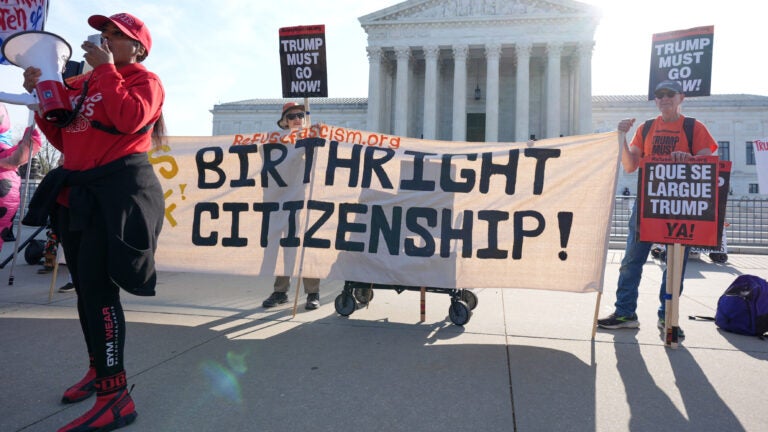
2 weeks agoTrump becomes first sitting president to attend supreme court as justices hear arguments on birthright citizenship - live
The Supreme Court hears arguments on Trump's executive order restricting birthright citizenship, with significant public demonstrations and Trump's unprecedented attendance.

US Elections
fromwww.theguardian.com
2 weeks agoTrump becomes first sitting president to attend supreme court as justices hear arguments on birthright citizenship - live
The Supreme Court hears arguments on Trump's executive order restricting birthright citizenship, with significant public demonstrations and Trump's unprecedented attendance.
Healthcare
fromwww.mediaite.com
1 day agoThat's Laughable!' Democrat Goes Off On Trump OMB Director's Reasoning For 15 Million Americans Losing Healthcare
Rep. Brendan Boyle challenged OMB Director Russell Vought on healthcare coverage loss for millions due to Trump's policies during a House Budget Committee hearing.
fromWIRED
2 days agoThe US Government Will Ask Data Centers How Much Power They Use
"Americans deserve to know how much energy data centers are sucking up and what that's doing to their utility bills. The EIA's mandatory survey is an important first step towards holding data centers accountable, but people are hurting right now."
Environment
fromThe Atlantic
2 days agoJared Kushner's Mysterious Role in the Trump Administration
Kushner has in the first 14 months of the second Trump administration sat down with world leaders including Vladimir Putin, Benjamin Netanyahu, and Volodymyr Zelensky, along with Saudis and multiple other actors from the Middle East.
Left-wing politics



fromwww.dw.com
3 days agoUS judge drops Trump's lawsuit against Wall Street Journal
Judge Darrin P. Gayles stated that Trump hadn't come close to meeting the 'actual malice' threshold necessary for public figures in defamation cases, emphasizing that the complaint did not meet the required standard.
US politics

Higher education
fromInside Higher Ed | Higher Education News, Events and Jobs
1 month agoPoll: Voters Generally Support Limiting Grad School Borrowing
Majorities of registered voters support federal graduate loan caps and a new earnings test for higher education programs under the One Big Beautiful Bill Act.
fromwww.dw.com
2 weeks agoUS Supreme Court debates citizenship, with rare Trump visit
Sauer argued to the court that 'unrestricted birthright citizenship contradicts the practice of the overwhelming majority of modern nations' and 'demeans the priceless and profound gift of American citizenship.'
US Elections
Left-wing politics
fromSlate Magazine
1 month agoThey've Been Measuring the Health of Democracies for Years. Guess What Their New Report Says About America.
The Trump administration's dismantling of democratic institutions has caused the United States' democracy rating to fall to 1965 levels, representing unprecedented autocratization in modern times.
Television
fromNieman Lab
1 month agoNewsonomics: Will national news shrink even faster than local news did?
Anderson Cooper's departure from CBS and potential CNN instability reflect broader erosion of trust in authoritative national news organizations during a critical period for democratic accountability.
US politics
fromwww.theguardian.com
1 month agoSenate expected to take up voter ID bill opposed by Democrats US politics live
The Save America Act requires proof of US citizenship for voter registration and approved identification at polls, facing Senate opposition due to filibuster rules and Democratic unanimity against it.
fromFast Company
1 month agoA record number of Americans want out-now the government is making it easier
Starting next month, the cost of renouncing your U.S. citizenship will go down dramatically - a boon for people already shouldering the burden of paying for a major overseas move. Anyone wishing to formally shed their American citizenship is required to obtain a form called a Certificate of Loss of Nationality, and right now it comes with a whopping $2,350 fee. In April, that fee will drop by 80% to $450.
US Elections
fromThe New Yorker
2 months agoDemocracy Dies in Broad Daylight
Last week- after the Wall Street Journal broke more news about the Trump family's dodgy crypto-business dealings and before the President shared a racist video of the Obamas depicted as dancing apes-the Amazon entrepreneur Jeff Bezos decided that one of his smaller properties, the Washington Post, has proved such a drag on his two-hundred-and-thirty-billion-dollar fortune that prudence required that he obliterate much of its newsroom.
Media industry
US politics
fromAxios
1 month agoDems plan probes into companies, colleges that cooperated with Trump
Democratic senators plan investigations into Trump administration cooperation with major institutions, corporations, and wealthy individuals, leveraging broader House subpoena authority and targeting private entities unable to claim executive privilege.
fromInside Higher Ed | Higher Education News, Events and Jobs
2 months ago4 Takeaways From Trump's First Year in Office
Within a month, Trump officials had threatened colleges' research funding, started gutting the Institute for Education Sciences, declared race-based programming illegal and unleashed Immigration and Customs Enforcement officers on campuses, among other actions. Then, over the next six months, the administration started dismantling the Education Department, cut thousands of research grants that didn't align with Trump'spriorities, helped oust the University of Virginia's president and cracked down on international students-deporting some who criticized Israel and revoking the visas of thousands.
Higher education
US politics
fromTruthout
1 month agoPlurality of Americans Back Firing Multiple Trump Cabinet Members
A majority of voters support President Trump's firing of DHS Secretary Kristi Noem, with 55% approving and 15% disapproving, amid scandals including FEMA gutting, court order violations, and misuse of taxpayer funds for personal advertising.
US Elections
fromwww.npr.org
1 month agoTrump says he won't sign bills until Congress overhauls voting
President Trump threatened to withhold his signature on all bills until Congress passes the SAVE America Act, which would require voters to prove citizenship with documents like passports or birth certificates.
US politics
fromLGBTQ Nation
1 month agoGallup set to stop tracking presidential approval ratings & people are pretty sure they know why - LGBTQ Nation
Gallup will stop producing presidential and individual political approval ratings after eighty-eight years, citing a strategic shift in research priorities.
fromEast Bay Express | Oakland, Berkeley & Alameda
1 month agoBack in time: California confronts Trump's third-term talk
The 22nd Amendment, added to the United States Constitution in 1951, states that no person shall be elected to the office of the president more than twice. Until recently, it seemed that Americans were in unanimous agreement that this rule was in the best interest of Americans and democracy as a whole. However, in late 2025 Trump constituents began selling t-shirts bearing the words, "Trump 2028 (Rewrite the Rules)."
US politics
fromAxios
2 months agoA year into Trump's term, voters say Biden was better
Harvard CAPS/Harris (Jan. 28-29): Mark Penn's polling firm found that 51% of registered voters say Trump is doing a worse job than Biden, compared with 49% who say he's doing better. Rasmussen Reports (Feb. 2-4): The Trump-friendly pollster is fending off MAGA criticism after finding that 48% of likely voters say Biden did a better job as president, compared with 40% who chose Trump. Another 8% said the two presidents have performed "about the same."
US politics
US politics
fromwww.mediaite.com
2 months agoTrump Targets Obama, Newsom, and New Alex Pretti Video in Another Late-Night Truth Social Barrage
President Donald Trump posted over 50 times on Truth Social, amplifying conspiracy claims, attacking political opponents, and sharing footage related to the Alex Pretti case.
fromThe Atlantic
4 months agoTrump Under Pressure
A year ago, Trump was "at the peak of his political power," and his first 10 months in office "were pretty much signs that there was very little that" could be done to stop him. But then, Olorunnipa noted, "we had the elections in the first part of this month." Following major victories for Democrats in New York, New Jersey, and Virginia, Trump is beginning to realize "that he's going to be a lame duck very soon."
fromFast Company
2 months agoU.S. political polarization started a lot earlier than you might expect
Researchers at the University of Cambridge's Political Psychology Lab tracked shifts in Americans' views across nearly four decades and found that divisions were broadly stable through the 1990s and early 2000s, before rising steadily from 2008 onward. Using more than 35,000 responses from the American National Election Studies between 1988 and 2024, they estimate that issue polarization has increased 64% since the late 1980s, with almost all of that change occurring after 2008.
US politics
US politics
fromwww.mercurynews.com
1 month agoFact check: Trump makes false claims about the economy, elections and crime in State of the Union
Trump made numerous false and misleading claims in his State of the Union address, with the most frequent inaccuracies concerning the economy, including fabricated investment figures, overstated economic performance, and false tariff claims.
US politics
fromIrish Independent
1 month agoSix takeaways from Trump's 2026 State of the Union address to Congress - the longest one in history
Trump centered his speech on economic issues like housing and healthcare while claiming inflation and mortgage rates are falling, though government data contradicts these assertions and voters disapprove of his economic handling.
fromInside Higher Ed | Higher Education News, Events and Jobs
2 months agoHow Congress's Budget Could Hamper Trump ED Agenda
These new restrictions-which can be found throughout the appropriations bill for the Department of Education and other sections of the 11-part funding package that was signed into law last week-are part of what policy experts describe as a bipartisan attempt to rebuke the Trump administration's budget proposal and restore Congress's power of the purse. Historically, the language of these budget bills has largely stayed the same, serving as little more than a template into which lawmakers plug that year's dollar amounts and policy riders.
US politics
fromNature
2 months agoDaily briefing: Trump - one year in
More than 7,800 research grants terminated or frozen. Some 25,000 scientists and personnel gone from agencies that oversee research. Proposed budget cuts of 35% - amounting to US$32 billion. In this graphics-rich immersive feature, Nature shines the spotlight on the impact that one year of the administration of Donald Trump has had on US science. Nature | 6 min scroll News
US politics
fromFortune
2 months agoIt turns out that Joe Biden really did crush Americans' dreams for the future. Just look at how the vibe changed 5 years ago | Fortune
"If you look at the optimism metric for future life, that really came down a lot from 2021 to 2023 and that corresponds really closely with the worst of the inflation crisis," Dan Witters, research director of the Gallup national health and well-being index, told Fortune. "The economic pressures of being able to afford things like food and fuel and gas and healthcare-that really can have a deleterious effect."
US politics
fromwww.mediaite.com
1 month agoHow Broken Is the Media? Just Look at the Coverage of Trump's Exploding Debt Crisis
In mid-February, the nonpartisan Congressional Budget Office (CBO) released a shocking report calculating that at the current rate of increase, the national debt is set to hit $64 trillion by 2036. Sixty-four trillion dollars is such an eye-popping number—double the national debt in 2023 and triple where it stood in 2018—that it would mean the public would owe over 120% of overall GDP, crushing the previous record of 106% in 1946.
US politics
US politics
fromAxios
2 months agoHow Trump's ruthless first year erased the Biden presidency
Trump is reversing Biden-era priorities—rolling back democratic accountability, racial-equity initiatives, expert-driven governance, and climate action while promoting racial grievance, immigration crackdowns, and fossil fuels.
[ Load more ]