Renovation
fromArchDaily
23 hours ago7 Unbuilt Houses Shaped by Site, Climate, and Constraints
Residential architecture is explored through unbuilt projects that respond to site, climate, and constraints, emphasizing the house as a spatial system.
Placing your subwoofer in the front quadrant of a room allows the walls to guide low-pitched sounds effectively, enhancing overall audio quality. Avoiding corners is crucial, as this can lead to muddy and overpowering bass that detracts from the listening experience.
Viewpoints are structures designed for observing the landscape from elevated positions. They act as devices that organize the gaze and establish a direct relationship between the body and the territory.
For most of human history, night arrived as a planetary certainty. Darkness spread across landscapes, and the sky revealed thousands of stars. Today, that sky is disappearing. Artificial light spills upward from cities, scattering through the atmosphere and turning night into a permanent haze. Research mapping global sky brightness shows that more than 80 percent of humanity now lives under light-polluted skies, and the Milky Way has vanished from view for over a third of the world's population.
Photovoltaic (PV) solar energy represents a modular technology that can be manufactured in large-scale facilities, generating economies of scale, while also being adaptable to small-scale applications. From residential rooftop systems to large-scale power generation installations, photovoltaic solar energy has established itself as a cost-effective option for electricity production in many countries around the world.
Decades of research in environmental psychology and building science reveal that indoor conditions can profoundly affect human health and behavior. Lighting influences circadian rhythms and sleep patterns. Air quality impacts cognitive performance and respiratory health. Temperature and acoustics shape comfort and concentration.
Perforated metal has long been valued for its strength, versatility, and clean visual appeal. Created by punching patterns of holes into metal sheets, it offers a practical balance between airflow, light control, and structural support. Across industries such as architecture, construction, mining, and interior design, perforated metal has become a go-to material for projects that require both function and style.
My family had Slide Show Night when I was growing up. Not every Saturday, but a whole bunch of Saturdays. Either my sister or I would be in charge of setting up the projector, the screen, and loading the carousel. During the show, there'd be a few landscapes or skylines taken during vacations, but almost all the shots were up close. Like most dads, mine wasn't a professional photographer, but he did a good job of capturing memory triggers: faces, gestures, and decorations.
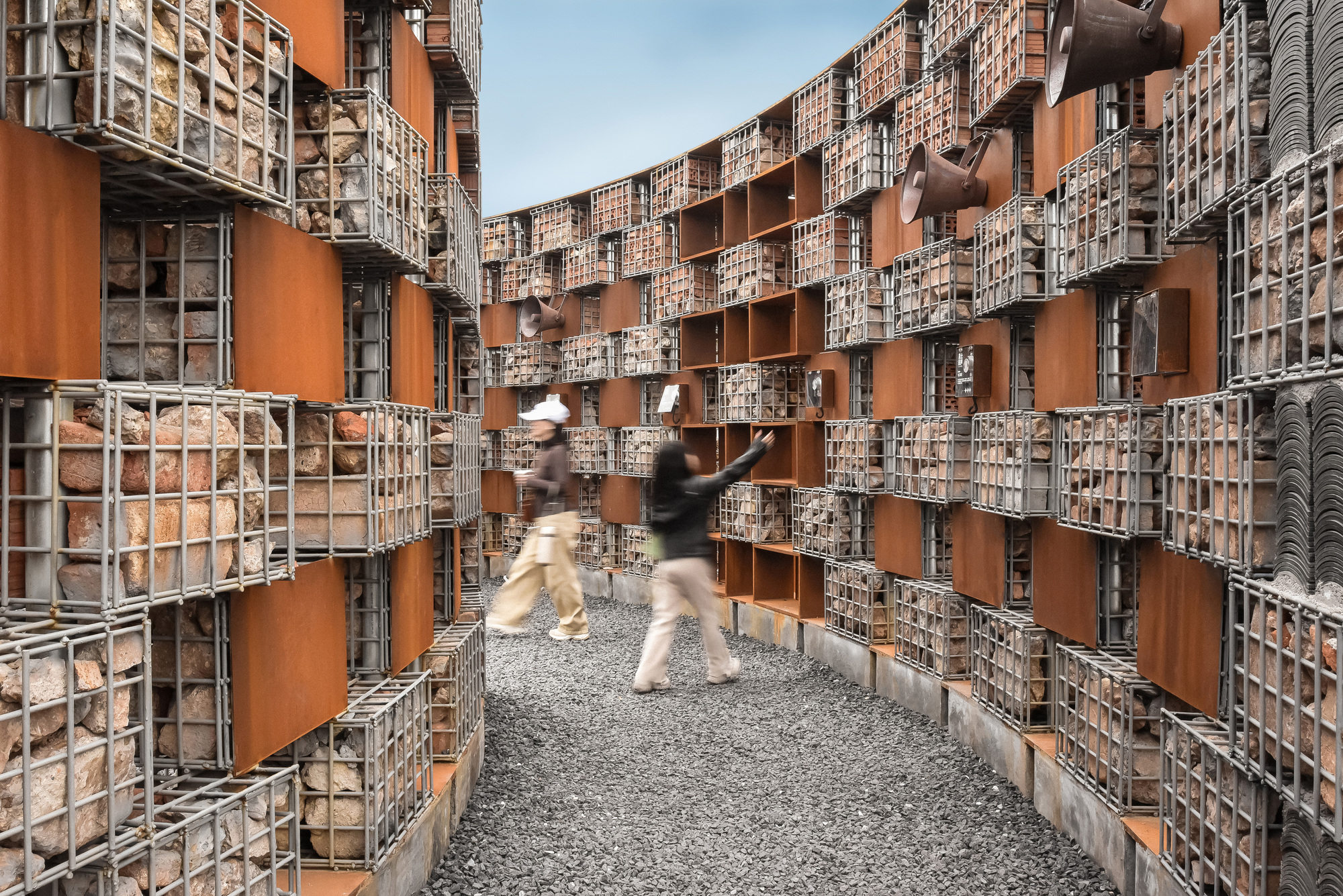
The design by 1Y Architects approaches this silence as material rather than absence. Instead of clearing the debris scattered across the site, the team gathered bricks, concrete fragments, and broken tiles from former factory buildings. These remnants form the structural fabric of the sound museum itself.
Diverse zones allow employees to shift from heads-down work to group sessions with ease. An area for guests, which contains a plant-filled bookshelf, is reminiscent of a living room. The social sector at the heart of the workplace includes a casual dining section and bar. Glass blocks let sunlight filter in and complement the tile backsplash. There's even a room dedicated to deep relaxation, complete with cosmic motifs and a recliner.
By utilizing this dual-entry condition, the design reorganizes the vertical circulation, placing the primary entrance on the upper level and redefining the ritual of returning home while transforming storage into an architectural façade.
The Eski.Sub draws inspiration from the visual language of Brutalist architecture and the cultural atmosphere of UK grime music scene. The project examines the relationship between design, urban context, and emotional listening experiences, positioning the loudspeaker as both an audio device and a spatial object.
From the large industrial roofs and galleries of the 19th century to the contemporary atriums of museums and public buildings, glass has been a recurring material in shaping large and monumental interior spaces. More than a technological or engineering solution, these horizontal glazed planes introduce a distinct luminous quality: light that comes from above. Unlike lateral daylight entering through façades, zenithal light is more evenly distributed, reduces harsh shadows, and lends spaces a sense of continuity and openness that is difficult to achieve otherwise.
For many architects, schematic design is defined by a familiar tension. It is the phase of open-ended exploration-where multiple ideas are tested, challenged, and refined for clients to define a project's direction. In essence, it's where the design magic happens. The challenge is rarely a lack of ideas, but the effort required to test and evaluate those ideas properly under time-, resource-, and budget constraints.
The rhythm of open offices is great until you need to concentrate or take a video call. The energy becomes noise, conversations drift across the floor, and people end up camping in meeting rooms or wearing noise-cancelling headphones all day. The ad hoc solutions never quite work, and what is missing is a middle ground, something more substantial than a desk but less isolating than a full pod.