#layout-and-flow
#layout-and-flow
[ follow ]
#user-experience #design #product-design #ai #figma #ux-design #design-systems #ui-design #web-development #technology
fromArchDaily
16 hours agoWhy Do We Want to Float? The Psychology of Lightness in Architecture
In 1962, the architect Buckminster Fuller envisioned a floating city that would free humanity from its dependence on the Earth. The speculative project consisted of enormous geodesic spheres that would naturally levitate in air warmed by the sun and be anchored to mountaintops.
Design

#design
UX design
fromMedium
4 days agoOh, but there's one more thing
Designers must address real project challenges while navigating the evolving role of AI in the creative process.

fromMedium
1 month agoYou can't design what you won't maintain
Santa Cruz de Tenerife is one of the most idyllic cities in the Canary Islands. At its heart stands the jewel - the Auditorio. It's a place where talent from both worlds, New and Old, comes together. A theatre, opera, dance, and music heaven.
Berlin


fromMedium
1 month agoUI Design with Gemini 3.1
Google recently released a new AI model, Gemini 3.1, that demonstrates great results in UI and web design tasks. I've already tested this model for web design tasks and in this article, I want to experiment with Gemini 3.1 and generate UI for a mobile application.
Mobile UX
fromMedium
1 month agoThe craft of the instruction
Instructions I created. Instructions I am continuing to hone - instructions that required me to study my own old essays, identifying what I do when I write. The sentence rhythms. The way I move between timescales. The zooming in and out from concept to detail. The instructions tell Claude how I would like ideas composed. I pull together concepts and experiences from my lived expertise to formulate a point of view - in this case, on this new AI technology.
Design
Software development
fromMedium
1 month agoYou're still designing for an architecture that no longer exists
The traditional graphical user interface built on windows, menus, and clicks is being replaced by AI-driven environments where work happens through natural interaction without navigating applications or interfaces.
fromMedium
3 months agoAgainst cleverness
Today we are at the cusp of revolutions in artificial intelligence, autonomous vehicles, renewable energy, and biotechnology. Each brings extraordinary promise, but each introduces more complexity, more interdependence, and more latent pathways to failure. This elevates prudence to be critical. Good design recognizes what cannot be foreseen. It acknowledges the limits of prediction and control. It builds not merely for performance, but for recovery.
fromMedium
2 months agoThe Design Vibeshift
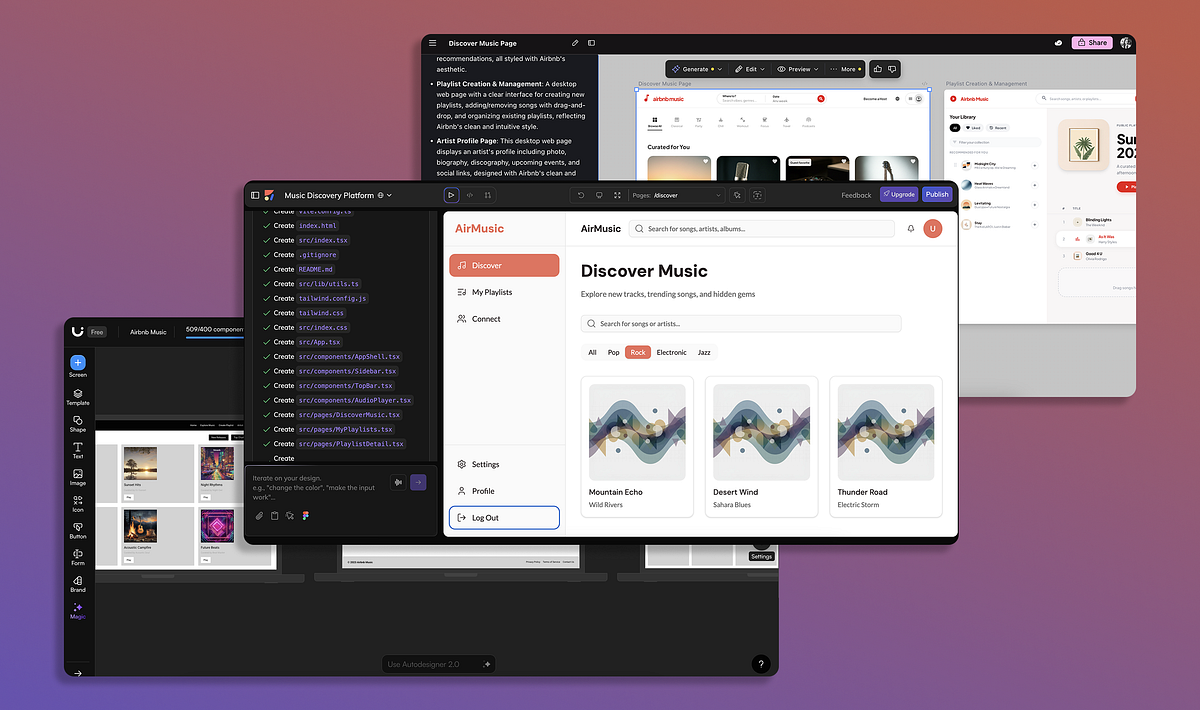
Something's been slowly shifting in the design zeitgeist. I've been watching my feed on X and the vibe has changed. More and more, I see designers sharing finished experiments or prototypes they coded themselves, rather than static Figma files. Moving from working on a canvas to talking to an LLM. The conversation isn't "here's a design I made" anymore... it's "here's something I shipped this afternoon."
UX design
fromblog.logrocket.com
2 months agoLinear vs. non-linear design: Which is better and when? - LogRocket Blog
Minimal doesn't always mean usable. This comparison shows how Linear-style UI keeps contrast, affordances, and structure intact, unlike brutalism's extremes or neumorphism's low-clarity depth effects. Daniel Schwarz Feb 5, 2026 2 min read Linear-style UIs look simple, but the theming system has to do real work. Here's how to meet WCAG 2.2 contrast requirements across light, dark, and high-contrast modes whether you're using a UI library
UX design
fromblog.logrocket.com
2 months agoWhich UI libraries/frameworks support the Linear aesthetic? - LogRocket Blog
Teams often use customer and user interchangeably until it breaks alignment. Here's how separating the two clarifies research, prioritization, and messaging across B2C, B2B, and B2B2C products.
UX design
[ Load more ]