#hawking-radiation
#hawking-radiation
[ follow ]







#quantum-mechanics
Philosophy
fromwww.scientificamerican.com
1 month agoA 100-year-old theory might explain what's wrong with quantum mechanics
Pilot wave theory, developed by Louis de Broglie a century ago, potentially resolves quantum mechanics' paradoxes by describing particles guided by attendant waves rather than existing in superposition.
Science
fromwww.scientificamerican.com
1 month agoHave astronomers found a runaway monster black hole or just a very weird galaxy?
Astronomers discovered RBH-1, a potentially runaway supermassive black hole traveling at over three million kilometers per hour, though ambiguous data makes its true nature uncertain.
#gravitational-waves

OMG science
fromwww.scientificamerican.com
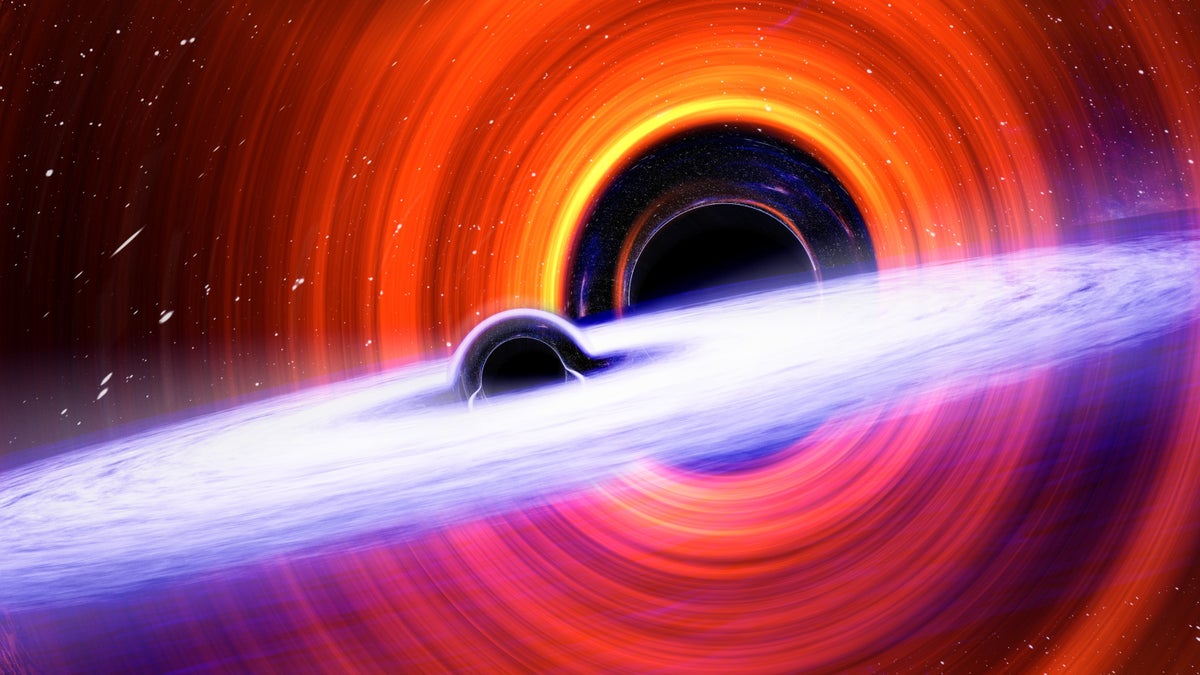
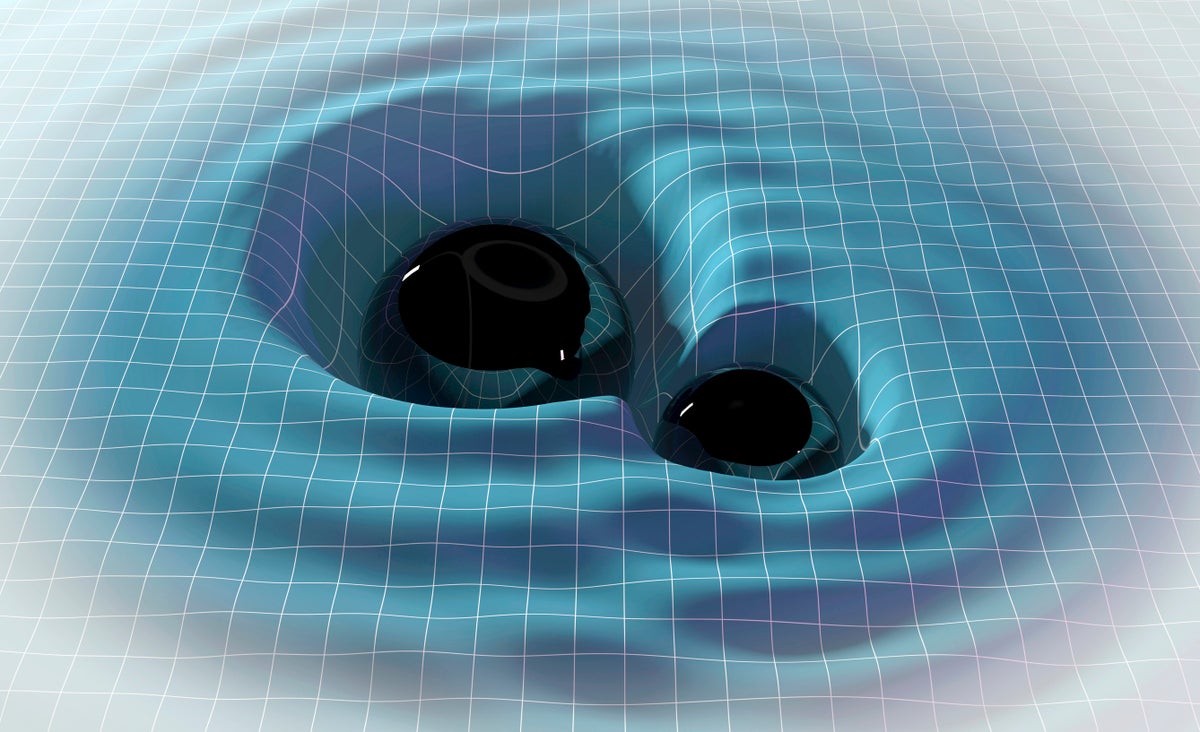
1 month agoA boom in gravitational waves leaves scientists with more questions than answers
A global network of gravitational-wave observatories has detected 218 candidate events, revealing complex structures in cosmic mergers and providing unprecedented insights into the universe.
OMG science
fromwww.scientificamerican.com
1 month agoNewly discovered ripples in spacetime put Einstein's general relativity to the test
A global network of gravitational wave observatories has more than doubled detections of cosmic collisions, revealing a universe filled with black holes, neutron stars, and their mergers with unprecedented variety and characteristics.


fromBig Think
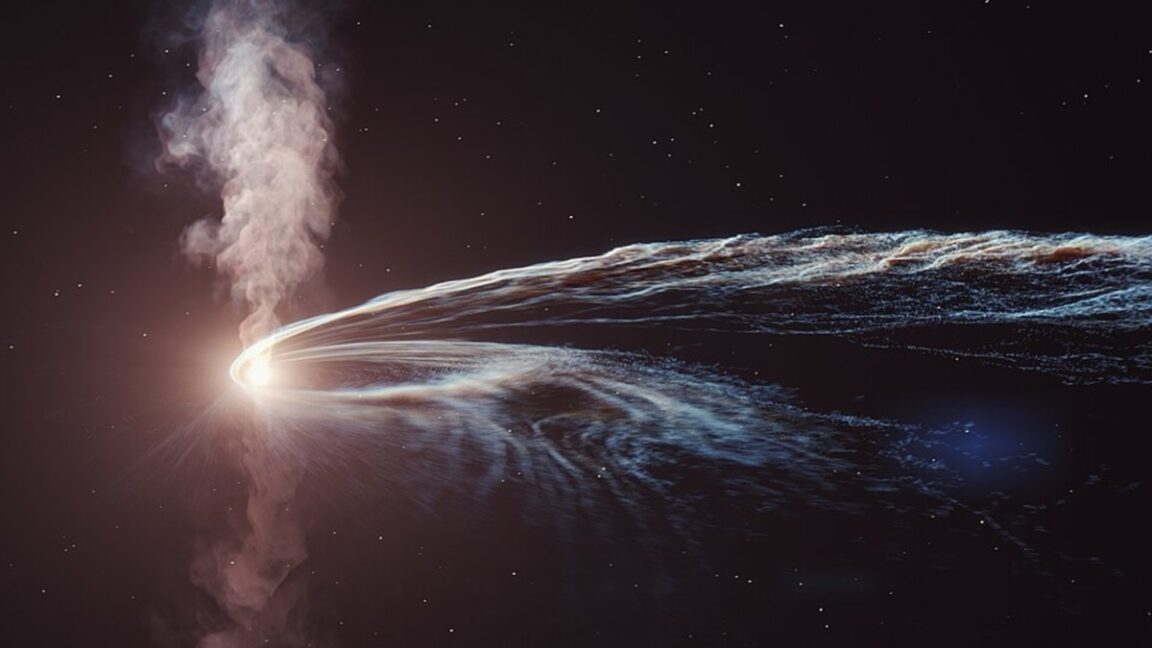
1 month agoAsk Ethan: Can quantum entanglement survive a black hole?
According to Einstein's General Relativity, for every black hole that exists within the Universe, there are only three properties that go into it that matter in any way: the black hole's total mass, the black hole's net electric charge, and the black hole's intrinsic angular momentum, and that's it. It doesn't matter what type of matter went into the black hole in order to form it; all that matters is its mass, charge, and angular momentum.
Science

fromBig Think
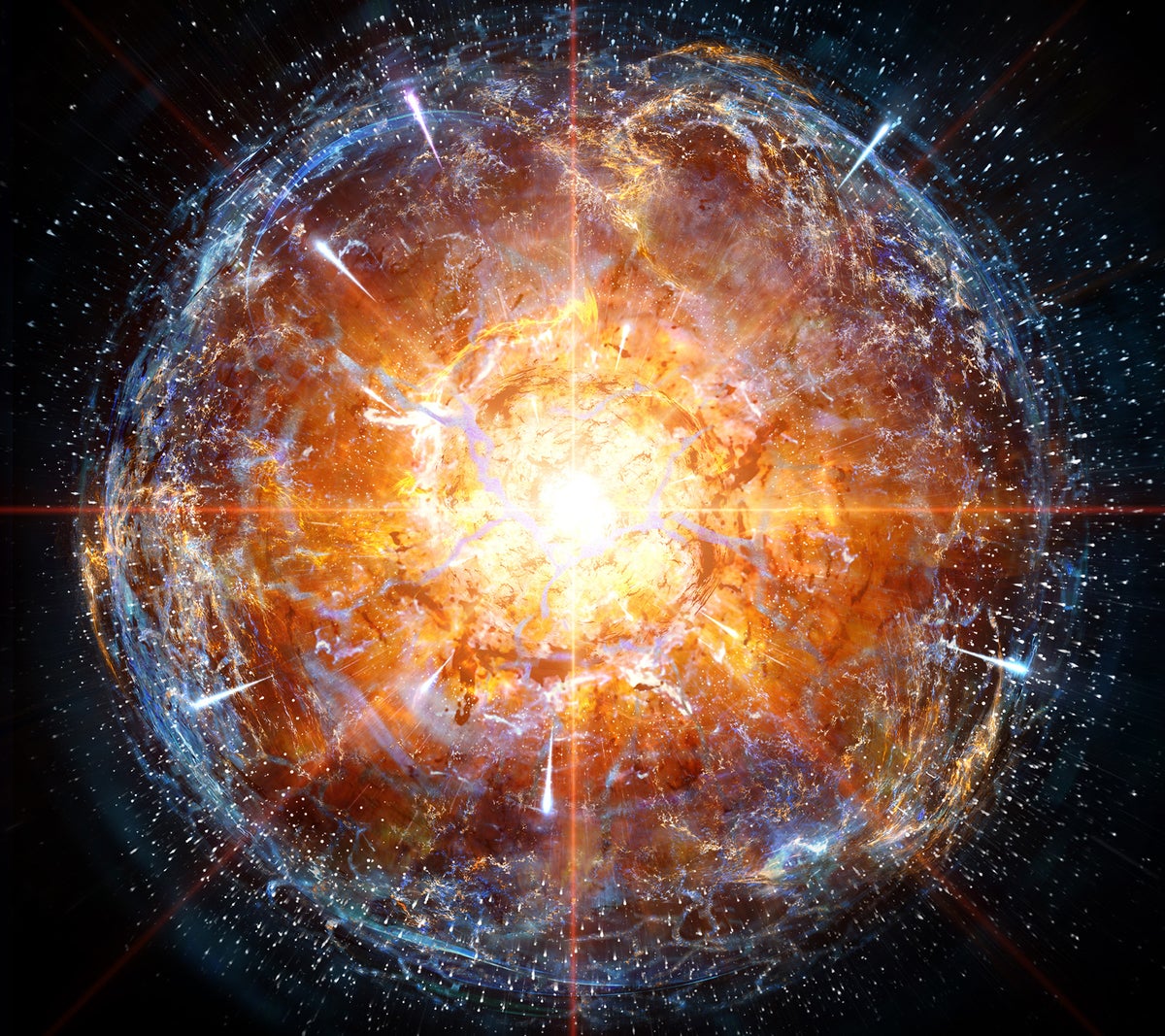
1 month agoOJ 287 has the most supermassive pair of black holes ever
The closest supermassive black hole pair, in NGC 7727, was discovered in 2021. Just 89 million light-years away, these 154,000,000- and 6,300,000-solar-mass black holes are just 1,600 light-years apart. Approximately 0.1% of young quasars are expected to be doubles, with typical separations of ~10,000 light-years.
OMG science
fromwww.theguardian.com
1 month agoPlease drive carefully: scientists plan to transport volatile antimatter for first time
A core question we want to understand is where did matter come from. And then, if you know about antimatter, it's natural to ask, why is that not here? The process is not understood and we are hunting for clues as to why it happened, says Dr Christian Smorra, a physicist on the Baryon Antibaryon Symmetry Experiment (Base) at Cern.
OMG science
Science
fromwww.scientificamerican.com
2 months agoBack from the dead, a black hole is erupting after a 100-million-year hiatus
A dormant supermassive black hole in galaxy J1007+3540 restarted after about 100 million years, producing a one-million-light-year radio jet of star-forming particles and gas.
OMG science
fromMail Online
1 month agoAstronomers watch the birth of a magnetar for the first time
Astronomers observed the birth of a magnetar, an extremely dense neutron star with the universe's most powerful magnetic fields, through a superluminous supernova's unusual flickering light pattern over 200 days.
fromwww.npr.org
2 months agoHave astronomers witnessed the birth of a black hole?
A bright star in a nearby galaxy has essentially vanished. Astronomers believe that it died and collapsed in on itself, transforming into the eerie cosmic phenomenon known as a black hole. "It used to be one of the brightest stars in the Andromeda galaxy," says Kishalay De, an astronomer with Columbia University and the Flatiron Institute. "Today, it is nowhere to be seen, even with the most sensitive telescopes."
Science
fromBig Think
1 month agoAsk Ethan: Will anything persist when the Universe dies?
Star-formation will eventually end, and then the last shining stars will burn out. Galaxies will dissociate due to gravitational interactions, ejecting all masses and leaving only supermassive black holes behind. And then those black holes will decay via Hawking radiation, leaving only cold, stable, isolated bodies, from which no further energy can be extracted, all accelerating away from us within our dark energy-dominated Universe.
Science
fromwww.scientificamerican.com
2 months agoThe biggest explosions in the universe, ranked
The universe is exploding. Or parts of it are. The night sky may seem calm, even serene, but that masks events of a catastrophic and nearly unimaginable scale. Across the galaxy and even the cosmos itself, immense outbursts of energy occur that could easily vaporize our planet. Happily, space is vast, and the terrible distance between these events and us diminishes what we see to a faint glowusually.
OMG science
fromBig Think
1 month agoRecord-breaking natural laser discovered 11 billion light-years away
an electron within a molecule gets excited to a higher-energy state, the electron de-transitions back to the lower energy state, where it emits light of a very specific wavelength in the process. Then, pumped or injected energy re-excites an electron within that very same molecule back into that higher-energy state, over and over.
Science
fromBig Think
1 month agoHow Einstein revolutionized the meaning of "where" and "when"
We now recognize that even ideas like "when" and "where" are subject to the laws of Einstein's relativity, and that in relativity, space and time are not absolute quantities, but rather are relative to each and every unique observer.
Science
Science
fromwww.scientificamerican.com
2 months agoScientists may have discovered a pulsar at the Milky Way's hearta result that could reveal new physics
A pulsar near Sagittarius A* would enable more precise measurements of spacetime and gravitational effects around the Milky Way's central supermassive black hole.
fromFuturism
1 month agoAstronomers Spot Huge Microwave Laser Blasting Into Space
This system is truly extraordinary. We're seeing the radio equivalent of a laser halfway across the universe. Fundamentally, masers and lasers are focused beams of light in the same frequency. In the realm of astrophysics, these can arise from clouds of dust being excited into a higher energy state from the light emitted by other sources, like stars and black holes.
OMG science
[ Load more ]