#disability
#disability
[ follow ]
#accessibility #caregiving #mental-health #mobility #policy #inclusion #parenting #long-covid #aging #homelessness
#caregiving
Medicine
fromNonprofit Quarterly | Civic News. Empowering Nonprofits. Advancing Justice.
1 week agoFeeling Invisible, Many Disabled Caregivers Also Need Support | Nonprofit Quarterly | Civic News. Empowering Nonprofits. Advancing Justice.
Disabled people are caregivers, often more likely than non-disabled people, and caregiving policy rarely accounts for caregivers’ own disabilities.

fromBrooklyn Paper
2 weeks agoRBC Brooklyn Half runners bring stories of resilience, grief and survival to the 13.1 mile race * Brooklyn Paper
“The first time, I think I couldn't even do half a block without being winded,” Hui told Brooklyn Paper. “But I kept on going, and then one day, something just felt good.” Since then, Hui has completed 25 marathons and hundreds of races with NYRR, despite living with multiple disabilities. Last year, she finished second-to-last in the entire New York City Marathon, crossing the line just before midnight.
Brooklyn
#accessibility

New York City
fromStreetsblog USA
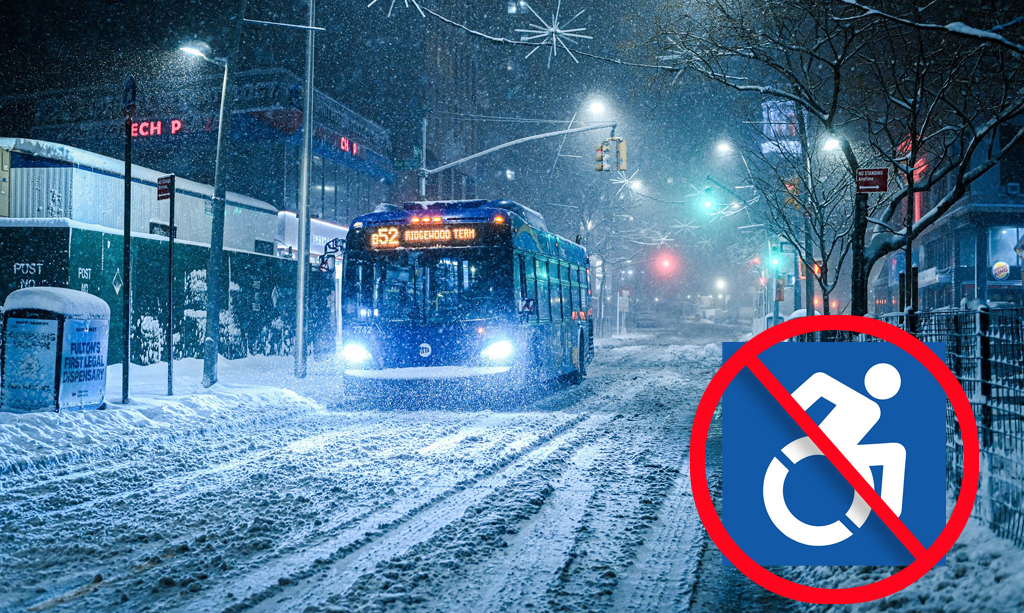
3 weeks ago'How Do We Remember to Remember Disabled People?': When Winter Weather Is an Accessibility Disaster - Streetsblog USA
Snowstorms severely limit mobility for disabled individuals due to inaccessible sidewalks and curb cuts, highlighting the need for better city planning.
Miami
fromenglish.elpais.com
1 month agoThe father's plea that ICE ignored: I have a daughter with Down syndrome and autism and a wife with cancer, please don't deport me'
A father struggles to connect with his daughter after being deported, while her mother fights for their family's unity despite challenges.
fromwww.aljazeera.com
2 months agoI have fought for the life of this child many, many times'
Martha carries her son Aaron, who is unable to walk or talk, while she works in the fields. She states, 'Aaron is so weak, so I have to carry him from the house and lay him somewhere so I can work.' This highlights the daily struggles she faces in balancing her responsibilities as a mother and a worker.
Parenting
#long-covid
Coronavirus
fromLos Angeles Times
2 months agoLong COVID leaves thousands of L.A. county residents sick, broke and ignored
Long COVID remains a life-altering chronic condition affecting thousands in L.A. County despite the end of the public health emergency, causing invisible disability with limited medical support and social understanding.
fromColossal
3 months agoVictoria Dugger Reinterprets the American Flag in Glitter and Fringe
When Victoria Dugger encountered Jasper Johns' " Flag " during a visit to the Museum of Modern Art in 2024, she found herself contemplating similar ideas. The encaustic painting is one of Johns' most recognizable works and revels in ambiguity: although it bears stars and stripes, it's not an exact representation of Old Glory, nor is it solely a gestural, abstract work. Instead, "Flag" prompts questions about motif, material, and meaning that defy any singular narrative.
Arts
fromwww.theguardian.com
3 months agoUK's unsung army' of full-time unpaid carers needs more support, report says
Britain is getting older and sicker, while a greater share of its population has a disability. While these trends affect the whole of society, they are starkest in the poorest half of working-age families across the country. While we talk a lot about the effects of ageing and ill-health, the implications on demand for unpaid care is largely absent from political debate.
UK politics
Social justice
fromStreetsblog
3 months agoReimagining Freedom: How Older Adults Can Benefit from Connecting with Other Nondrivers - Streetsblog USA
Many people, especially seniors, assume driving is essential despite widespread nondriving populations and existing strategies for mobility among nondrivers.
fromSlate Magazine
3 months agoMy Wife Is Encouraging Me to Get My Needs "Handled" In a New Way. I'm Not Sure This Even Exists.
As a result of multiple disabilities, my wife may never be able to have sex with me again, or at least not for a long time. She always had a low libido, but recent developments have made sex actively difficult and unpleasant for her. I love my wife and do not wish to divorce her, but this presents a problem for me, because I have a very active libido.
Relationships
fromwww.theguardian.com
3 months agoRosie Jones looks back: Without realising it, I'd been workshopping jokes down the pub, saying, I'm not disabled, I'm drunk'
I was a smiley, happy child. I've had cerebral palsy since birth, so I've never known any other reality. At three years old I went to a disabled nursery connected to a disabled school, and I remember thinking, Why am I here? At the end of the day, the teacher brought my parents in and said, Rosie should be in a mainstream school.
Television
fromRoger Ebert
4 months agoSundance 2026: Joybubbles, Soul Patrol, Who Killed Alex Odeh? | Festivals & Awards | Roger Ebert
A false music cue or an overworked script can turn the most powerful story banal. You don't find those slip-ups in Sundance as often as they occur in other places-all five of the current nominees for Best Documentary at the Oscars premiered at Sundance-but the festival also isn't immune to those missteps either. In this dispatch are three works from the US Documentary competition
Film

fromThe New Yorker
4 months agoThe Mental Pratfalls of Anne Gridley, in "Watch Me Walk"
I remember laughing so hard, largely because of how Gridley, so relaxed in her comedy, played Juliet as someone who made sense to herself, if no one else, and what did she care? Gridley's comedic stance-part purveyor of nonsense, part paragon of common sense-put her squarely in the tradition of amazing women like Imogene Coca, and "Mad TV" 's Debra Wilson, comedians who made mental pratfalls a thing.
Arts
US politics
fromLGBTQ Nation
1 year agoMarjorie Taylor Greene promoted hate against a disabled trans student. He got punished. - LGBTQ Nation
A disabled transgender adult had Instagram and Facebook accounts banned after posting post-top-surgery photos amid harassment and false claims from anti-trans influencers and a congresswoman.
fromPadailypost
5 months ago38% of Stanford undergrads claim a disability; many get extra time on tests
I have had conversations with people in the Stanford administration. They've talked about at what point can we say no? What if it hits 50 or 60%? At what point do you just say 'We can't do this'?
Higher education

:max_bytes(150000):strip_icc()/TAL-header-traveling-as-little-person-jennifer-arnold-TRAVASJENNARNLD1025-80b60cf2dd0145c28902ab280fd3b865.jpg)

US politics
fromLGBTQ Nation
5 months agoTim Walz's daughter unleashes on MAGA for harrassing her family: "You people are f**ing disgraceful" - LGBTQ Nation
Hope Walz condemned online and in-person harassment and slurs aimed at her family, especially attacks targeting her nonverbal-learning-disorder brother, after the president's insult.
Mental health
fromwww.theguardian.com
5 months agoI'm 15 years old and have a disability. Social media has been a lifeline why is the government kicking me off? | Ezra Sholl
Banning social media for under-16s can harm disabled, hospitalized, or isolated teenagers who rely on online platforms for connection, community, and access to the outside world.


fromLos Angeles Times
6 months agoThis disabled mom survived the Eaton fire. Now, the recovery is killing her
Breathless as if the smoke still lingered, on a recent morning she bundled her effervescent 3-year-old daughter, Luna, into her car seat for the two-hour trek from her aunt's house in Riverside, where they have lived for much of the past year, back to their family's 1909 Craftsman home. It stands steps from the Eaton fire burn scar - untouched, but uninhabitable.
Public health
UK news
fromBusiness Matters
6 months agoAlan Milburn to lead review into mental health's role in youth unemployment
A major government review will examine how mental health and disability are driving rising economic inactivity among young people and propose measures to reconnect them to work or education.
fromTruthout
6 months agoMonths After LA Wildfires, Disabled Residents Still Struggle to Find Safe Housing
After disasters - natural or otherwise - people with disabilities often find themselves in temporary lodging that offers a roof, but lacks the safe, customized environment they need. This can result in many dangers and difficulties, including leaving people in wheelchairs or who require walkers to spend weeks or months in unfamiliar rental housing with dangerous stairways, rather than accessibility-friendly ramps.
California
fromBusiness Insider
6 months agoShe's 93 and still job searching despite 14 broken arms and other injuries. She can't afford not to work.
Patricia Willson, 93, stares intently at her leg as her nurse unwraps layers of bandages, revealing a scar that, to Willson's elation, is nowhere near as gruesome as it had been months ago. Hunched over from a fractured back, Willson scrolls through her phone to remind her nurse what the scar had looked like. Last December, she sliced her leg open on a box. A few months later, the three-inch gash got infected.
Public health
Chicago
fromABC7 Los Angeles
6 months agoRandy Hall, blind dishwasher at River North, Chicago restaurant Beatrix, voted 'America's Best Dishwasher' by Plate Magazine
A blind dishwasher built a 12-year career at Beatrix, earning national recognition through exceptional loyalty, work ethic, and community support.
fromwww.santacruzsentinel.com
7 months agoAt 58, Cynthia Ranii was paralyzed from the chest down. 20 years later, her sights are set on a Paralympic medal
At 78 years old, Ranii was used to competing against younger opponents, but this one was especially boyish; no older than 12 by her estimation. If she leaned on him a little harder, she thought she could leave with a clean sweep. But after dropping the first two sets, the boy began to listen to advice from his parents, who had coached him throughout the match.
East Bay (California)
fromPsychology Today
7 months agoWhat a Virtual Wheelchair Can Teach the Brain
In the history of psychology, some of the deepest insights have come from asking a deceptively simple question: What if you could step into someone else's skin? For decades, psychologists have tried to make society more inclusive by asking people to imagine what life is like for someone different from them, but imagination only goes so far. You can picture what it might be like to roll into a job interview in a wheelchair, or to navigate a crowded hallway with limited mobility,
Psychology
Media industry
fromwww.independent.co.uk
7 months agoPregnant women and pensioners massively underrepresented in TV adverts
Pensioners, pregnant women and disabled people are markedly under-represented in UK TV advertising despite their population shares, while Black people are notably over-represented.
fromwww.theguardian.com
7 months agoA moment that changed me: I froze in a job interview and it made me stop hiding my disability
To my horror, I couldn't make out a single word on the display. The customer, a woman with her young daughter, stood impatiently as I froze. I didn't know what to say. After a few awkward minutes, the hiring manager dismissed me and I received a rejection email the next morning. My dreams of attending Wireless and Reading festivals with my friends disintegrated and I had another, more important, revelation: for the first time in my life, I realised that I was disabled.
Medicine
fromwww.bbc.com
8 months agoFaulty lifts 'force residents to sleep in lobby'
Disabled residents living in temporary accommodation have said broken lifts forced them to sleep in the lobby. The Waterloo Hub Hotel (WHH) on Kennington Road, near Lambeth North station, houses dozens of people, some with limited mobility, under the care of Camden and Westminster councils. Wheelchair-user Michael said he was told by the council "to walk up the stairs", but "I am disabled".
UK news
fromApaonline
8 months agoHow Disability Affects Well-being
What is the relationship between disability and well-being? (In this post, I'll call this the Relationship Question.) The Relationship Question is both enormously complex and highly fraught -philosophically, socially, and politically. Philosophers have starkly different views. One prominent view, held by Elizabeth Barnes, is that disability is a Mere Difference: having a disability does not, on its own, make one's life go worse, although in our ableist society, disabled people are more likely to live worse lives because of barriers and stigmas.
Philosophy


Psychology
fromPsychology Today
8 months agoWhat Disabled People's Stories Show About Interdependence
Disabled people emphasized interdependence in their life stories, which supported resilience during COVID-19 despite disproportionate harms to employment, quality of life, mental health, and mortality.
Television
fromPinkNews | Latest lesbian, gay, bi and trans news | LGBTQ+ news
8 months agoSocial media star and 'king of gay rap' Rolling Ray reportedly dies aged 28
Social media star Rolling Ray, known for popularizing the catchphrase "purr" and for his wheelchair-based persona, died at 28, days before his 29th birthday.
fromwww.theguardian.com
8 months agoCelebrate the rise of accessible design it benefits everyone
Fashion is a vocabulary. Clothing communicates parts of who we are, what we are interested in and how we want to be seen. It reveals choices that we make but it also exposes lack of choice. I am a disabled woman; I have dwarfism. My disability and stature is obvious and often shapes a first interaction. I've learned to love scouring through rails of clothes in high street stores and charity shops,
Fashion & style
[ Load more ]